



Use Wozber and land your dream job
Create CV
No registration required
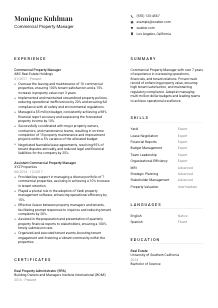
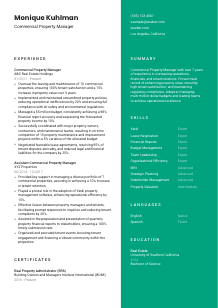
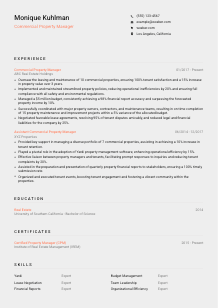
Handling prime properties, but your CV doesn't seem to make rent? Check out this Commercial Property Manager CV example, created with Wozber free CV builder. It shows how to position your commercial real estate expertise in harmony with job specs, ensuring your career portfolio collects the highest returns!
Commercial property managers are trusted with operating income, tenant relationships, vendor performance, compliance, and the long-term value of the asset. A CV for this work needs to show that you can run a property like a business unit, not simply keep daily operations moving. Hiring teams look for evidence of leasing results, budget control, maintenance oversight, dispute handling, and the judgment to protect both tenant satisfaction and NOI.
A tailored CV changes what stands out first. When your experience uses the same language as the opening, the reviewer can quickly connect your background to lease negotiations, property operations, reporting, and software fluency instead of sorting through adjacent real estate experience. Wozber's free CV builder helps shape that into an ATS-compliant CV with the right terminology and structure, so your application reads clearly as commercial property management experience from the first scan.
Commercial property management is a client-facing, operations-heavy role, so the top of your CV should immediately present you as reachable, local when required, and clearly aligned with the position. Keep this section clean and practical. Every line should help a hiring manager place you in the role without distractions.
Use your full name in a slightly larger font than the rest of the header so it anchors the page immediately. This section does not need design flourishes. In property management, a polished, businesslike presentation lands better than anything decorative.
Place "Commercial Property Manager" under your name if that reflects the role you are pursuing. This helps frame your background before the reader reaches your work history and keeps your CV aligned with the title used in the job posting.
Include one phone number and one professional email address you check regularly. If you add a website or LinkedIn profile, make sure it supports your candidacy with relevant property, portfolio, or professional information rather than generic social content.
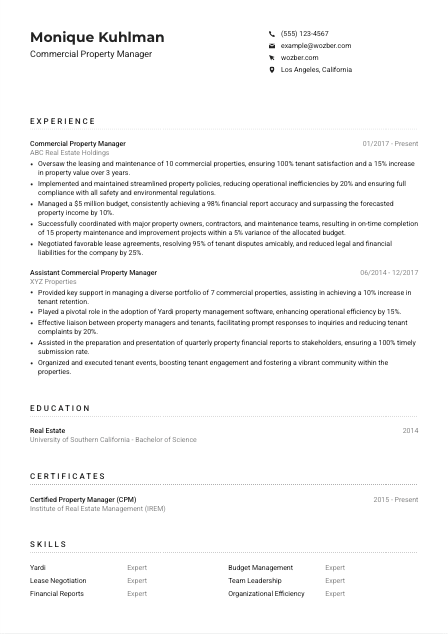
Some openings require local presence because the work involves site visits, contractor coordination, tenant meetings, and market familiarity. Here, listing "Los Angeles, California" directly answers a stated requirement and removes guesswork about availability.
A useful profile might reinforce your real estate background, certifications, or portfolio scope. If it is incomplete or inconsistent with your CV, leave it off. For this profession, accuracy across contact details, title, and credentials matters more than having every possible link.
Treat the header as a quick confirmation that you are a credible, accessible commercial property management candidate. If this section is clear, local when needed, and professionally aligned, the reader can move straight to your portfolio, financial, and tenant-facing experience.




This is the section that carries the most weight for a commercial property manager. Employers want to see the scale of properties you managed, the business results you delivered, and how you handled the mix of leasing, maintenance, reporting, compliance, and tenant relations that defines the job.
Read the responsibilities line by line and map your experience to them. For a commercial property manager, that usually means leasing oversight, vendor and maintenance coordination, budget ownership, financial reporting, policy implementation, compliance, and dispute resolution. If your bullets already cover these areas, move the strongest ones higher so the match is obvious.
Use reverse chronological order and give each role enough context to show complexity. Include employer name, title, and dates, then make your bullets do the real work by showing portfolio size, budget scope, property type, or team coordination responsibilities. A line such as managing 10 commercial properties or supporting a portfolio of 7 properties tells the reader far more than a generic duty list.
Commercial property management is measured through occupancy, tenant satisfaction, property condition, compliance, income performance, and project execution. Write bullets that show what changed because of your work. The sample CV does this well with outcomes like reducing operational inefficiencies by 20% and increasing property value by 15% over 3 years.
Use numbers where they reflect how the job is actually evaluated. Strong examples include budget size, forecast accuracy, revenue growth, lease renewal rates, tenant retention, project counts, cost variance, response times, or liability reduction. Metrics such as managing a $5 million budget, beating forecasted income by 10%, or completing projects within a 5% budget variance immediately make your experience more credible.
Prioritise achievements that show you can protect asset value and run day-to-day operations effectively. Tenant events or general administrative support can be worth keeping if they improved retention or engagement, but your strongest space should go to lease negotiations, financial control, vendor management, maintenance delivery, and compliance performance.
The best experience sections make it easy to picture you handling a commercial portfolio. If your bullets show asset oversight, financial discipline, tenant management, and measurable results, you are giving hiring teams the information they need most.
Education usually plays a supporting role once you have several years of experience, but it still matters in commercial property management because the work combines finance, operations, contracts, and real estate knowledge. Present your degree clearly and keep the emphasis on the field most relevant to the role.
If you hold a bachelor's degree in Real Estate, Business, Finance, or a related field, state it plainly. When the posting names a degree preference, matching that language helps the reviewer connect your academic background to the operational and financial demands of managing commercial properties.
List degree, field of study, school, and graduation year in a clean order. There is no need to overbuild this section. For experienced candidates, clarity is enough, especially when the degree supports your credibility in budgeting, valuation, leasing, or asset operations.
A degree such as a Bachelor of Science in Real Estate speaks directly to this profession and is worth presenting clearly. In the example CV, that field choice reinforces the candidate's fit without needing extra explanation.
Most commercial property managers with 5+ years of experience do not need course lists. Include relevant coursework only if it strengthens a less direct degree or helps junior candidates show knowledge in real estate finance, property law, facilities operations, or investment analysis.
Honors, leadership roles, or projects can be useful if they connect to real estate, finance, negotiations, or business operations. If you are already established in the field, keep these brief so the CV stays focused on recent property management performance.
Your education section should confirm that you have the academic foundation for commercial real estate operations without taking attention away from your portfolio results. Keep it relevant, concise, and aligned with the opening.
In commercial property management, certifications can quickly elevate how your background is read. They show formal training in property operations, asset performance, building administration, and industry standards, which is especially useful when an employer lists them as preferred qualifications.
If you hold a CPM or RPA, place it prominently because those designations are directly relevant to commercial property management and were specifically preferred in this opening. When a posting calls out a credential by name, make it easy to find.
Put property management and real estate credentials ahead of broader business or software certificates. The reader should see immediately that your development tracks with leasing, operations, compliance, and building administration rather than unrelated coursework.
Add the year earned or indicate that the credential remains active when appropriate. This shows the certification is current and gives context for your professional development. The example CV handles this neatly by showing ongoing status for both CPM and RPA.
Commercial properties operate under changing market conditions, safety standards, and tenant expectations. Continuing education in areas such as environmental compliance, budgeting, lease administration, or facilities oversight can strengthen your profile even when the certification is not mandatory.
Relevant certifications help validate your technical grounding in commercial property operations. When they are placed clearly and tied to the work you do, they add another layer of confidence to your application.
A commercial property manager's skills section should read like the operating toolkit behind the results in your experience section. Focus on the software, financial, leasing, compliance, and coordination skills that support day-to-day asset performance.
Start with the skills the employer explicitly requests. Here that includes property management software proficiency, communication, budgeting, financial reporting, lease negotiations, and coordination across owners, contractors, and maintenance teams. Matching that language helps both ATS screening and human review.
Give the most space to skills that directly affect occupancy, tenant experience, reporting accuracy, and property value. Yardi, MRI, lease negotiation, budget management, financial reporting, stakeholder management, and compliance-related skills belong near the top because they connect directly to the work.
Use a clean format so systems and people can scan it quickly. Grouping software, financial, operational, and interpersonal skills can help if your format allows it. An ATS-friendly CV format also reduces the chance that tools like Yardi or MRI are missed during parsing.
The right skills list tells a hiring manager how you operate before they even read your bullets in depth. Keep it grounded in commercial leasing, financial control, software fluency, vendor coordination, and tenant-facing communication.
Commercial property management depends on clear communication across tenants, owners, vendors, legal partners, and maintenance teams. Language skills matter most when they support that day-to-day coordination, especially in diverse markets and multi-stakeholder environments.
If the posting specifies clear English communication, list English first and label your proficiency accurately. This is especially important in a role that involves lease discussions, written notices, contractor coordination, and reporting to stakeholders.
Additional languages can be valuable when working with diverse tenant populations, vendors, or ownership groups. In some markets, bilingual ability can make tenant communication smoother and reduce friction during issue resolution.
Use clear levels such as Native, Fluent, Advanced, or Conversational. Avoid overstating ability. In a property management role, language proficiency can directly affect negotiations, service communication, and documentation quality.
Only keep this section if it adds something practical to your candidacy. For example, a second language may help with tenant relations, vendor coordination, or community engagement across a mixed commercial portfolio.
If you speak more than one language, present it as a support to communication and service delivery, not as a generic extra. In the example CV, fluent Spanish adds useful context because it can support tenant and vendor interactions in a large metropolitan market.
List languages when they improve your ability to communicate across the people who keep a commercial property running. Clear English is essential here, and any additional language should reinforce your effectiveness on the ground.
Your summary should give a quick, credible picture of the scale you handle and the outcomes you deliver. For commercial property management, that usually means years in the field, portfolio operations, financial control, tenant relations, compliance, and the results you have produced across those areas.
Before writing, identify the few themes that define your work best. That may be multi-site portfolio oversight, lease administration, NOI improvement, capital project coordination, tenant retention, or budget ownership. Use those themes to shape a summary that reflects your real scope rather than generic management language.
State your years of experience and make commercial property management explicit. A line such as "Commercial Property Manager with 7+ years of experience overseeing operations, financials, and tenant relations" gives immediate context and matches the kind of background this opening requests.
Choose achievements that connect to asset performance and day-to-day management. Increased property value, high tenant satisfaction, strong budget control, compliance delivery, or successful lease negotiations all work well. The sample summary is effective because it ties experience to property value, tenant satisfaction, regulatory compliance, and multi-million-dollar budgets.
Aim for a short paragraph that can be read in seconds. Avoid broad claims that are not backed up elsewhere in the CV. A concise summary with the right terms can also strengthen ATS optimisation by reinforcing your core role, software exposure, and commercial management focus.
A well-written summary tells the reader, early and clearly, that you understand commercial property operations and have already delivered results in that environment. It should prepare them to see the same story supported throughout the rest of the CV.
A commercial property manager CV works when it makes the business side of the role easy to see: portfolio oversight, leasing results, financial control, compliance, vendor coordination, and tenant outcomes. Every section should support that picture, from your title and location through your software skills, certifications, and measurable experience.
Use Wozber to turn that experience into a polished, ATS-friendly CV template with language aligned to the job description, then check it with an ATS CV scanner so the right tools, responsibilities, and results are visible section by section. The finished CV should make one thing clear fast: you know how to protect asset value and run commercial properties effectively.




