



Use Wozber and land your dream job
Create CV
No registration required
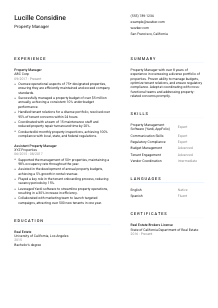
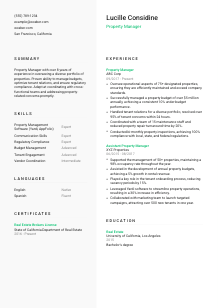
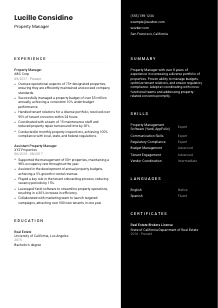
Overseeing properties, but feel your CV is in need of maintenance? Check out this Property Manager CV example, created with Wozber free CV builder. Learn how to align your real estate skills with job expectations, setting your career prospects as high as a luxury penthouse!
Property managers are trusted with assets, budgets, tenant relationships, vendor coordination, and compliance at the same time. A CV for this field needs to show that you can keep operations running across occupied properties, handle issues before they escalate, and make sound decisions that protect both resident experience and property performance.
When the CV is tailored well, hiring teams can quickly see your operating scope, software familiarity, financial responsibility, and lease or compliance experience instead of sorting through generic management claims. Wozber's free CV builder helps you shape that experience into an ATS-friendly CV format that reflects the language of the job posting and makes your property oversight background easier to read in context.
Property management hiring starts with practical details. If a company needs someone who can work on-site, respond to tenants quickly, or already meets local licensing expectations, your header should make those basics easy to confirm without forcing anyone to hunt for them.
Use your full name in a clean, prominent format so it anchors the CV immediately. Skip nicknames unless they are part of your professional identity, and keep the presentation polished enough for a client-facing role where professionalism matters.
Place "Property Manager" below your name if that is the role you are pursuing. This helps frame the rest of the CV around operations, tenant service, budgeting, inspections, and vendor oversight instead of leaving your background open to interpretation.
Make it easy to reach you for interviews, site visits, or follow-up questions about portfolio experience.
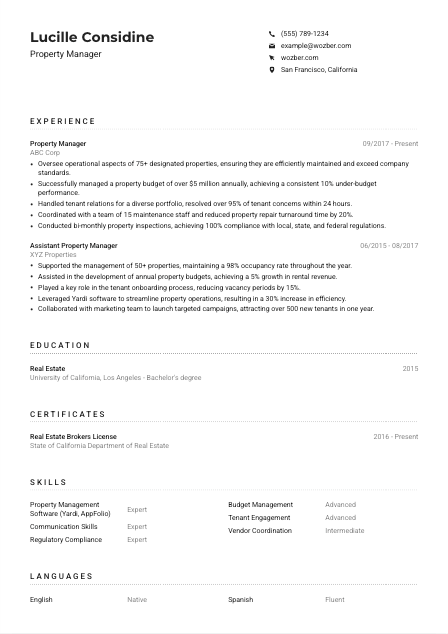
If the posting calls for local presence or relocation, list your city and state clearly. In the example, "San Francisco, California" directly supports a stated location requirement, but that kind of geographic detail matters only when the employer has made it relevant.
Include LinkedIn or a professional website only if it reinforces your CV with relevant experience, licenses, portfolio scale, or recommendations. Make sure the information matches your CV, especially titles, dates, and current location.
Your header should answer the practical questions first: who you are, what role you do, how to contact you, and whether you meet any location-based requirement. In property management, that kind of clarity supports a faster hiring decision.




This is the section where a property manager CV either becomes credible or stays vague. Hiring teams look for evidence that you have handled real buildings, real tenants, real budgets, and the day-to-day pressure of keeping properties compliant, occupied, and well maintained.
Read the posting closely and mark the responsibilities that define the workload. For a property manager, that usually means budget ownership, tenant relations, inspections, lease enforcement, maintenance coordination, vendor management, occupancy, and regulatory compliance. Those points should shape which achievements you highlight first.
Start with your most recent position and include title, company, and dates. If you have progressed from assistant property manager to property manager, that progression already tells a useful story about growing responsibility for portfolio size, financial reporting, or staff coordination.
Replace generic management statements with bullets tied to property outcomes. Good bullets show the scale of the portfolio, the kind of tenant issues you handled, the budgets you managed, and how you worked with maintenance teams or outside vendors. The example does this well by pairing operational oversight with tenant resolution speed, repair turnaround time, and inspection compliance.
Metrics make property work easier to understand. Include figures such as number of units or properties, annual budget size, occupancy rate, rent growth, response time, compliance results, vendor savings, or maintenance turnaround improvements. "Managed a $5 million annual budget" or "maintained 98% occupancy" says far more than "responsible for finances."
Prioritise experience that maps to the target opening. If a job emphasizes financial reporting, inspections, and tenant service, give those results more space than unrelated administrative tasks. The goal is to show that your background already covers the operational mix the employer needs.
Your experience section should make the scope of your property work obvious. When portfolio size, budget responsibility, tenant outcomes, and compliance results are clear, your candidacy reads like someone who can step into active operations without a long ramp-up.
Education matters most when it confirms the foundation behind your property management work. Degrees in real estate, business, or related fields can strengthen your profile, especially when a posting explicitly asks for them.
If the employer asks for a bachelor's degree in Business Management, Real Estate, or a related field, make sure that qualification is easy to find. In the example, a bachelor's degree in Real Estate aligns directly with the posting and supports the candidate's industry focus.
List degree, field of study, school, and graduation year in a consistent structure. That gives hiring teams a quick read and helps ATS parsing keep your academic information accurate.
When your degree is directly tied to the role, you do not need to over-explain it. A Real Estate or Business background already points to knowledge of property operations, finance, contracts, and market fundamentals that support day-to-day management decisions.
Early-career candidates can include relevant coursework in areas like real estate finance, property law, facilities management, accounting, or lease administration. If you already have several years of property management results, detailed coursework usually matters less than portfolio performance.
Honors, student leadership, or projects are worth adding only if they connect to real estate, operations, finance, or client service. Keep this section concise once your work history carries the stronger proof.
Use education to confirm you meet the stated requirement and to reinforce the business or real estate foundation behind your experience. It should support your CV, not compete with your operating record.
In property management, credentials can carry real weight because they often connect to legal authority, regulatory knowledge, or market-specific eligibility. Present them clearly so hiring teams can tell whether you meet a required or preferred standard.
If a role mentions a Real Estate Brokers or Salesperson License, place that credential high in the section. In the example, the California Real Estate Brokers License is especially relevant because it aligns with the state's regulatory environment and the employer's stated preference.
Prioritise credentials tied to leasing, compliance, fair housing, budgeting, facilities, or residential and commercial property operations. Do not list every course you have taken. Focus on qualifications that help explain why you can manage properties responsibly and within regulations.
For active licenses or certifications with renewal cycles, include issue date, renewal period, or current validity if relevant. That helps employers understand whether the credential is current and usable right away.
Property regulations, software, reporting practices, and tenant expectations change over time. If you have current training in areas such as fair housing, risk management, or property systems, include it when it strengthens your operational profile.
This section should quickly answer whether you hold the licenses or certifications that matter for the role. For property management, that can directly affect legal eligibility, local market readiness, and employer confidence.
A property manager's skills section should reflect the job as it is actually performed. That means operational software, financial control, tenant communication, vendor coordination, compliance awareness, and the judgment to keep buildings running smoothly.
Review the job description for named systems, workflows, and soft skills. Here, property management software such as Yardi or AppFolio, communication, and compliance stand out immediately. Those are better anchors than broad terms like "leadership" on their own.
List the tools and capabilities you have actually used in day-to-day operations. If you mention Yardi, budgeting, tenant engagement, lease enforcement, inspections, or vendor coordination, your work history should show where and how you applied them. The example CV supports its software claim by tying Yardi use to a 30% efficiency improvement.
Put the most job-relevant skills first and avoid padding the section with generic strengths. A focused list such as property management software, budget management, regulatory compliance, tenant relations, and vendor coordination gives a hiring manager a much clearer read on your operational fit.
Every skill in this section should connect to how you manage properties, serve tenants, control costs, or maintain compliance. If a skill would not matter in a property walkthrough, budget review, or tenant issue escalation, it probably does not belong near the top.
Language ability can matter in property management because the job involves constant interaction with tenants, vendors, owners, maintenance teams, and local contacts. Include languages when they affect communication quality or help you serve a broader resident base.
If a posting specifies English proficiency, list English at the top with an accurate level. That quickly confirms you can handle lease conversations, tenant notices, vendor calls, and written reporting in the language the role requires.
Additional languages can be useful in multifamily, mixed-use, or community-facing environments where tenant communication matters. In some markets, bilingual ability can improve service, reduce misunderstandings, and help during move-ins, renewals, or conflict resolution.
Terms such as "Native," "Fluent," "Professional," or "Conversational" are easy to understand and more useful than vague descriptions. Keep them honest and consistent.
Extra languages are especially relevant when the resident population is diverse or when the role includes frequent in-person communication. They are not mandatory for every property manager opening, but they can strengthen your profile when they match the operating environment.
Only list a language if you can use it confidently in a professional setting. Property managers often deal with complaints, lease terms, service requests, and compliance notices, so accuracy matters.
Language skills are most valuable when they improve tenant communication and day-to-day coordination. Present them as a working capability, not as filler.
The summary should quickly tell the reader what kind of property manager you are. Focus on years of experience, portfolio scope, core strengths, and the parts of the job you handle well, such as budgeting, tenant relations, compliance, inspections, or software-driven operations.
Before writing, identify the main hiring priorities in the posting. For property management, that often includes budget oversight, tenant service, maintenance coordination, inspections, reporting, and software fluency. Those themes should shape your first few lines.
Start with your title, years of experience, and the type of property work you do. For example, the sample CV opens with more than 8 years in property management and then moves directly into operational strengths, which gives immediate context.
Mention two or three relevant capabilities and, where possible, hint at results. Strong examples include managing diverse portfolios, controlling budgets, improving tenant response, maintaining occupancy, or keeping properties compliant with local and federal requirements.
Aim for 3 to 5 lines with concrete language. Avoid generic claims about being driven or results-oriented unless you tie them to actual property work, such as resolving tenant issues promptly or overseeing multi-site operations efficiently.
By the time someone finishes your summary, they should understand your level, your operating scope, and the parts of property management you handle best. That short section should set up the rest of the CV as a credible record of property performance.
A strong Property Manager CV makes the operational story easy to follow: what you managed, how large the portfolio was, which systems you used, how you handled tenants and vendors, and what results you delivered on budgets, occupancy, repairs, or compliance.
Use Wozber's free CV builder to organise those details into an ATS-compliant CV, refine role-specific wording with AI support, and strengthen ATS optimisation before you apply. The finished CV should make one thing clear right away: you can be trusted to run properties well.




