




Use Wozber and land your dream job
Create CV
No registration required
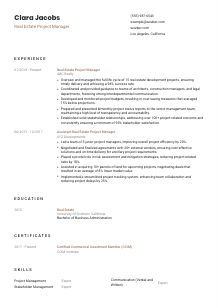
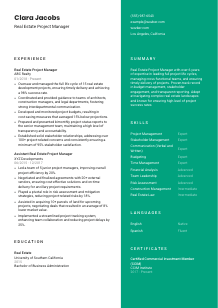
Overseeing ambitious projects, but your CV feels under construction? Explore this Real Estate Project Manager CV example, created with Wozber free CV builder. It shows how to map out your managerial skills and site savvy to match the job specifications, paving the way for a career skyline that's always on the rise!

Real estate project management sits at the point where pro formas, construction schedules, consultant coordination, and stakeholder pressure all meet. Hiring teams want a CV that makes that operating range easy to see. It should show that you can move a development from early planning through closeout while keeping budgets, timelines, and cross-functional decisions under control.
A tailored CV changes how quickly that range comes through, especially when an ATS is screening for terms tied to development lifecycle management, budgeting, reporting, and team coordination. Wozber's free CV builder helps you shape an ATS-compliant CV around the language of the role, so senior reviewers can immediately see whether your background supports real estate delivery, financial discipline, and dependable communication.
This section is brief, but it still carries useful information in real estate hiring. It should present you as easy to reach, professionally established, and, when relevant, already based where the project portfolio or office footprint requires local availability.
Use your full name in the largest text on the page, then place your target title directly underneath. For this role, "Real Estate Project Manager" works well because it aligns with the posting and immediately places you in the right part of the candidate pool.
Add a phone number and a professional email address that you actively monitor. Real estate hiring often moves through multiple interview stages with asset managers, development leaders, and operations stakeholders, so missed calls and outdated contact details create avoidable friction.
If the job requires local presence, include your city and state. In the example, listing "Los Angeles, California" directly answers a stated requirement. That is especially useful in real estate roles where site access, municipal coordination, and in-person stakeholder meetings can matter.
A LinkedIn profile or personal website can add context if it is current and consistent with your CV. For a real estate project manager, that might reinforce your development background, portfolio exposure, certifications, or progression from assistant PM to full project leadership.
Skip extra personal details that do not affect hiring decisions. This area should do one job well: give the employer accurate contact information and, where the posting calls for it, confirm basics such as title alignment and location without distracting from your project record.
Your header should make you look straightforward to contact and appropriately positioned for the work. If the posting includes a location requirement or local market expectation, answer it here and move the reader quickly to your development experience.




For a real estate project manager, the experience section carries most of the hiring weight. This is where you show project scope, development lifecycle ownership, budget control, consultant coordination, reporting habits, and the business results of your decisions.
Start by identifying the work patterns behind the job description, not just the nouns. Here, the role centers on full lifecycle project oversight, cross-functional coordination, budget management, senior reporting, and stakeholder communication. Those themes should shape which bullets you keep and how you phrase them.
List positions in reverse chronological order and make the progression clear. If you advanced from an assistant project management role into full project ownership, show that growth. The example does this well by moving from Assistant Real Estate Project Manager into a lead title with broader delivery and reporting responsibility.
Each bullet should show what you managed, who you coordinated with, and what changed because of your work. In this field, that often means entitlement or development coordination, consultant alignment, vendor negotiations, schedule control, budget tracking, risk mitigation, or stakeholder issue resolution. A bullet such as reducing costs by 15% or improving project efficiency by 20% works because it ties management activity to a clear business result.
Use numbers that reflect delivery performance. Project count, budget variance, cost savings, on-time completion rate, delay reduction, risk reduction, stakeholder satisfaction, parcel acquisitions, or reporting cadence all add credibility. The sample's "15 projects," "98% success rate," and "bimonthly project status reports" give hiring managers a sharper sense of scale and operating discipline than generic claims ever could.
Keep bullets that strengthen your case for managing real estate projects from concept to completion. General administrative work, unrelated industries, or broad management claims without project context should move down or out. What matters most is whether the section shows that you can coordinate architects, construction teams, legal partners, vendors, and leadership while protecting budget and timeline.
By the end of this section, a reviewer should understand the scale of projects you have handled, the teams you have led through delivery, and the financial and operational results you produced. That is the clearest path to showing you can step into a live development pipeline and run it well.
Education matters here because it anchors your technical and commercial understanding of the field. Degrees in real estate, business, construction-related disciplines, or adjacent programs help frame your grasp of development economics, contracts, market context, and project execution.
If the posting calls for a bachelor's degree in Real Estate, Business, or a related field, make that match obvious. In the example, a Bachelor of Business Administration in Real Estate checks the box cleanly and should be written exactly enough for both ATS parsing and quick human review.
List your degree, field of study, school, and graduation year or date. Keep it simple. Education sections in project management CVs are usually scanned quickly, so clarity matters more than design flair.
If your degree title is broad, use the field or concentration to connect it to the role. A business degree with a real estate focus, for example, tells a stronger story than a generic degree listing with no context. That helps position your academic background closer to development, finance, and project oversight work.
Early-career candidates can benefit from listing coursework in real estate finance, urban development, construction management, contract law, or project controls. If you already have substantial experience, coursework becomes optional unless it fills a specific gap the employer is likely to notice.
If you have completed relevant learning outside your degree, such as project management training, construction administration coursework, or classes in zoning, entitlement, or real estate analysis, include it when it adds practical value. It shows continued development in areas that directly affect project delivery.
This section should confirm that your academic background supports the commercial and operational side of real estate projects. Keep it concise, accurate, and clearly connected to the kind of development work the employer needs covered.
Certifications can strengthen a real estate project manager CV when they reflect market knowledge, investment fluency, project discipline, or continued industry involvement. They are especially useful when a posting names a preferred credential or when your experience spans complex commercial work.
When a certification appears in the job description, move it to the top of this section. Here, the CCIM designation is preferred, so listing it prominently is the right move. That tells the employer you meet a stated preference tied to commercial real estate knowledge and credibility.
Choose certifications that support your ability to manage developments, budgets, negotiations, or real estate transactions. A short list of highly relevant credentials carries more weight than a crowded section full of unrelated certificates.
Dates help show whether a certification is active, recent, or part of your ongoing professional involvement. In the sample, "2017 - Present" works because it signals continuing status rather than a one-time training event from years ago.
Real estate regulations, financing conditions, and delivery models change over time. Updated certifications or active designations show that you stay connected to the commercial side of the industry, not just the administrative mechanics of project tracking.
This section should reinforce the parts of your background that are harder to show through job titles alone. A relevant credential like CCIM can sharpen your positioning for commercial or development-focused roles and add weight to your project leadership experience.
The skills section should echo how the job is actually done. For real estate project management, that means balancing project controls, financial oversight, stakeholder communication, and coordination across design, construction, legal, and vendor teams.
Pull both explicit and implied skills from the job description. Here, that includes project management tools, budgeting, written and verbal communication, stakeholder management, and cross-functional coordination. Your skills list should mirror that operating mix rather than read like a generic management profile.
Lead with the capabilities that drive delivery: project management, budgeting, stakeholder management, reporting, team leadership, risk assessment, financial analysis, and construction coordination. The example skill set works because it combines management strengths with real estate-specific support skills such as construction management and real estate law.
Do not bury the important skills under dozens of weak additions. A tighter list is easier for both ATS matching and hiring review, especially when every item maps to work you can defend in your experience section. If you use proficiency labels, make sure they are believable and consistent with your accomplishments.
Your skills should confirm that you can run the commercial, operational, and communication sides of a real estate project at the same time. When aligned with the posting and backed by quantified experience, this section helps your CV read as immediately usable for the role.
Real estate project work depends on clear communication across meetings, reports, negotiations, and issue resolution. Language skills matter most when they affect day-to-day coordination with clients, community stakeholders, contractors, or internal leadership.
If the posting specifies language ability, list it clearly. In this case, fluent English is a stated requirement, so your CV should show that without ambiguity. Use a straightforward proficiency label such as "Native" or "Fluent."
Extra languages can be valuable when a portfolio involves multilingual vendors, tenants, investors, or community stakeholders. Spanish, for example, may be useful in many real estate markets, but include it because it reflects your real communication ability, not as filler.
Choose labels that match how you actually work in meetings, emails, presentations, and negotiations. If you can handle business discussions and stakeholder conversations, "Fluent" fits. If your ability is more limited, use a lower level rather than overstating it.
Some real estate roles are heavily local, while others involve broader investor, tenant, or consultant networks. Language capability becomes more valuable when it improves coordination, reduces misunderstandings, or strengthens community-facing communication.
For this profession, language skills are useful when they help move projects forward. They can support smoother stakeholder meetings, clearer issue resolution, and better relationship management across diverse groups involved in development work.
List languages in a way that supports the communication demands of the role. At minimum, confirm required English fluency clearly. Any additional language should strengthen your picture as someone who can manage complex stakeholder interactions with confidence.
Your summary should quickly explain the kind of real estate project manager you are. Focus on scope, years of experience, development lifecycle ownership, and the business outcomes you are known for delivering, then match that profile to the priorities in the target posting.
Review the posting and identify the few themes that belong in your opening lines. For this one, those are lifecycle management, budget control, cross-functional leadership, reporting to senior management, and stakeholder communication. Those should shape the summary more than broad traits like "hardworking" or "results-driven."
Start with a direct statement of who you are professionally. The sample's "Real Estate Project Manager with over 6 years of expertise" works because it immediately establishes role alignment and clears the experience threshold in the posting, which asks for at least 5 years.
Choose the strengths that matter most for the specific job. Phrases such as "leading full project life cycles," "managing cross-functional teams," and "budget management" are effective because they correspond to actual responsibilities in the role rather than vague personal qualities.
Close the summary with one concise point about your track record. That could be consistent on-time delivery, strong stakeholder satisfaction, cost control, or transparent reporting to leadership. Keep it tight. In three to four lines, the reader should understand your lane in real estate project delivery and why your background matches the opening.
A hiring manager should be able to read your summary and immediately place you within the real estate development process. When Wozber's AI CV builder helps align that language with the posting and ATS optimisation needs, your opening section does a better job of showing project ownership, financial control, and stakeholder leadership from the first glance.
Your CV should now present a clear picture of how you manage real estate developments, coordinate cross-functional teams, control budgets, and report progress to leadership. That is the combination employers are trying to confirm when they hire for this kind of project role.
Use Wozber to tighten wording, align your content with the job description, and structure everything in an ATS-friendly CV format that keeps your project experience easy to read. The finished document should make one thing obvious: you know how to move a real estate project from concept to completion with control and accountability.




