



Use Wozber and land your dream job
Create CV
No registration required
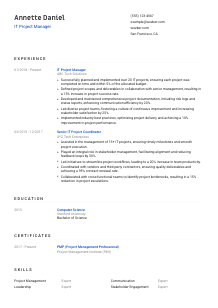
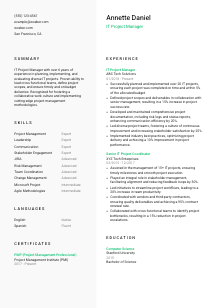
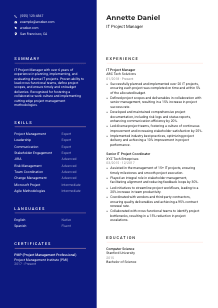
Steering tech projects, but your CV feels like a software bug? Check out this IT Project Manager CV example, created with Wozber free CV builder. Learn how to showcase your project management prowess in line with IT expectations, programming your career for success!
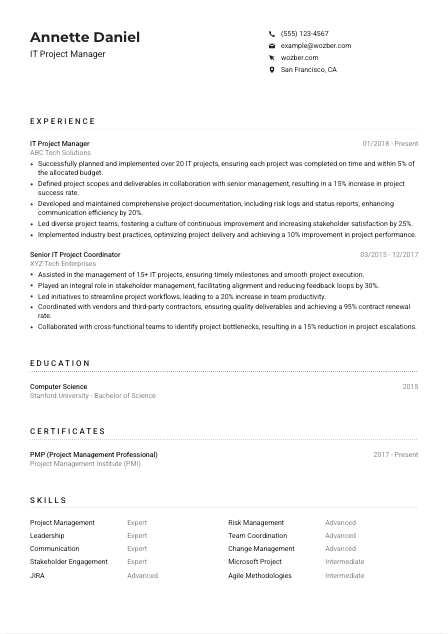
IT Project Managers are hired to bring order to moving parts that can easily drift off course. A CV for this role needs to make delivery discipline visible fast: how you defined scope, kept timelines realistic, managed risk, coordinated technical teams, and kept projects on track when priorities changed.
When those details are tailored to the job description, the CV reads less like a general operations profile and more like a project leader who can run IT delivery in the employer's environment. Wozber's free CV builder helps you align project language, tools, and outcomes in an ATS-friendly CV format so hiring teams can quickly see whether your background matches the kind of planning, reporting, and team leadership the role requires.
This section is brief, but it still shapes how smoothly your application moves forward. For IT Project Manager roles, the basics should confirm professionalism and remove easy objections before a reviewer even reaches your project history.
Use your full name exactly as you present it on LinkedIn, certifications, and other professional records. Keep it easy to scan at the top of the page so the document feels consistent and credible from the first line.
Place "IT Project Manager" directly under your name when that is the role you are pursuing. This helps position your experience correctly, especially if your recent title was something adjacent such as Senior IT Project Coordinator, Technical Program Coordinator, or Delivery Lead.
Include a current phone number and a professional email address. Check them carefully. For a role built around stakeholder communication, a sloppy email handle or incorrect phone number creates the wrong impression before anyone reads about your delivery record.
If the employer requires local presence, state your city and state clearly. Here, listing San Francisco, CA directly supports the posted requirement and avoids questions about relocation or availability.
A LinkedIn profile or personal website can strengthen this section if it supports your CV with consistent titles, project scope, certifications, or recommendations. Keep it updated so it reinforces your experience with delivery leadership, stakeholder communication, and project tools rather than introducing mismatched information.
Your personal details should confirm that you are reachable, professionally presented, and logistically aligned with the role. For an IT Project Manager, that clean start matters more than flashy formatting.




This is the section hiring teams read most closely for IT Project Manager roles. They want to see how you handled scope, budget, reporting, cross-functional coordination, and project outcomes, not just that you were present on a project team.
Pull out the core work the employer cares about and mirror it in your bullets where it reflects your real experience. In this case, that includes planning and implementing IT projects, defining scope and deliverables, maintaining documentation, leading teams, and improving project delivery practices.
List positions in reverse chronological order and make the path to project ownership easy to follow. If you moved from coordination into full project management, show that growth clearly. The example CV does this well by moving from Senior IT Project Coordinator into IT Project Manager, which makes the step up in responsibility obvious.
Each bullet should combine what you managed with how you managed it and what changed as a result. Strong IT Project Manager bullets often mention scope definition, risk logs, stakeholder reporting, sprint or milestone control, vendor coordination, governance, or process improvement. Instead of saying you "oversaw projects," show the mechanism and result, such as improving project success rate, reducing escalations, or raising stakeholder satisfaction.
Use metrics that belong to project work: number of projects delivered, budget variance, schedule adherence, reduction in escalations, productivity gains, reporting improvements, or stakeholder satisfaction scores. The sample bullets work because they stay close to common project measures, such as delivering 20+ IT projects within 5% of budget and improving communication efficiency by 20%.
Keep the section centered on delivery, coordination, and execution. Older bullets that focus on unrelated technical tasks, general administration, or broad team support can dilute your message unless they directly explain how you developed into a stronger project manager. Every line should help a reviewer picture you running timelines, communication, and execution in a live IT environment.
By the end of this section, your CV should make one thing clear: you do not just participate in IT projects, you move them forward with structure, communication, and measurable control.
Education is usually a screening checkpoint for IT Project Manager roles rather than the main selling point. Still, it matters because many postings ask for a technical or related degree, especially when the projects involve software delivery, infrastructure, or enterprise systems.
If the posting asks for a bachelor's degree in Computer Science, Information Technology, or a related field, make sure that information is easy to find. In the example, "Bachelor of Science in Computer Science" directly answers that requirement without extra explanation.
List the degree, field of study, school, and graduation year. Keep it scannable. Hiring teams reviewing many project management CVs do not need a long academic narrative here.
A degree tied to computer science, information systems, or IT supports your credibility when you are leading technical teams and discussing project constraints with engineers, analysts, or infrastructure staff. If your degree is in a related field, name it clearly rather than assuming the connection will be obvious.
Add coursework, capstones, or academic distinctions only if they strengthen your candidacy, especially early in your career or if you are moving into IT project management from another track. For experienced candidates, certifications and project outcomes usually carry more weight than course lists.
If you already have several years of project delivery experience, avoid overloading this section with honors or extracurricular detail. The space is better used for project results, tools, governance practices, or certifications that speak more directly to how you manage IT work today.
This section should quickly satisfy the academic requirement and reinforce that you have the technical foundation to manage IT delivery conversations with confidence.
Certifications matter most when they support how employers structure project work and assess leadership maturity. For IT Project Managers, the right credential can reinforce your command of planning standards, stakeholder communication, and disciplined execution.
If a role mentions PMP, Scrum, PRINCE2, or another framework-based credential, give those certifications priority. Here, PMP is listed as a plus, so including it near the top strengthens alignment immediately.
Only include certifications that support project delivery, governance, technology context, or related methodologies. A short list of directly relevant credentials says more than a long list of loosely connected courses.
Add issuance or renewal dates when the certification is active or time-sensitive. That matters for credentials such as PMP because it shows you have maintained the designation rather than listing something outdated.
Project management practices change with tools, delivery models, and reporting expectations. Keeping this section current helps show that you stay engaged with the field, whether through PMP renewal, Agile coursework, risk management training, or governance-focused learning.
A focused certification section tells employers that your project management approach is grounded in recognized standards, not just informal experience.
The skills section should read like the toolset and operating strengths behind your project results. For IT Project Manager roles, that means balancing execution skills, stakeholder leadership, and the systems or methods used to run delivery work.
Read the job description for explicit tools and the underlying capabilities behind them. In this example, JIRA and Microsoft Project are named directly, while leadership, communication, and interpersonal skills point to broader project coordination responsibilities.
Every skill here should be backed up by your experience, summary, or certifications. If you claim risk management, stakeholder engagement, Agile methodologies, or change management, your bullets should show where you used those skills in actual project work.
Place the most role-relevant skills first. For IT Project Manager positions, that usually means project management, stakeholder communication, team leadership, scheduling, risk management, delivery methodologies, and named platforms such as JIRA or Microsoft Project before broader soft skills. The sample CV handles this well by leading with core management and coordination strengths, then supporting them with tools and methods.
Your skills section should quickly show that you can run the process side of IT delivery and speak the language of the teams, tools, and reporting structures around it.
Language skills are not the headline feature of most IT Project Manager CVs, but they can matter when a posting names a required working language or the role involves cross-functional and cross-regional coordination.
When a job description states that English proficiency is a condition of employment, list English clearly and use an honest proficiency level. That removes doubt around meeting a stated requirement.
Start with the language needed for project meetings, status reporting, vendor coordination, and stakeholder communication. Additional languages can follow, especially if they support international teams, client-facing work, or multicultural collaboration.
Extra languages are useful when they help you manage offshore teams, regional vendors, or distributed stakeholders. They are less important than delivery results, but they can still strengthen the profile when communication breadth matters.
Terms such as "Native," "Fluent," "Intermediate," and "Basic" are usually enough. Keep the scale consistent so employers can quickly gauge whether you can lead meetings, write updates, or manage stakeholder discussions in that language.
For project management, language ability matters most when it helps reduce misunderstandings, improve coordination, or support smoother reporting across teams. Frame it as a practical business asset, not a filler section.
This section should confirm that you can communicate at the level the role demands and, where relevant, support collaboration across a wider set of teams or stakeholders.
The summary should establish your level, project scope, and management strengths in a few lines. For IT Project Manager roles, that means leading with delivery experience and the kind of projects, teams, or outcomes you have managed.
Before writing the summary, identify the central themes in the posting. Here, the emphasis is on planning IT projects, keeping them on time and within budget, coordinating stakeholders, maintaining documentation, and improving project practices. Your summary should reflect that operating profile, not a generic management statement.
Begin with a direct line that states your title, years of experience, and the kind of work you manage. A phrase like "IT Project Manager with 6+ years of experience delivering technology projects" gives immediate context and is stronger than a vague statement about being results-driven.
Use the next lines to name strengths that matter in IT delivery, such as cross-functional team leadership, scope definition, budget control, risk tracking, Agile delivery, or stakeholder reporting. The example summary works because it ties experience to practical outcomes like on-time, on-budget delivery and collaborative team leadership.
Aim for three to five lines. Avoid buzzwords and keep the wording close to how IT project work is actually discussed. If a hiring manager reads only your summary and your most recent role, they should already understand the scale and style of project leadership you bring.
A well-tailored summary gives hiring teams an immediate read on your delivery background, leadership style, and project management range before they move into the rest of the CV.
An effective IT Project Manager CV makes project control visible. It shows how you planned work, aligned stakeholders, managed risk, maintained documentation, and delivered outcomes against deadlines and budgets.
Use Wozber's free CV builder to tighten that alignment, improve ATS optimisation, and present your experience in an ATS-compliant CV that reflects the language of the role. When the details are tailored well, hiring teams can quickly recognize the kind of project leadership they need.




