



Use Wozber and land your dream job
Create CV
No registration required
Coordinating trials, but your CV seems experimental? Navigate this Clinical Project Manager CV example, built with the Wozber free CV builder. Learn how to effectively present your research leadership to match project-driven requisites, ensuring your career graph charts a path as successful as your trials!
Clinical project management sits at the intersection of study execution and regulatory control. Hiring teams want to see that you can move a trial from start-up through close-out without losing grip on timelines, budgets, site coordination, protocol adherence, or escalation handling. Your CV should make that operational command visible fast, especially if you have managed multiple studies, supported enrollment milestones, or coordinated clinical operations with data management and biostatistics.
The first screen often comes down to whether your CV clearly connects your background to clinical trial oversight rather than adjacent roles. Using Wozber's free CV builder helps you shape an ATS-compliant CV around the language of study management, ICH/GCP, FDA expectations, and project delivery so reviewers can quickly see where you have already handled the same kind of trial ownership.
This section does more than identify you. For a Clinical Project Manager, it should immediately show professional alignment, clean communication, and any practical requirement that affects eligibility, such as location for an on-site or relocation-based opening.
Place your full name at the top in a clean, readable format. Keep the presentation straightforward and polished. In a role that depends on precise documentation and controlled communication, a cluttered header sends the wrong message before anyone reaches your trial experience.
Add "Clinical Project Manager" beneath your name when that is the role you are pursuing. This removes ambiguity for recruiters and ATS software, especially if your previous title was a close variant such as Clinical Trial Manager or Senior Clinical Operations Lead.
Include a reliable phone number and a professional email address. Use an address based on your name whenever possible. In clinical hiring, where interview scheduling may involve multiple stakeholders across operations and HR, accurate contact information is a simple but important detail.
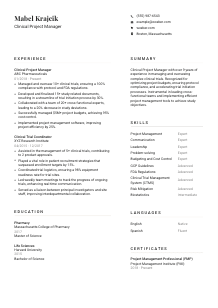
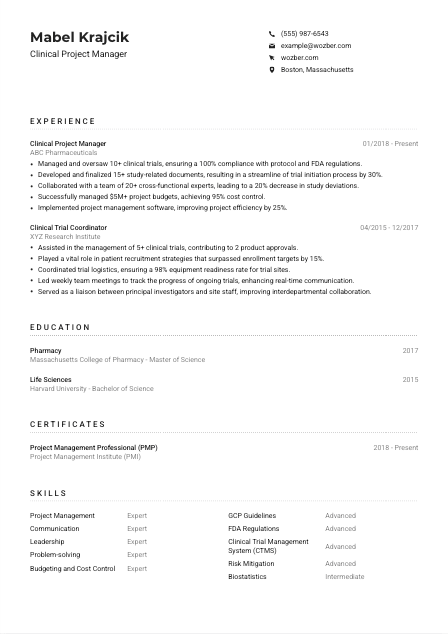
If the employer specifies a location, include your city and state or note your willingness to relocate. In the example, Boston, Massachusetts is a stated requirement, so showing Boston in the contact section removes an avoidable objection early in the review.
A LinkedIn profile can support your application if it reflects the same titles, dates, and clinical scope shown on your CV. Keep it consistent with your study management history, regulatory exposure, and leadership progression so it strengthens your credibility rather than creating questions.
When these details are handled well, the top of your CV confirms basic eligibility and professionalism without distracting from the substance of your clinical trial experience.




This is the section most likely to decide whether you move forward. For Clinical Project Manager roles, employers look for direct ownership of study delivery, compliance oversight, cross-functional coordination, budget control, and the ability to keep trials moving when issues surface.
Before rewriting your bullets, identify the work patterns the employer cares about most. Here, that includes full trial oversight, study document development, compliance with protocol and ICH/GCP, cross-functional collaboration, and management of timelines, budgets, and risk. Mirror that language where it matches your real work so your experience reads as directly relevant in both ATS and human review.
List positions in reverse chronological order with title, organisation, and dates. Make sure your most recent role carries the most detail, since hiring managers usually want to understand your current study scope, therapeutic exposure, and level of ownership before they look further back.
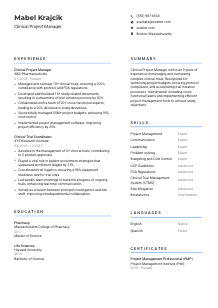
Each bullet should show what you managed and what changed because of your work. For example, the sample CV does this well with "Managed and oversaw 10+ clinical trials, ensuring 100% compliance with protocol and FDA regulations." That line works because it combines scope, regulatory accountability, and a measurable result instead of stopping at a generic duty statement.
Quantify the parts of the job that matter in this field: number of studies, budget size, enrollment gains, deviation reduction, document cycle time, site readiness, audit outcomes, or timeline improvement. A bullet about controlling a $5M+ budget at 95% cost control is stronger than saying you "managed finances" because it shows the scale at which you operated.
Trim accomplishments that do not support your candidacy for trial oversight. Prioritise bullets about protocol execution, informed consent or study document handling, vendor or site coordination, risk mitigation, compliance management, and cross-functional leadership. Even earlier roles, such as Clinical Trial Coordinator, should be framed around trial operations, enrollment support, site logistics, and communication with investigators.
Your experience section should leave no doubt that you can manage clinical studies with control over execution, compliance, and stakeholder coordination. That is the standard hiring teams are trying to confirm.
Education matters in this field because it shows the scientific foundation behind your project decisions. Most employers want to see a degree that supports work with protocols, investigational products, patient safety, and regulated study processes.
Start with the degree requirement in the posting and make sure your education section answers it clearly. For this opening, a Bachelor's degree in Life Sciences, Pharmacy, or a related field is the baseline, so that information should be easy to find without interpretation.
List degree, field of study, school, and graduation year. A clean format is especially helpful in regulated industries where reviewers expect documentation to be precise and easy to validate.
Name your degree and discipline exactly. In the example, a Bachelor of Science in Life Sciences directly matches the requirement, while a Master of Science in Pharmacy adds further relevance for organizations working with drug development, protocol interpretation, or investigator-facing study materials.
If you are early in your career, you can include coursework, research projects, or thesis work tied to clinical research, pharmacology, biostatistics, or regulatory science. For experienced Clinical Project Managers, these details are usually less important than your record of trial execution.
Honors, research involvement, or strong capstone work can help if they connect to the role and your experience is still developing. Once you have several years of clinical project management behind you, keep the section concise and let your study leadership carry more weight.
For an experienced Clinical Project Manager, education should confirm that you meet the technical foundation of the role without taking attention away from your trial management record.
Certifications are not always required for Clinical Project Manager positions, but the right ones can strengthen how your leadership and process discipline are perceived. They are most useful when they support the work you already show in trial delivery, compliance, or cross-functional execution.
Choose certifications that strengthen the profile the employer is hiring for. A PMP fits well because it supports planning, execution, stakeholder management, and risk control, all of which matter when overseeing clinical studies from start-up to close-out.
A short list of well-chosen certifications is more effective than a long list of loosely related courses. Focus on credentials tied to project management, clinical research operations, regulatory compliance, or quality systems if those areas are central to your background.
Show the year earned and, if applicable, the active date range. In regulated environments, current credentials can support the impression that you stay aligned with current practices and recognized standards.
Clinical project work changes with new systems, oversight expectations, and operational models. If you have recent certifications in project management, clinical research, risk management, or quality, include them to show that your methods are current, not frozen at an earlier stage of your career.
A well-chosen certification section adds professional depth, especially when it reinforces the planning discipline and operational control expected from someone running clinical trials.
A Clinical Project Manager skills section should read like the operating toolkit behind your study results. That means balancing regulatory knowledge, project control, and team leadership rather than listing broad strengths without clinical context.
Review the posting and note both explicit and implied skills. In this case, project management, GCP knowledge, FDA regulations, communication, leadership, problem-solving, budgeting, and project management software all belong near the top because they map directly to the job's daily demands.
Lead with capabilities tied to running studies successfully. Skills such as Clinical Trial Management, ICH/GCP, FDA Compliance, Risk Mitigation, Budget Management, Cross-Functional Leadership, and CTMS proficiency carry more value here than generic office software or broad workplace traits.
Resist the urge to turn the skills section into a full inventory. Choose the skills that support the experience you already show. In the sample CV, items like "Project Management," "GCP Guidelines," "FDA Regulations," and "Clinical Trial Management System (CTMS)" work because they reinforce the same themes already proven in the bullet points.
The best skills section confirms that you understand both the compliance side and the delivery side of clinical project management, and that your experience supports both.
Language ability matters in clinical research when you need to coordinate with sites, vendors, investigators, and internal teams clearly. On the CV, list only the languages that add real value or satisfy an explicit requirement.
If the job description names a required language, include it clearly with an honest proficiency level. Here, English is essential, so it should appear first and be marked accurately as Native or Fluent.
Ordering matters. Listing English first answers a direct screening requirement immediately and avoids making reviewers search for a basic qualification.
Additional languages are useful when they reflect your ability to work with diverse patient populations, global study teams, or international sites. They are a plus, not a substitute for the clinical management qualifications the role is built on.
Stick to standard labels such as Native, Fluent, Intermediate, or Basic. Vague wording creates uncertainty, especially in roles where precise communication can affect site coordination, training, and documentation.
Even when a position is based in one city, clinical programs often involve distributed teams and external partners. If you speak another language well enough to support collaboration, it can add useful range to your profile, as long as the level is credible.
For this role, language should support communication credibility. Lead with English, then include any additional languages that genuinely add value in a clinical setting.
The summary should quickly establish the scale of your clinical project experience and the kind of trial leadership you bring. It works best when it combines years of experience, study oversight, regulatory fluency, and one or two concrete strengths that match the opening.
Start with your years of experience and your core identity as a Clinical Project Manager or closely related leader. Since the job asks for at least 5 years, a summary that states "over 9 years of experience" immediately clears that threshold and frames you as an experienced hire.
Do not stop at general project management language. Mention clinical trials, study oversight, regulatory compliance, trial start-up, close-out, or cross-functional coordination so the reader knows your experience sits inside a regulated research environment.
Choose highlights that reflect the employer's priorities. The sample summary works because it references protocol compliance, budget optimisation, trial initiation, and team leadership, all of which connect directly to the job description.
Aim for three to five lines with no filler. A hiring manager should be able to understand your level, your clinical scope, and your strongest differentiators almost immediately. Save the full detail for your experience section, where metrics and examples can do the heavy lifting.
A sharp summary tells the reader, early and clearly, that your background includes the trial oversight, compliance discipline, and project control this role requires.
A Clinical Project Manager CV should make one thing easy to see: you can keep a study on track while protecting compliance, budget, documentation quality, and cross-functional execution. When those points are visible in your experience, skills, and summary, the application reads with much more confidence.
Use Wozber to tighten that alignment from top to bottom. Wozber's AI CV builder, ATS CV scanner, and ATS-friendly CV format help you match your language to the posting, surface missing requirements, and present your clinical project work in a structure that is easy to screen. The result should make your readiness to lead clinical trials clear from the first pass.