



Use Wozber and land your dream job
Create CV
No registration required
Strategizing campaigns, but your CV feels off-brand? Browse through this Marketing Manager CV example, created with Wozber free CV builder. Learn how to present your leadership and innovation in line with job expectations, so your career is always trending!
Marketing Manager CVs get attention when they show how strategy turned into pipeline, revenue, stronger brand performance, or more efficient campaign spend. Hiring teams want to see how you set direction, managed execution across channels, and used reporting to improve results, whether that meant lifting sales, improving conversion rates, or tightening brand consistency across campaigns and collateral.
A tailored CV changes how quickly that story comes through. When your headings, bullets, and skills reflect the language of the job description, an ATS-compliant CV is more likely to surface the right experience, and Wozber's free CV builder helps organise that language around real campaign outcomes, team leadership, and marketing analysis so your value is clear early.
This section is straightforward, but it still affects whether your CV feels aligned from the first line. For a Marketing Manager role, your header should make it easy to confirm title relevance, location, and contact details without distracting from the strategic work shown later in the document.
Use your full name in a clean, readable font and make it the most visible text in the header. Marketing is a brand-conscious field, so presentation matters here, but keep it polished rather than overly designed. The header should feel credible and easy to scan, much like a strong campaign headline.
Place "Marketing Manager" directly under your name if that is the role you are targeting. This helps recruiters and ATS systems connect your CV to the opening immediately. If your current title is different, such as Marketing Specialist, use the target title only when your experience clearly supports that level of responsibility through strategy ownership, campaign leadership, and team coordination.
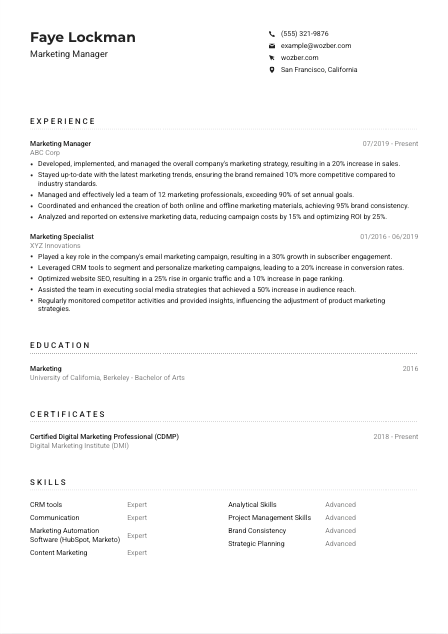
If the posting requires a specific location, include it clearly in your header. Here, San Francisco, California matters because it removes doubt about a stated requirement. For other Marketing Manager roles, only include location details that help confirm availability or market alignment.
Include LinkedIn or a personal site if it reinforces your marketing credibility. For this field, that could mean a profile with campaign achievements, portfolio samples, brand work, content strategy examples, or speaking appearances. Make sure the information matches your CV in titles, dates, and measurable outcomes.
Your header should confirm that you are reachable, relevant, and set up for the role without clutter. Save the persuasion for the sections where you prove campaign performance, leadership scope, and decision-making with data.




This is the section that carries the most weight for a Marketing Manager. Hiring teams look for ownership over strategy, channel execution, reporting, team leadership, and commercial results. Generic statements about running campaigns are less persuasive than bullets showing what changed under your direction and how you measured it.
Read the posting like a campaign brief. Mark the responsibilities and requirements that define the role's scope, such as shaping overall marketing strategy, leading a team, overseeing online and offline materials, using CRM and automation tools, and analysing data to optimise ROI. Those ideas should appear naturally in your experience section if they reflect your background.
List your most recent role first, then work backward. For each job, include title, company, and dates. This structure helps reviewers follow your progression from execution-focused marketing work into broader ownership of strategy, team management, and budget-conscious decision-making.
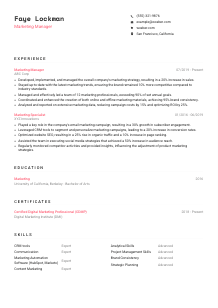
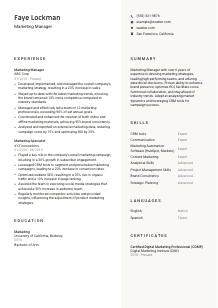
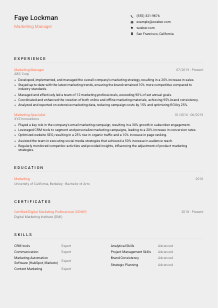
Each bullet should show a business result tied to marketing activity. Instead of saying you were responsible for strategy or campaign management, show what that work achieved. The example CV does this well by linking strategy ownership to a 20% sales increase, team leadership to exceeding 90% of annual goals, and reporting work to a 25% ROI improvement.
Numbers make your impact easier to evaluate when they reflect real marketing performance. Include metrics such as conversion lift, subscriber engagement, sales growth, organic traffic, campaign cost reduction, audience reach, lead quality, pipeline contribution, or brand consistency scores. If you managed a team, mention scope as well, such as leading 12 marketers across content, email, social, and creative production.
Prioritise experience that supports Marketing Manager responsibilities. Earlier roles still matter, especially if they show channel expertise in email, SEO, content, CRM segmentation, or campaign analysis, but your strongest bullets should point toward strategic planning, cross-functional coordination, and performance reporting. Cut details that do not support that narrative.
The best experience sections make it easy to see your operating level. By the time someone finishes this section, they should understand the scale of campaigns you managed, the teams or stakeholders you directed, and the results your marketing decisions produced.
Education is usually not the deciding factor for a Marketing Manager, but it still needs to line up cleanly with the posting. When a role asks for a bachelor's degree in Marketing, Business, or a related field, your education section should confirm that requirement quickly and without extra interpretation.
If your degree falls within the requested field, make that obvious. In this example, a Bachelor of Arts in Marketing aligns neatly with the requirement. If your degree is in a related area, keep the wording precise and let your experience do the rest of the work.
List the degree, field of study, school, and graduation year. That is usually enough for a mid-level or senior marketing role. Hiring teams should be able to confirm your academic background in seconds and move back to the experience section, where strategic and analytical strength are better demonstrated.
For marketing leadership roles, a clearly named field such as Marketing or Business reinforces your foundation in market analysis, branding, consumer behaviour, and campaign planning. If the title of your degree is less direct, the field of study becomes even more important.
Most candidates with 5+ years of experience do not need to list coursework. Include it only if it strengthens your case, such as a capstone in digital strategy, market research, brand management, or analytics that closely matches the role you are targeting. Otherwise, keep this section lean.
Honors, scholarships, or leadership roles can stay if they are notable and recent enough to support your profile. For an experienced Marketing Manager, these details are secondary, so keep them only if they add something distinctive rather than taking space from campaign and leadership achievements.
Education should answer the requirement cleanly and get out of the way. Once the degree match is clear, the rest of the CV should carry the conversation through results, tools, and leadership scope.
Certifications are not mandatory in every Marketing Manager search, but the right ones can support your credibility in digital channels, automation, analytics, or platform-specific work. They are most useful when they reinforce the kind of marketing decisions and systems the role actually involves.
Even when certifications are not listed as a requirement, they can still help if the job emphasizes digital marketing, CRM usage, marketing automation, analytics, or fast-changing channel knowledge. Use them to strengthen relevant expertise, not to fill space.
List certifications that connect to campaign execution or marketing leadership. A credential such as Certified Digital Marketing Professional supports knowledge in areas a Marketing Manager often oversees, including digital strategy, customer acquisition, and performance measurement. Platform-specific certificates in automation, analytics, SEO, or paid media can also be useful when they match your target role.
Show when you earned the certification and whether it remains active. In marketing, recency matters because tools, attribution models, privacy standards, and channel best practices change quickly. Current dates help signal that your knowledge has kept pace.
Ongoing learning matters in a field shaped by algorithm changes, shifting content formats, new automation workflows, and tighter ROI expectations. Add new certifications when they reflect real capability you can apply, especially in areas like lifecycle marketing, CRM operations, analytics, or campaign optimisation.
A certificate can strengthen your profile, especially in digital and data-heavy marketing environments. It works best when it supports the results and tool fluency already visible in your experience section.
A Marketing Manager skills section should help a reviewer confirm two things quickly: whether you can run the systems behind modern marketing, and whether you can lead work that improves business results. The most useful skill lists mix tool-based capabilities with strategic and operational strengths.
Look past generic wording and identify the capabilities the role depends on. In this description, that includes marketing automation software, CRM tools, data-driven decision-making, communication, leadership, and project management. Those are not filler keywords. They point to how campaigns are planned, launched, analysed, and improved.
Choose skills that match the target role and that you can support elsewhere on the CV. For this example, skills like CRM tools, marketing automation software, content marketing, strategic planning, analytical skills, and brand consistency align well because the experience section also shows segmentation work, strategy ownership, and ROI analysis. Add leadership and communication if your bullets show team direction, stakeholder management, or cross-functional coordination.
Put the most important skills near the top, and keep the list easy to scan. Specific tools or capability areas often carry more weight than broad labels, so "Marketing Automation Software (HubSpot, Marketo)" says more than "Marketing tools." Balance platform knowledge with role-level strengths such as campaign analytics, budget optimisation, team leadership, and project management.
Your skills section should read like the operating toolkit of a Marketing Manager, not a collection of buzzwords. If the role emphasizes automation, CRM, analytics, and leadership, your list should confirm all four clearly and credibly.
Language skills matter most when they affect communication with teams, customers, markets, or leadership. For a Marketing Manager, English proficiency is often essential because strategy documents, briefs, reporting, presentations, and brand messaging all depend on precise written and spoken communication.
If the posting explicitly requires English, list it clearly and state your level honestly. In this case, "Native" or "Fluent" helps confirm that you can handle campaign copy review, stakeholder presentations, reporting, and day-to-day communication without hesitation.
When additional languages matter for audience reach, regional campaigns, or market research, include them in order of relevance. A second language can be especially useful in roles tied to multicultural markets, international coordination, or customer segmentation across regions.
Additional languages are a practical asset when they expand your ability to understand audiences, localize messaging, or collaborate with broader teams. For example, Spanish on a Marketing Manager CV may strengthen your profile in markets where multilingual communication supports campaign performance or stakeholder engagement.
Stick to terms such as Native, Fluent, Intermediate, or Basic. Avoid vague phrasing. Clear proficiency levels help employers judge whether you can write content, present insights, conduct calls, or simply support collaboration in another language.
If you speak more than one language, think about where that capability intersects with your work. It may support content review, audience research, regional campaign planning, partnership outreach, or brand messaging across markets. That practical context is what makes language skills more than a side note.
For marketing roles, language skills matter when they improve communication or market reach. Present them clearly, and let the reader see how they support campaign execution, audience understanding, or broader team collaboration.
Your summary should establish your level quickly: how long you have worked in marketing, what kind of scope you manage, and what results tend to follow your work. For a Marketing Manager, that usually means combining strategic direction, channel knowledge, team leadership, and analytical decision-making in a few tightly written lines.
Before writing, isolate the handful of priorities that define the target job. Here, those include overall marketing strategy, team leadership, brand consistency, CRM and automation proficiency, and data-driven optimisation. Use those themes to decide what belongs in the opening paragraph of your CV.
Lead with your current level and years of experience, such as "Marketing Manager with 6+ years of experience." That instantly places you within the expected range for a role asking for at least 5 years in digital or content marketing. Keep the wording direct and grounded in actual practice.
Use the next lines to connect your background to the job's priorities. Mention the outcomes you influence, such as revenue growth, campaign ROI, brand performance, audience engagement, or cross-channel execution. The sample summary works because it ties strategy, team leadership, CRM usage, and data-driven decisions into one coherent profile instead of listing disconnected strengths.
Aim for 3 to 5 lines. That is enough space to establish your scope without repeating bullets from the experience section. Avoid generic claims about being results-driven. Name the kind of marketing work you lead and the business outcomes you improve.
A well-written summary tells the reader, in a few seconds, whether you work at the level the role demands. For a Marketing Manager, that means strategy, execution oversight, team leadership, and measurable performance should all be visible before the first job entry begins.
A Marketing Manager CV should leave little doubt about three things: you can set direction, you can lead execution across channels and teams, and you can use data to improve results. If those points are clear in your summary, experience, and skills, your CV is already doing the job it needs to do.
Use Wozber's AI CV builder to tighten that alignment further, especially when you need sharper phrasing, stronger keyword coverage, and cleaner ATS optimisation. Combined with an ATS-friendly CV format and focused editing, it helps present your campaign results, leadership scope, and marketing systems knowledge in a way that is easier to read and easier to shortlist.
Before you send it, check every section against the role you want next. The finished CV should make your strategic range and marketing impact easy to judge.




