




Use Wozber and land your dream job
Create CV
No registration required
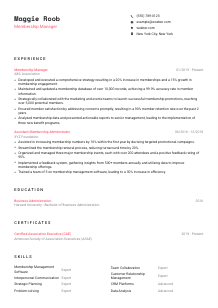
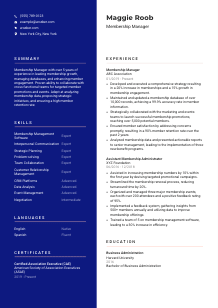
Strengthening the team but feeling detached from your CV? Adjust your approach with this Membership Manager CV example, created with Wozber free CV builder. Learn how to blend your membership expertise with job expectations, plugging you into career connections as effortlessly as a loyalty program!
Membership teams sit at the intersection of growth, service, and data accuracy. Hiring managers want to see that you can increase member numbers, keep records clean, improve renewals, and work across marketing, events, and leadership without letting the member experience slip. Your CV should make that operating range clear through results, not broad claims.
A tailored CV changes how quickly your background reads as true membership management rather than general account support or customer service. Using Wozber's free CV builder helps you line up your language with the posting, keep the structure ATS-friendly, and surface the parts of your work that show you can drive retention, manage membership systems, and turn member data into useful recommendations.
This section is simple, but it still affects whether your application moves forward smoothly. For Membership Manager roles, your header should immediately confirm who you are, what role you do, and, when relevant to the posting, whether you meet a location requirement.
Use your full name in a clear, readable format at the top of the page. Keep it slightly larger than the body text so it is easy to find during a quick scan by a recruiter or membership leader reviewing several CVs in one sitting.
Place "Membership Manager" directly under your name when that is the role you are pursuing. Matching the target title helps frame the rest of your CV correctly and supports ATS alignment, especially when your recent title was a close variation such as membership administrator or account manager.
List a working phone number and a professional email address with no formatting clutter. Accuracy matters here. If a hiring team wants to follow up after seeing strong results in renewals, member engagement, or database management, you do not want a typo to block that next step.
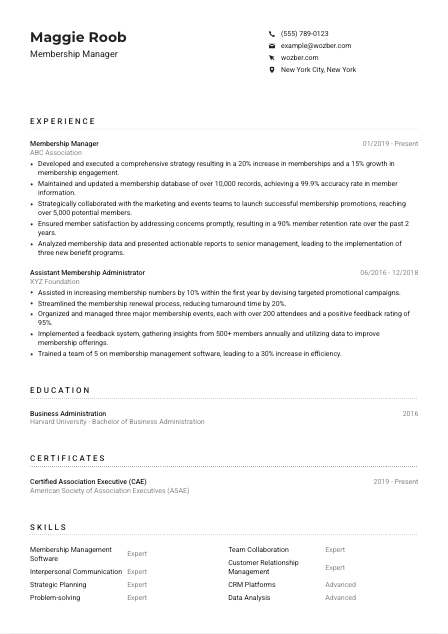
If a posting requires local candidates, include your city and state in the header. In the example, listing New York City, New York immediately addresses a stated requirement. Only do this when it is relevant to the employer's ask, rather than treating location as a universal membership hiring standard.
Include LinkedIn or a professional website if it supports your application. For this profession, that profile should reinforce the same story your CV tells, such as association work, member engagement campaigns, event coordination, CRM experience, or retention-focused accomplishments.
Your header should answer the practical questions first: who you are, what role you do, how to reach you, and whether you meet any stated location requirement. Once that is clear, the reader can focus on your membership results.




This is the section hiring teams will study most closely. Membership management is measured through growth, retention, renewal flow, record accuracy, member satisfaction, cross-team execution, and the quality of reporting you bring to leadership.
Before editing your bullets, identify the themes the employer repeats. For this role, those themes include recruiting and retaining members, maintaining records, processing renewals, coordinating with marketing and events, managing benefits, and reporting membership trends to senior management. Your experience bullets should answer those priorities directly.
List your most recent role first with your title, organisation, and dates in a format that is easy to scan. This matters because hiring teams want to see your current scope quickly, whether that involves owning a member database, running engagement campaigns, or leading retention initiatives across departments.
Membership CVs land better when bullets show what changed because of your work. The example does this well with outcomes like a 20% increase in memberships, a 15% rise in engagement, and a 90% retention rate. Write your own bullets the same way by starting with the action you led and finishing with the business or member outcome.
Quantify the parts of the job that are naturally measured. Useful numbers include renewal turnaround time, retention rate, response volume, campaign reach, event attendance, member satisfaction scores, database size, data accuracy, or benefit-program uptake. A line about maintaining 10,000 records at 99.9% accuracy says far more than simply stating that you managed a database.
Prioritise accomplishments tied to member acquisition, engagement, service, systems, and reporting. If you have unrelated wins, leave them out unless they clearly support the role. For a Membership Manager, a bullet about launching member promotions with marketing or proposing new benefit programs is more useful than a generic operations achievement with no member-facing connection.
Your work history should show that you can grow a membership base, keep operations reliable, and improve the member experience with measurable results. When the bullets are focused and quantified, the scope of your contribution becomes easy to trust.
Education rarely carries the application on its own for a Membership Manager, but it still helps confirm your foundation in business, communication, marketing, or related organizational work. Present it clearly and let it support the practical experience above it.
If the posting asks for a bachelor's degree in Business, Marketing, Communications, or a related field, make that easy to find. A degree such as a Bachelor of Business Administration aligns cleanly with the requirement and supports the operational and relationship-building side of membership work.
List your degree, field of study, school, and graduation year. That structure is easy for both recruiters and ATS systems to read, and it keeps the section clean without pulling attention away from stronger membership achievements elsewhere on the CV.
When your major directly supports the posting, do not bury it. Business, communications, nonprofit management, or marketing coursework can all make sense for membership roles, especially when the job blends member operations with campaign support and stakeholder communication.
Coursework is optional, and usually most useful for early-career applicants. Include it only when it strengthens your case, such as classes in marketing analytics, customer relationship management, communications strategy, event planning, or data reporting that connect directly to membership functions.
Honors, leadership roles, or major projects can add value if you are earlier in your career and need more proof of initiative. For example, a student organisation leadership role or a capstone focused on retention strategy can support your profile when professional membership experience is still developing.
This section should confirm that you meet the degree requirement and, where relevant, show academic grounding in communication, business, or member-focused strategy. Keep it concise so your operational results stay in the lead.
Certifications are not required in every Membership Manager search, but they can add weight when they reflect real knowledge of association operations, member strategy, or professional standards. Include them when they are current and genuinely relevant.
Prioritise certifications that connect directly to association management, membership operations, or related professional practice. In the example, credentials such as CAE and CMP reinforce specialization in the field, which is much more useful than listing unrelated general business certificates.
A short list of relevant certifications is stronger than a long list of loosely connected training. Choose credentials that support the responsibilities in the posting, such as member engagement, program development, stakeholder communication, or association leadership.
Show the year earned and, if applicable, the active period. This helps hiring teams understand whether the certification is current and whether you have continued investing in your knowledge as member expectations, engagement channels, and CRM workflows evolve.
Membership teams often work across service, data, events, and growth strategy, so continued learning matters. If you have pursued formal credentials, present them as proof that you stay current on the practices behind retention, member value, and association operations.
A well-chosen certification section adds professional depth, especially in association and member-based organizations. Keep it relevant, current, and directly connected to the kind of membership work you want to lead.
The right skills section should echo the tools and abilities you actually use to manage members, campaigns, records, and service issues. It needs to look grounded in day-to-day membership operations, not padded with broad corporate language.
Start with the posting and note both explicit and implied skills. Here, membership management software, CRM platforms, communication, negotiation, and data analysis are direct matches. Collaboration with marketing and events also points to coordination, campaign support, and stakeholder management as relevant skills to include.
Membership work depends on both platform fluency and human judgment. Show the mix. Software, CRM, reporting, and database skills matter because records and renewals must stay accurate. Communication, problem-solving, and negotiation matter because members ask questions, raise concerns, and evaluate the value of staying engaged.
Do not overload this section. Pick the skills that best support the responsibilities in the role. In the example, membership management software, customer relationship management, data analysis, event management, and interpersonal communication all connect cleanly to the posting. That kind of selection reads as deliberate rather than generic.
Your skills list should make it clear that you can run the systems, communication, and coordination work behind a healthy membership program. Relevance matters more than volume.
Membership managers spend a large part of the job communicating, whether that means handling renewals, responding to concerns, supporting campaigns, or coordinating events. If language ability is listed in the posting, reflect it clearly and honestly.
When a job states that clear English communication is required, list English prominently with an accurate proficiency level. That immediately addresses a stated qualification and supports the communication-heavy nature of membership outreach, service, and reporting.
Additional languages can be useful when the organisation serves diverse communities, international members, or multilingual stakeholders. If you can communicate with a broader member base, that can support recruitment, retention, and event engagement.
Use plain labels such as Native, Fluent, Intermediate, or Basic. Membership roles involve real-time communication with members and internal teams, so inflated language claims can create the wrong expectations once interviews move into scenario-based questions or stakeholder-facing examples.
Only emphasize multilingual ability when it connects to the organisation's membership base or outreach model. For some roles, English is enough. For others, a second language can help with community engagement, chapter support, or event participation across a wider member population.
Treat languages as working tools, not decorative extras. In member-facing roles, they can improve service quality, reduce friction in outreach, and help members feel understood during renewals, issue resolution, and event communication.
List the languages that genuinely support your work and describe your level honestly. For a Membership Manager, strong language presentation should reinforce your ability to communicate clearly with members and colleagues.
Your summary should quickly establish the kind of membership work you handle best. It should connect your experience to outcomes the employer cares about, such as growth, retention, engagement, systems management, and reporting to leadership.
Before writing, identify the few themes that define the position. In this case, that includes member growth, retention, database management, collaboration with marketing and events, and data-backed recommendations. Those themes should shape the language of your summary from the first line.
Lead with your title and years of experience, then anchor it in membership work. A line like "Membership Manager with over 5 years of experience leading membership growth and engagement" works because it immediately tells the reader your level and your area of focus.
Use the next lines to mention the strengths that matter most for the target role. That might include running large membership databases, improving retention, coordinating campaigns with marketing teams, or turning member data into recommendations for leadership. The example summary does this well by combining growth, database management, engagement, and reporting in a tight space.
Aim for three to five lines with no filler. Avoid vague adjectives and focus instead on scope, outcomes, and specialties. A concise summary that names your membership focus, years of experience, and a few proven results will do more work than a paragraph full of broad professional claims.
When this section is done well, the reader understands within seconds that you are equipped to manage membership growth, member operations, and engagement strategy. That gives the rest of the CV a clear context.
A Membership Manager CV should leave little doubt about three things: you can grow and retain members, you can keep membership operations running accurately, and you can turn member data into practical decisions. If those points are visible in your experience, skills, and summary, the document is doing its job.
Use Wozber's free CV builder to shape that story in an ATS-compliant CV, refine your wording with its AI CV builder features, and check alignment with the ATS CV scanner. The finished CV should make it easy to see your command of member engagement, renewal workflows, and cross-functional membership strategy.




