



Use Wozber and land your dream job
Create CV
No registration required
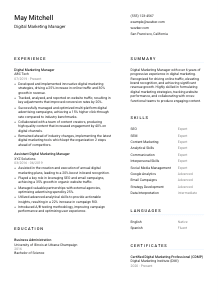
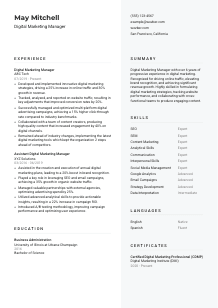
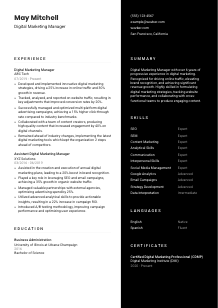
Charting campaigns, but feeling lost in your CV strategy? Check out this Digital Marketing Manager CV example, created with Wozber free CV builder. Learn how to align your online insights and outreach skills with job descriptions, steering your career's success with targeted precision!
Digital marketing managers are expected to connect channel execution with business results. Hiring teams look past broad claims about creativity and focus on whether you can build campaigns, read performance data, improve conversion paths, and work across SEO, paid media, content, email, and analytics without losing sight of revenue goals.
When that scope is tailored clearly on the page, your CV is easier to rank in an ATS and easier for a reviewer to place in the right lane, whether they need stronger acquisition strategy, sharper reporting, or hands-on campaign optimisation. Wozber's free CV builder helps shape an ATS-compliant CV around the exact language of the role so your traffic growth, campaign metrics, and channel expertise are visible from the first scan.
Digital marketing is a field where audience targeting matters, and your header works the same way. Keep the top of the CV clean, professional, and aligned with the job so basic fit is clear before anyone reaches your campaign results.
Use your full name in the most prominent text, then place "Digital Marketing Manager" directly beneath it. That immediate role match helps recruiters and ATS systems categorize you correctly, especially when they are reviewing candidates across brand, growth, content, and performance marketing tracks.
List a working phone number and a professional email address with no formatting errors. If you include a LinkedIn profile or portfolio, make sure it reflects the same positioning as your CV and shows relevant campaign, analytics, or content leadership work rather than a generic online presence.
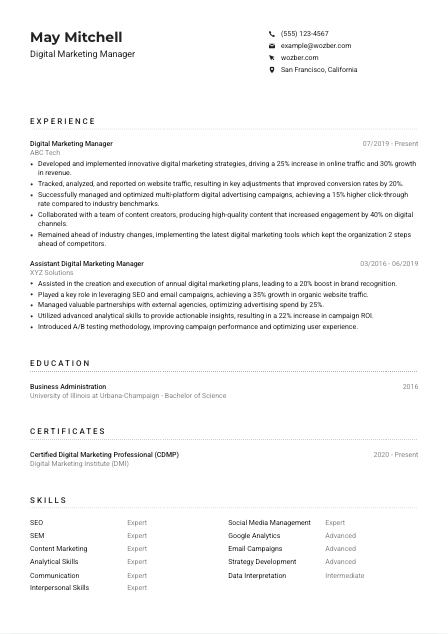
Some openings have firm location expectations because the role works closely with local stakeholders, hybrid teams, or office-based planning. Here, San Francisco, California belongs in your header because the job specifically asks for candidates based there, and the sample CV handles that requirement directly.
A website, portfolio, or personal brand link can help if it shows marketing work such as campaign case studies, content strategy samples, newsletters, landing pages, or thought leadership. If the link is thin or outdated, leave it out. Every item in this section should support your credibility as someone who manages digital channels professionally.
Skip extra personal details such as a full street address, headshot, or unrelated social links. For this profession, the header should make it easy to contact you, confirm key requirements, and move quickly into the evidence that matters most: traffic growth, campaign performance, reporting, and channel expertise.
Your personal details should confirm that you are easy to contact, properly positioned for the role, and aligned with any practical requirement the employer flagged. Then the CV can move straight into your marketing results.




This is where a digital marketing manager CV either becomes persuasive or stays generic. Hiring teams want to see which channels you owned, what you improved, how you measured it, and whether your work changed traffic, leads, conversion, engagement, pipeline, or revenue.
Start by isolating the core work in the job description: strategy development, website traffic analysis, digital advertising, content collaboration, and performance reporting. Then choose achievements from your background that map to those same responsibilities. In the example, the strongest bullets mirror the posting closely by covering traffic growth, revenue growth, campaign optimisation, analytics, and content partnership.
Use reverse chronological order and make each entry easy to read: job title, employer, dates, then accomplishment bullets. For marketing roles, scope matters. Show whether you led strategy, supported a senior manager, managed agencies, ran paid media across platforms, or partnered with content, product, and sales teams on execution.
Do not stop at "managed campaigns" or "worked with content teams." Explain what changed because of your work. Good bullets show a marketing action and a business result, such as improving click-through rate, lifting organic traffic, raising conversion rate, lowering acquisition cost, or increasing revenue from digital channels.
Numbers carry real weight in this field because campaign quality is measured constantly. Use metrics tied to channel performance and business impact: traffic growth, ROI, engagement rate, CTR, conversion rate, lead volume, email open rate, pipeline contribution, or revenue lift. The sample CV does this well with results like 25% traffic growth, 30% revenue growth, 20% higher conversions, and a 15% stronger click-through rate.
Prioritise work that proves channel fluency and decision-making. SEO, SEM, content marketing, social media, email campaigns, web analytics, A/B testing, and cross-functional collaboration are all more valuable here than broad claims about being hard-working or adaptable. Shape the section so a hiring manager can quickly see both execution skill and strategic ownership.
Your experience section should make the reader confident that you can plan campaigns, optimise performance, report on results, and connect digital activity to growth. If the bullets read like real marketing outcomes, the rest of the CV becomes much easier to trust.
Education is usually not the deciding section for an experienced digital marketing manager, but it still matters when the employer asks for a specific academic baseline. Present it clearly so the requirement is met without distracting from your campaign and analytics track record.
If the job asks for a Bachelor's degree in Marketing, Business, or a related field, make sure your degree is easy to find and labeled accurately. A Business Administration degree, as shown in the example, fits this kind of requirement well because it supports both commercial understanding and marketing decision-making.
List degree, field of study, school name, and graduation year. Keep it clean and ATS-friendly. This section does not need extra design treatment. It needs to confirm your academic background quickly so the reviewer can return to your channel results and analytics experience.
If you are early in your career, coursework in marketing analytics, consumer behaviour, communications, business strategy, or digital media can add context. For more experienced candidates, those details are usually less important than campaign results, platform knowledge, and reporting history.
Mention academic honors, marketing club leadership, case competitions, or related projects only if they strengthen your story. For a candidate with 5+ years of experience, this content should stay brief and secondary to professional accomplishments.
The longer your career in digital marketing, the less space education should take. One concise entry is often enough for a manager-level CV unless you have a highly relevant graduate degree or specialised academic training tied to analytics, branding, or growth marketing.
Education should confirm that you meet the stated academic requirement and support your professional credibility without taking attention away from campaign execution, reporting skill, and commercial results.
Digital marketing changes quickly, and certifications can show that your knowledge has kept pace with platform updates, measurement practices, and channel strategy. They are especially useful when they strengthen the specific mix of analytics, paid media, SEO, email, or broader digital marketing capability the role needs.
Some employers ask for platform-specific credentials, while others do not. This job description does not require one, so you have room to choose certifications that support your strengths and add relevance rather than listing everything you have completed.
Choose certifications that reinforce real job responsibilities, such as Google Analytics, Google Ads, Meta advertising, HubSpot, SEO training, or broader digital marketing programs. The sample's Certified Digital Marketing Professional credential works because it supports cross-channel expertise rather than a narrow specialty alone.
Certification names mean more when the issuer is recognizable and the timing is clear. Listing both helps employers understand whether the credential reflects current platform knowledge or older coursework that may no longer match today's tools and practices.
A certificate can strengthen your positioning, but it should not do the heavy lifting for the CV. In marketing hiring, a credential matters most when your experience also shows campaign execution, reporting discipline, testing, and measurable improvement across channels.
Use this section to show that your marketing knowledge is current and professionally maintained. The best certifications add credibility to the experience section rather than competing with it.
A digital marketing manager is usually hired for a mix of channel knowledge, performance analysis, and cross-functional execution. Your skills section should make that mix visible fast, using the same language employers use when they describe how growth work gets done.
Read the posting closely and mark the capabilities it emphasizes. Here, that includes SEO, SEM, social media, content marketing, email campaigns, analytics, communication, and stakeholder collaboration. Those terms belong in your skills section if they reflect work you have actually done.
Prioritise the skills that matter most to day-to-day performance in the role. Channel expertise like SEO, SEM, social media management, content marketing, and email marketing should sit alongside analytical tools and strategic strengths such as Google Analytics, campaign optimisation, reporting, A/B testing, and strategy development.
Avoid turning this section into a catch-all inventory. A shorter list with role-relevant skills is more effective than a long list padded with generic business terms. The example works because it balances channel skills, analytical ability, and communication strengths that fit a manager who must both optimise campaigns and work across teams.
Your skills should quickly map your experience to the employer's digital marketing priorities. When the list is targeted, a reviewer can immediately see whether you bring the channel coverage, analytical depth, and collaboration range the role requires.
For many digital marketing roles, language ability affects campaign quality, reporting clarity, stakeholder communication, and audience reach. Include this section when the job names a language requirement or when additional languages support the markets, customers, or teams you work with.
If the posting specifies English fluency, list English clearly and state your level accurately. That removes doubt around a requirement that matters for writing reports, presenting results, managing agencies, and collaborating on content.
Additional languages can strengthen your profile when the company serves multilingual audiences or works across regions. Spanish in the example is a useful extra because it may support broader audience communication, though it is an added advantage rather than a universal need for every digital marketing manager role.
Use clear terms such as Native, Fluent, Advanced, or Conversational. Marketing roles often involve writing, editing, presenting, and customer-facing communication, so overstating ability can create problems quickly once interviews move into campaign discussion or content review.
If the position supports international growth, multilingual content, regional paid campaigns, or global stakeholder coordination, language skills can become much more relevant. If not, keep the section brief and factual.
Only list languages you would be comfortable using in real work situations, whether that means meetings, reporting, campaign localization, or vendor communication. The section should reflect operational value, not personal trivia.
This section should confirm that you can communicate at the level the role demands and, where relevant, support broader audience or market coverage. Keep the focus on practical business use.
The summary is your fastest chance to frame what kind of digital marketing manager you are. Done well, it tells the reader whether your strength is growth strategy, channel execution, analytics, content leadership, or a combination that matches the role.
Before writing the summary, identify the employer's priorities. In this case, they want someone who can develop digital strategy, drive traffic and revenue, analyse website performance, optimise campaigns, collaborate with content teams, and stay current with digital trends. Those ideas should shape your opening lines.
Start with your title and years of experience, then define your focus clearly. For example, "Digital Marketing Manager with 6+ years of experience across SEO, paid media, email, and content strategy" says much more than a broad statement about being passionate or results-driven.
Include one or two business outcomes that show why your work is valuable, such as growing online traffic, increasing revenue, improving conversion rates, or raising campaign ROI. The sample summary uses traffic growth, brand recognition, and revenue impact well because those are native measures for this profession.
Aim for a short paragraph that is easy to scan and rich in meaning. Avoid vague adjectives and focus on channel expertise, reporting ability, and measurable outcomes. A hiring manager should be able to read these lines and immediately understand the scale and direction of your contribution.
A strong summary should quickly position you as a marketer who can set strategy, manage channels, read the data, and improve commercial performance. Once that frame is clear, the rest of the CV has a much easier job.
A Digital Marketing Manager CV works when it connects channel expertise to business outcomes in plain, specific language. If your sections consistently show strategy, execution, analytics, and measurable growth, hiring teams can quickly see where you would add value.
Use Wozber's AI CV builder to tailor each section around the job description, strengthen ATS optimisation, and present your experience in an ATS-friendly CV format that highlights the metrics and marketing capabilities the role depends on. The finished CV should make one thing easy to judge: your ability to drive digital performance with both strategic focus and hands-on execution.




