



Use Wozber and land your dream job
Create CV
No registration required
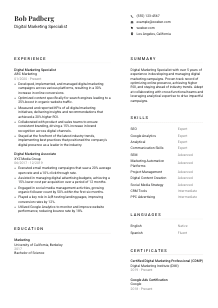
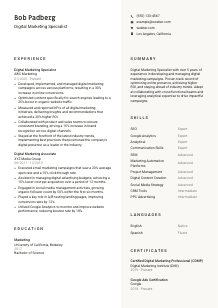
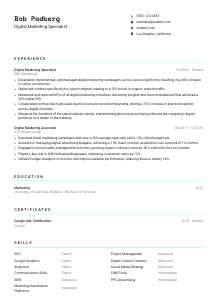
Mastering campaigns, but your CV feels unclicked? Check out this Digital Marketing Specialist CV example, created with Wozber free CV builder. Learn how to channel your digital brilliance to match job requirements, ensuring your career trajectory surfs the same wave as your online metrics!
Digital marketing CVs are easiest to overlook when they read like channel lists instead of performance stories. Hiring teams want to see how you planned campaigns, improved search visibility, managed paid and owned channels, and turned reporting into decisions that moved conversions, ROI, or acquisition costs in the right direction.
The first pass often comes down to whether your CV quickly connects your work to the channels and metrics in the job ad. Using Wozber's free CV builder helps you shape that experience into an ATS-compliant CV with the right terminology for SEO, email, paid media, analytics, and cross-functional campaign work, so your value is easier to read before anyone opens a dashboard.
This section is simple, but it still affects how smoothly your application moves forward. For a Digital Marketing Specialist, it should confirm role alignment, make contact easy, and address any practical requirement the posting calls out, without adding clutter.
Use your full name in a clean, prominent format so it reads like a professional header, not an afterthought. In marketing, presentation matters, and this is the first element attached to your campaign results, analytics work, and channel expertise.
Place "Digital Marketing Specialist" directly under your name when that is the role you are pursuing. This keeps your positioning immediate and consistent, especially if your recent title was slightly different, such as Digital Marketing Associate or Performance Marketing Coordinator.
Add a reliable phone number and a professional email address, and check both carefully. If you include a website, portfolio, or LinkedIn profile, make sure it supports the story your CV tells with campaign examples, content work, certifications, or platform experience.
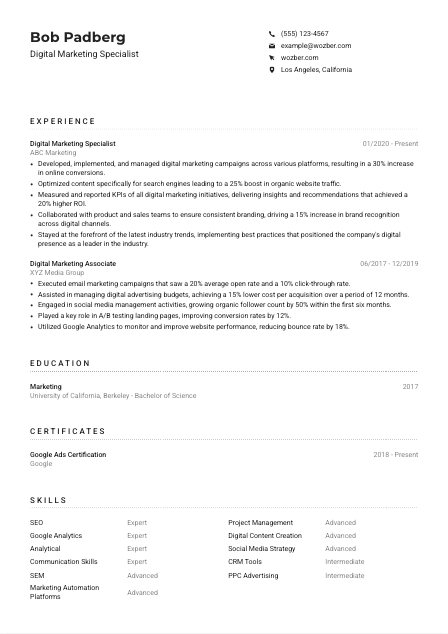
If a posting includes a location requirement, show that you meet it in your contact section. Here, listing Los Angeles, California directly answers a stated requirement and removes a common screening question early in the process. Treat this as job-specific tailoring, not a universal rule for every digital marketing application.
A LinkedIn profile, portfolio, or personal site can strengthen this section when it adds real marketing context. Useful additions include campaign snapshots, content samples, landing pages, ad creative, or a concise overview of platforms such as Google Analytics, CRM systems, or automation tools.
Your personal details should tell the employer three things right away: who you are, which role you are targeting, and whether any practical requirement like location is already covered.




This is the section most likely to decide whether you move ahead. For digital marketing hiring, broad claims about strategy or brand growth carry far less weight than bullets that show channels used, actions taken, tools applied, and measurable movement in traffic, conversions, ROI, engagement, or cost efficiency.
Before rewriting bullets, identify the recurring priorities in the posting. Here, the pattern is clear: multi-platform campaigns, SEO and SEM, email marketing, social media management, analytics, ROI, and collaboration across teams. Your experience section should echo those priorities with real work, not just repeat the wording.
Use reverse chronological order and make each entry easy to scan with job title, company, and dates. That structure helps readers track your growth from execution-focused work into broader ownership, whether that means managing larger budgets, more channels, or stronger reporting responsibility.
Each bullet should show what you owned and what changed because of it. Instead of saying you "managed digital campaigns," show the result. The sample CV does this well with statements like increasing online conversions by 30% and lifting organic traffic by 25%, which immediately ties campaign work to business outcomes.
Choose numbers that hiring teams in marketing actually care about: conversion rate, CTR, open rate, CPA, ROAS, organic traffic, bounce rate, lead volume, engagement, or ROI. Metrics such as a 15% lower cost per acquisition or a 12% improvement from A/B testing tell a much clearer story than generic words like "successful" or "effective."
Prioritise accomplishments tied to channels, audience growth, reporting, optimisation, and campaign performance. If a bullet does not connect to acquisition, retention, content performance, paid media, SEO, analytics, or collaboration with sales and product teams, shorten it or remove it to keep the section tightly aligned with digital marketing work.
By the end of this section, a reader should be able to tell which channels you have managed, how you measure success, and whether your work has already produced the kind of growth this role is expected to deliver.
Education is often a quick qualification check for this kind of role. It does not need extra decoration, but it should make it easy to confirm that you meet the academic background requested, especially when the posting names marketing, digital communications, or a related field.
If the job asks for a bachelor's degree in Marketing, Digital Communications, or a related field, present that information clearly and in the same language where accurate. A Bachelor of Science in Marketing, as shown in the example, immediately satisfies that requirement without forcing the reader to interpret it.
List your degree, field of study, school, and graduation year or date range in a simple order. Recruiters and hiring managers usually scan this section quickly, so clarity matters more than extra wording.
If your degree is directly relevant, state the field exactly. If it is adjacent rather than exact, use the official title and let the rest of your CV carry the role alignment through internships, campaign work, analytics projects, or certifications.
Relevant coursework can strengthen this section if you are early in your career or if the classes connect directly to the role, such as digital analytics, consumer behaviour, search marketing, paid media, or marketing research. Skip it when your professional experience already demonstrates those capabilities better.
Honors, awards, leadership roles, or significant class projects can be worth adding if they support your marketing profile. Keep them only when they add something concrete, such as campaign planning, research, content strategy, or data analysis, rather than filling space.
Your education entry should quickly confirm that you meet the degree requirement and support the marketing foundation shown elsewhere in your CV.
Certifications are especially useful in digital marketing because they show recent platform knowledge and ongoing professional development. They matter most when they reinforce the channels, tools, or optimisation work that already appear in your experience.
Start with credentials that match the work described in the posting. For a role centered on SEO, SEM, analytics, email, and digital advertising, certifications such as Google Ads or broader digital marketing credentials are more useful than generic training unrelated to campaign execution.
A short, relevant certification list is stronger than a long catalogue of loosely connected courses. Prioritise credentials tied to paid media, analytics, automation, CRM platforms, content optimisation, or digital strategy, depending on what your target role emphasizes.
Many marketing certifications expire or require renewal, so dates help show that your platform knowledge is current. Entries like "2018 - Present" or "2019 - Present" work well when the credential remains active and still relevant to the role.
Digital marketing tools and ad platforms evolve quickly, and your certification list should reflect that. Keep it current as you build expertise in areas like Google Ads, GA4, automation platforms, SEO tooling, or email systems, especially when those platforms appear in the jobs you are targeting.
Used well, certifications reinforce that your campaign knowledge is current and tied to the tools and channels employers expect you to handle.
A Digital Marketing Specialist skills section should look like a working toolkit, not a general strengths list. The best versions combine channel expertise, reporting tools, optimisation skills, and the collaboration abilities needed to execute campaigns with content, product, design, and sales teams.
Mark the skills the employer names directly, then add closely related terms you genuinely use. In this case, that includes SEO, SEM, email marketing, digital advertising, social media management, Google Analytics, CRM tools, marketing automation, analytical skills, project management, and communication.
Organise your skills so the reader can quickly understand your range. For example, separate channel skills like SEO, PPC, and social media strategy from tools like Google Analytics, CRM systems, and automation platforms, then include business-facing strengths such as reporting, project coordination, and stakeholder communication.
Only include skills that show up elsewhere in your CV through accomplishments, platforms, or campaign work. If you list SEO, SEM, Google Analytics, and project management, your experience bullets should show organic traffic gains, paid campaign optimisation, reporting ownership, or cross-team execution that supports those claims.
Your skills list should make it easy to see which channels you know, which tools you use, and whether your toolkit matches the marketing workflow in the target role.
Language ability matters in digital marketing because the work depends on clear messaging, reporting, and collaboration. Even when only one language is required, this section can still help by confirming communication strength and, in some cases, broader audience reach.
Check the posting for language expectations and list the required language clearly. Here, high English proficiency is specifically requested, so English should appear first with an accurate proficiency level.
Use a direct label such as "Native" or "Fluent" so there is no ambiguity. For a role involving campaign messaging, reporting, stakeholder communication, and cross-functional collaboration, that clarity matters.
Additional languages can be valuable when the business serves multilingual audiences, runs region-specific campaigns, or works across international markets. Spanish, for example, can be relevant in many U.S. markets, but include extra languages because they are true assets, not because you want to fill space.
Use plain, recognizable labels such as Native, Fluent, Intermediate, or Basic. Marketing roles often involve writing, presenting results, or adapting messaging, so overstating proficiency can quickly become obvious.
If a second language has helped you localize content, support regional campaigns, or collaborate across markets, that value can also appear in your experience section. Here, the language section itself should stay concise and factual.
At minimum, this section should confirm the required English proficiency. When relevant, it can also hint at broader campaign reach and audience understanding.
The summary sits at the top of the CV, so it needs to frame your value quickly and accurately. For digital marketing roles, that usually means combining years of experience, channel coverage, analytical strength, and a few business outcomes without drifting into vague personal branding language.
Build your summary around the parts of the job that matter most: channel management, optimisation, analytics, ROI, and collaboration. This keeps the section anchored in the actual work instead of generic claims about being results-driven.
Open with your title and years of experience, then define your scope. A line like "Digital Marketing Specialist with over 5 years of experience in developing and managing digital marketing campaigns" works because it establishes both seniority and function immediately.
Mention the strengths that recur in the posting and your background, such as SEO, paid campaigns, analytics, email marketing, or improving ROI. The example summary works because it ties optimisation and higher ROI to practical digital marketing work rather than speaking in abstractions.
Aim for three to five lines with enough detail to create interest without repeating your full experience section. Every phrase should help explain what kind of marketer you are, how you operate, and what outcomes you tend to influence.
A hiring manager should finish this section with a clear picture of your marketing scope, your strongest channels or tools, and the performance results you are used to driving.
Once each section is tailored, your CV should read like a coherent digital marketing profile rather than a collection of unrelated tasks. The strongest version makes campaign ownership, channel expertise, analytics fluency, and ROI contribution easy to find from top to bottom.
Wozber's free CV builder and ATS optimisation tools can help you tighten that alignment, surface missing keywords from the posting, and present everything in an ATS-friendly CV format that keeps your marketing results readable. That gives hiring teams a faster, clearer way to judge whether you can run the channels, report on performance, and improve outcomes in the role.




