



Use Wozber and land your dream job
Create CV
No registration required
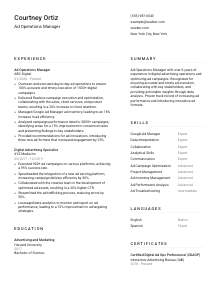
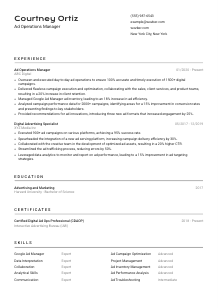
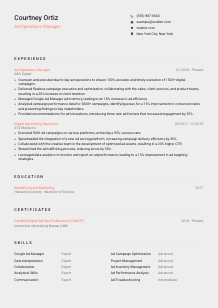
Mastering ad flow, but your CV seems queued? Check out this Ad Operations Manager CV example, created with Wozber free CV builder. It shows how to blend your campaign control with job specifics, ensuring your career journey hits those click-through rates!
Ad operations managers sit at the point where campaign setup, platform accuracy, and revenue delivery meet. A CV for this work needs to show more than general digital marketing experience. It should make clear that you can traffic campaigns cleanly, manage inventory without costly errors, troubleshoot tags, and keep performance reporting credible when multiple teams depend on the numbers.
When that detail is missing, your background can blur into broader marketing or account support work. Using Wozber's free CV builder to tailor the language of your CV and keep it ATS-compliant helps surface the parts hiring teams look for first, such as ad serving platform depth, campaign execution volume, and optimisation results. That makes it easier to see whether you can run daily ad operations without slowing delivery or missing revenue opportunities.
In ad operations, small execution errors create outsized problems. Your contact section should reflect the same precision you bring to trafficking, QA, and reporting. Keep it clean, accurate, and aligned with any concrete requirement stated in the posting.
Place your name at the top in a clear, readable format. There is no need for styling tricks. In a role built on accuracy and operational control, a straightforward header sets the right tone and makes your CV easier to scan during a fast first review.
Add the job title directly under your name when it matches your background. Using "Ad Operations Manager" immediately frames your experience around campaign trafficking, ad inventory management, troubleshooting, and cross-functional execution instead of leaving readers to infer your direction.
List a working phone number and a professional email address. If your email still looks dated or casual, replace it. Client-facing and cross-team communication matter in ad operations, so even basic contact details should reflect reliability and professionalism.
If a role specifies a location, reflect that clearly in your header. Here, New York City, New York is a stated requirement, so including it removes an obvious question early. Treat this as tailoring to the posting, not as a rule for every ad ops application.
Include LinkedIn or a personal site only if it supports your application. For ad operations, that usually means a profile with consistent titles, dates, platform expertise, and measurable campaign work. Make sure it matches the CV instead of introducing conflicting information.
Your personal details should confirm that you are reachable, professionally presented, and aligned with any explicit posting requirements. For an Ad Operations Manager, even the header should feel orderly and dependable.




This is the section hiring teams read most closely for ad operations roles. They want proof that you can keep campaigns moving, catch delivery issues early, work inside ad servers with confidence, and translate performance data into action for sales, client services, or product teams.
Read the posting for the work patterns behind the keywords. In this case, the core themes are day-to-day campaign execution, Google Ad Manager fluency, ad tag troubleshooting, performance analysis, and collaboration across revenue and product-facing teams. Those themes should shape which bullets you keep, rewrite, or cut.
List your positions in reverse chronological order and make each entry easy to read with title, company, and dates. For ad ops candidates, progression matters. Moving from specialist-level campaign execution into broader ownership of inventory, optimisation, stakeholder reporting, or process improvement tells a stronger story than a flat list of duties.
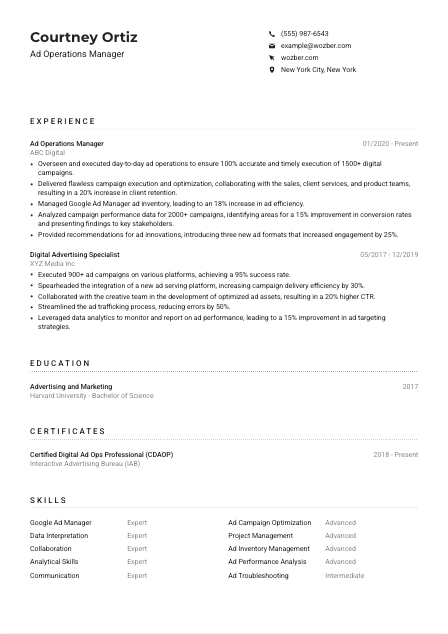
Do not stop at "managed campaigns" or "worked with teams." Show what your work changed. Strong bullets in this field connect operational tasks to delivery accuracy, retention, efficiency, CTR, conversion rate, or fewer trafficking errors. The sample CV does this well with points like managing Google Ad Manager inventory to improve efficiency and collaborating across teams to lift client retention by 20%.
Ad operations is measurable work, so quantify scope wherever you can. Campaign volume, delivery accuracy, reduction in errors, implementation speed, engagement lift, and optimisation gains all help. Numbers such as 1500+ campaigns managed or a 50% drop in trafficking errors tell hiring teams how much complexity you have handled, not just what tools you touched.
Prioritise bullets that show campaign trafficking, inventory control, implementation, troubleshooting, optimisation, reporting, and stakeholder communication. If an achievement could fit almost any digital role, sharpen it or remove it. Your experience section should leave no doubt that you can run the operational side of digital advertising at a manager level.
Your experience should show a pattern of clean execution and measurable improvement. When the bullets connect platform work to campaign delivery, performance gains, and smoother coordination across teams, your fit for ad operations becomes much easier to judge.
Education matters in ad operations mainly as a baseline qualification and as context for your foundation in advertising, marketing, or business. It will not outweigh execution history, but it should still match the posting cleanly and be presented without clutter.
Start with what the employer asked for. This posting calls for a bachelor's degree in Marketing, Advertising, Business, or a related field. If your degree lines up, make that connection easy to see. A degree in Advertising and Marketing, for example, supports the industry context behind campaign operations work.
List degree, field of study, school, and graduation year. That is usually enough for an experienced ad operations candidate. Straight formatting helps recruiters confirm the requirement quickly and move back to the sections that show your campaign and platform work.
If your degree title or major is closely related to digital advertising, use the full wording rather than abbreviating it. Specificity helps here. "Bachelor of Science in Advertising and Marketing" says more than a shortened degree label and supports the relevance of your background.
Relevant coursework can help early-career candidates who need more context around analytics, media planning, digital advertising, or marketing technology. If you already have 4+ years in ad operations, campaign delivery metrics and platform achievements will usually carry more weight than a list of classes.
Academic distinctions, capstone projects, or student media work can strengthen this section if they connect to analytics, advertising execution, or campaign strategy. For seasoned professionals, keep these details only if they add something your experience section does not already cover.
For this role, education should confirm that you meet the degree requirement and have relevant industry grounding. Keep it concise, accurate, and secondary to the operational results shown elsewhere on the CV.
Certifications are especially useful in ad operations because platforms, privacy standards, and delivery practices change quickly. The right credential can reinforce platform fluency, current knowledge, and commitment to staying sharp in a technical advertising environment.
Some ad operations roles require platform-specific or industry-recognized certifications, while others do not mention them at all. Start there. If nothing is specified, choose certifications that support the actual work, such as ad serving, programmatic, analytics, or digital media operations.
List certifications that strengthen your case for campaign execution, optimisation, troubleshooting, or inventory management. A credential like "Certified Digital Ad Ops Professional" works well because it reinforces specialised knowledge instead of adding a general marketing certificate with weaker relevance.
If a certification is active, renewed, or time-bound, include the dates. In ad tech, recency matters because platforms, standards, and workflows evolve fast. Current dates suggest that your knowledge reflects the tools and practices teams are using now.
Hiring managers value candidates who keep pace with changes in ad tech, campaign measurement, and execution standards. Recent learning in areas like ad serving, privacy changes, or performance analysis can strengthen your profile, especially when it complements hands-on experience in tools such as Google Ad Manager.
Relevant certifications support the story your experience already tells. They work best when they reinforce current ad operations knowledge, platform credibility, and your ability to keep up with a fast-moving digital advertising stack.
The skills section for an Ad Operations Manager should read like the toolkit behind successful campaign delivery. Hiring teams look here for ad server expertise, analytical strength, troubleshooting ability, and the collaboration skills needed to keep sales, client services, and product teams aligned.
Start with the posting and identify the tools and capabilities used in routine execution. Here that includes Google Ad Manager, ad trafficking, ad inventory management, performance analysis, project coordination, and strong written and verbal communication. Those are the skills that belong near the top.
A strong skills list balances technical and collaborative strengths. Include hard skills like Google Ad Manager, ad tags implementation, campaign optimisation, and ad performance analysis, then support them with skills such as stakeholder communication, collaboration, and project management. That reflects how ad ops work actually gets done.
Do not overload this section with every ad tech term you have seen. Prioritise the skills you can back up with achievements in your experience section. The sample CV handles this well by pairing platform expertise and analysis skills with capabilities like troubleshooting and inventory management, all of which connect directly to the job description.
Your skills section should quickly confirm that you understand the ad operations workflow from setup through reporting. When the listed skills match the posting and are supported by results elsewhere on the page, the section does real work.
Language skills matter in ad operations when the role involves client communication, cross-market coordination, or reporting to varied stakeholders. Even when only one language is required, listing proficiency clearly can reinforce your communication strengths.
If the posting calls for strong English speaking and writing, list English prominently and describe your level accurately. That is especially relevant in ad operations roles where campaign updates, issue escalation, client communication, and performance summaries all depend on precise language.
Additional languages can be useful when working with international clients, regional publishers, or multilingual teams. They are a bonus, not a replacement for the core operational qualifications. In the sample CV, Spanish adds breadth without distracting from the candidate's ad operations background.
Choose plain terms such as Native, Fluent, Intermediate, or Basic. Avoid vague phrasing. Recruiters should be able to tell at a glance whether you can handle stakeholder communication, reporting, or day-to-day collaboration in each listed language.
For most ad operations openings, languages support the application rather than define it. Include them when they add context, but keep the emphasis on campaign execution, platform expertise, and analytical communication unless the role itself has a strong international component.
Used well, this section reinforces your communication range without pulling focus from the core of the role. For ad operations, that means showing you can communicate clearly where campaigns, issues, and reporting require it.
The summary should position you quickly as someone who can run ad operations with control and insight. In a few lines, it needs to establish your level, your platform and campaign experience, and the kind of performance or process improvements you have delivered.
Start by identifying the operational core of the target role. For this job, that means campaign execution, ad server expertise, inventory management, troubleshooting, and performance analysis. Those are the themes your opening lines should reflect instead of broad marketing language.
Open with your professional identity and years of relevant experience. A line such as "Ad Operations Manager with 6+ years in digital advertising operations" immediately tells the reader that your background sits in the right lane and meets the experience threshold in the posting.
Use the next sentence or two to connect your background to the employer's priorities. Mention results tied to campaign accuracy, platform management, optimisation, reporting, or stakeholder collaboration. The example summary works because it links timely execution, cross-functional work, and actionable insights instead of staying generic.
Aim for a short paragraph that creates a clear first impression without repeating the full experience section. Avoid filler terms like "results-driven" unless they are followed by concrete proof. Precision matters more than polish here, just as it does in campaign setup and reporting.
A good summary should quickly establish that you are an ad operations professional who can manage delivery, interpret performance data, and work across teams without losing control of the details. If those points land early, the rest of the CV has a much stronger start.
An Ad Operations Manager CV should make platform expertise, campaign execution quality, and analytical follow-through easy to find. When each section is tailored to those priorities, your background reads less like general digital marketing and more like someone trusted to keep revenue-generating campaigns running accurately.
Use Wozber's free CV builder, ATS-friendly CV templates, and ATS CV scanner to tighten wording, align your experience with the posting, and improve ATS optimisation. The final result should make one thing clear fast: you can manage ad operations with the precision, responsiveness, and performance focus the role demands.




