



Use Wozber and land your dream job
Create CV
No registration required
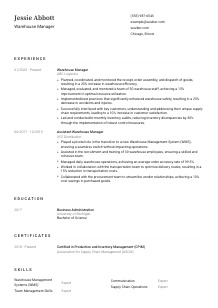
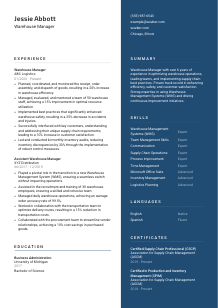
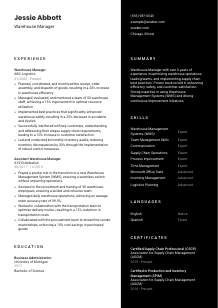
Supervising stock, but your CV doesn't seem shelved right? Unbox this Warehouse Manager CV example, created with Wozber free CV builder. Learn how to stack your leadership acumen and supply chain know-how to match job criteria, ensuring your career doesn't get lost in the inventory!
Warehouse management sits at the intersection of speed, accuracy, labour planning, and safety. Hiring teams want to see whether you can keep goods moving, control inventory, lead floor staff, and solve daily operational problems without disrupting service levels. A Warehouse Manager CV needs to show that operating range clearly, from receiving and order assembly to dispatch, audits, and workforce supervision.
When the CV is tailored well, the first read makes your operational scope easier to place. Wozber's free CV builder helps you shape an ATS-compliant CV around the language of the role, so systems and hiring teams can quickly connect your background with warehouse workflows, WMS use, staff management, and inventory control. That clarity matters when employers need to separate hands-on warehouse leaders from broader operations profiles.
Warehouse environments run on clear handoffs and practical coordination, and your contact section should follow the same standard. Keep it clean, accurate, and aligned with the posting so the basics do not create friction before your operations experience even gets reviewed.
Your name should sit at the top in a readable format that is easy to identify on both screen and print. Skip decorative styling. For a Warehouse Manager, the priority is straightforward professionalism, the same quality employers expect in shift planning, safety reporting, and daily operational communication.
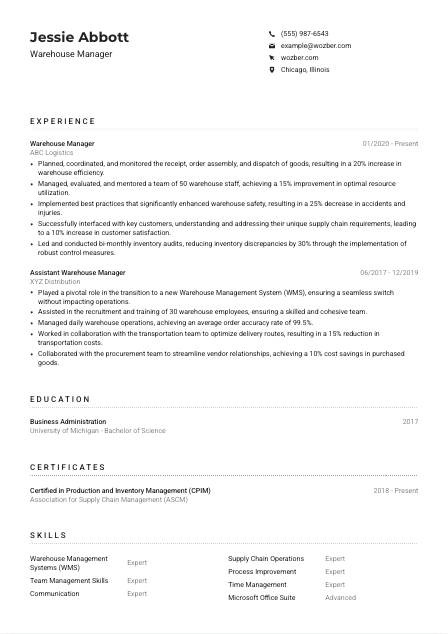
Place "Warehouse Manager" beneath your name when that matches the role you are pursuing. It gives immediate context and helps frame the rest of the CV around warehouse operations, team supervision, inventory accuracy, and fulfillment performance. In the example, this direct title choice instantly aligns the candidate with the opening.
Include a reliable phone number and a professional email address. Double-check both. Warehouse leadership hiring can move quickly, especially when employers need someone who can step into staffing issues, customer escalations, or process gaps, so missed calls or a casual email address can undercut an otherwise solid application.
If the employer asks for a local candidate or someone open to relocation, include the city and state. Here, listing "Chicago, Illinois" directly answers a stated requirement. Use location as a tailoring choice when it matters to the job, not as a default detail you repeat elsewhere on the CV.
A LinkedIn profile can strengthen your application if it matches the CV and expands on your warehouse background. Keep dates, titles, certifications, and major results consistent. If your profile includes metrics such as order accuracy, headcount managed, audit cadence, or safety improvements, it can reinforce the same operational story.
This section should confirm who you are, how to reach you, and whether you meet any location-based requirement. Simple, accurate details let the hiring team move straight to your warehouse results.




This is the section most likely to decide whether you move forward. Warehouse Manager experience should show command of daily operations, labour utilization, inventory control, customer coordination, and safe execution under volume pressure. Titles matter, but the real differentiator is what you improved and how large an operation you handled.
Read the description for the actual work to emphasize, not just the title requirements. Here, the core themes are receiving, order assembly, dispatch, staff management, safety, customer coordination, inventory audits, and WMS proficiency. Build your bullets around those priorities so your experience reads like a direct answer to the role.
List your most recent role first, followed by earlier positions in warehouse or supply chain operations. Include company name, job title, and employment dates in a format that is easy to scan. For management hiring, this layout helps reviewers quickly confirm years of experience, progression into leadership, and continuity in warehouse operations.
Do not stop at listing duties like "managed operations" or "supervised staff." Show what changed under your oversight. The example does this well by tying core warehouse work to outcomes, such as improving efficiency, mentoring a 50-person team, and reducing safety incidents. That kind of framing tells employers how you operate, not just where you worked.
Quantify results with measures that make sense for warehouse work: efficiency gains, order accuracy, discrepancy reduction, accident reduction, cost savings, staffing scope, throughput, or customer satisfaction. A bullet such as "reduced inventory discrepancies by 30% through bi-monthly audits and control measures" is far stronger than a vague claim about improving inventory management.
Prioritise work that reflects warehouse leadership and supply chain execution. Emphasize WMS rollouts, labour supervision, audit routines, shipping coordination, process improvement, and cross-functional work with transportation, procurement, or customer teams. If you include older or less relevant experience, strip it down so the focus stays on the operational responsibilities tied to warehouse management.
The experience section should leave no doubt that you can run a warehouse, manage people, and improve measurable outcomes. If each bullet connects an action to a result, your background becomes much easier to shortlist.
Education usually plays a supporting role for experienced warehouse leaders, but it still matters when a posting names a preferred field. Present it clearly so employers can confirm the academic foundation behind your logistics, business, or supply chain experience without having to search for it.
If the posting asks for a bachelor's degree in Business Administration, Logistics, Supply Chain Management, or a related discipline, reflect that wording accurately. The sample CV's Bachelor of Science in Business Administration is a good example of direct alignment. If your degree is related rather than exact, use the formal field name and let your experience reinforce the fit.
List degree, field of study, school name, and graduation year or date. That is usually enough for a Warehouse Manager CV. Clean formatting helps recruiters confirm qualifications quickly, especially when they are comparing candidates with similar years of operational experience.
Place your education where it supports your candidacy without distracting from stronger experience. If your degree closely matches the posting, make sure the field is written in full and not buried in abbreviations. This matters most when the employer uses degree requirements as an early screening filter.
Most experienced warehouse managers do not need to list courses. Include them only if they add something useful, such as logistics, inventory systems, operations management, or supply chain analytics, and only when your experience is lighter or you are moving into warehouse leadership from a related path.
Honors, student leadership, or relevant projects can help if you are earlier in your career. For seasoned candidates, these details usually take a back seat to fulfillment metrics, team size, and operational improvements. Keep the space for what best supports the level you are targeting.
For most Warehouse Manager candidates, this section works best when it is brief, accurate, and clearly tied to the posted degree requirement. Then your experience can carry the heavier weight.
Certifications can add useful weight in warehouse and supply chain hiring, especially when they relate to inventory control, planning, and end-to-end operations. They are most effective when they reinforce the kind of warehouse leadership the role actually requires.
If an employer prefers CPIM, CSCP, or another supply chain credential, list it prominently. That shows direct alignment with the role and signals formal knowledge in areas such as inventory planning, operations, and supply chain coordination. The example CV includes both CPIM and CSCP, which is strong support for a warehouse leadership application.
Choose certifications that connect to inventory accuracy, supply chain planning, process discipline, safety, or operational leadership. A short, relevant list is stronger than a long list of loosely related courses because it keeps attention on qualifications that matter in a warehouse setting.
If a certification is current, recently earned, or renewed, include the date range or issue date. This helps show that your knowledge is active and up to date, particularly in fields where standards, systems, and process expectations continue to evolve.
Warehouse leaders are often expected to improve processes, tighten controls, and work across broader supply chain functions. Continuing education supports that progression. If you are pursuing a credential or maintaining one, that can reinforce your commitment to stronger planning, inventory discipline, and operational improvement.
Relevant credentials can strengthen a warehouse CV when they support the actual work you do. Keep this section focused on certifications that add operational credibility, not clutter.
A Warehouse Manager skills section should read like the toolkit behind your results. Focus on systems, operational strengths, and leadership capabilities that show how you keep inventory accurate, teams productive, and workflows moving across receiving, storage, picking, and shipping.
Pull out the required and preferred skills directly from the posting. In this case, that includes Warehouse Management Systems, Microsoft Office Suite, leadership, team management, English communication, and supply chain operations. These terms often shape both ATS screening and the first human scan, so use them when they match your real experience.
Lead with the abilities most central to warehouse leadership, such as WMS proficiency, inventory management, logistics planning, process improvement, team supervision, and safety practices. In the sample CV, WMS, team management, supply chain operations, and inventory management all support the responsibilities named in the posting.
Avoid broad filler like "hardworking" or "problem-solving" unless you can support it elsewhere with warehouse examples. Choose skills tied to actual execution, such as cycle counting, labour scheduling, KPI tracking, dispatch coordination, vendor coordination, order accuracy, and continuous improvement. A focused list gives a clearer picture of how you run warehouse operations day to day.
The right skills section should echo the operational demands of the job. If a hiring manager can connect your skills directly to warehouse output, inventory control, and team leadership, the section is doing its job.
Language ability is usually a supporting detail in warehouse management, but it becomes important when the role calls for customer interaction, team coordination, or clear safety communication. Present languages in a way that reflects actual working proficiency.
Some warehouse roles need only basic communication, while others require strong written and verbal communication for customer coordination, reporting, and team leadership. Here, English proficiency is specifically called out, so it should appear clearly in your CV.
If English is mandatory, place it at the top of this section and label your proficiency accurately, such as "Native" or "Fluent." This is especially relevant for managers responsible for instructions, audits, incident reporting, and conversations with customers or cross-functional partners.
Extra language ability can support communication with diverse warehouse teams, carriers, vendors, or customers. The example includes Spanish, which could be useful in many distribution environments, but only list languages you can use in real workplace situations.
Choose plain, recognized levels such as "Native," "Fluent," "Intermediate," or "Basic." Overstating ability can quickly become a problem in interviews or on the job, especially when the role includes direct staff supervision or customer communication.
Language skills matter most when they improve coordination, reduce misunderstandings, or support a mixed workforce and customer base. If that is part of your background, this section can quietly strengthen your profile without taking attention away from warehouse operations and leadership.
For Warehouse Manager roles, languages should support the operational picture already shown elsewhere. Clear, accurate language details are enough to show you can communicate where it counts.
The summary sits at the top of the CV, so it needs to establish your level fast. For warehouse management, that means years of experience, operational scope, leadership strength, and the kind of results you deliver across efficiency, safety, inventory control, and service.
Before writing, identify the few points that define your candidacy for the target job. For this type of role, those usually include warehouse or supply chain experience, time in management, WMS proficiency, team leadership, and operational improvement. Use those themes to shape the first lines.
Start with a direct statement such as "Warehouse Manager with 6+ years of experience in warehouse and supply chain operations." That quickly places you in the right hiring lane. If you also meet a managerial threshold, mention that too when it is important to the posting.
Choose accomplishments that connect directly to warehouse performance. The example summary highlights efficiency, safety, and customer satisfaction, all of which match the employer's needs. You can also mention inventory accuracy, order fulfillment, labour management, or WMS-driven process improvements if those are your strongest points.
Aim for 3 to 5 lines with specific wording and no generic claims. Avoid vague phrases about being results-driven or dynamic unless the next words explain what you actually improved. A concise summary with real warehouse terminology sets up the rest of the CV much more effectively.
A good summary tells the reader, in a few lines, what scale of warehouse work you know, what teams or processes you lead, and what results tend to follow. That makes the rest of the CV easier to trust.
A well-tailored Warehouse Manager CV should make your operational range easy to see: inventory control, staff leadership, WMS use, safety discipline, customer coordination, and measurable warehouse results. When those elements are presented clearly, hiring teams can quickly judge whether you are ready to manage the floor and improve performance.
Wozber's free CV builder can help you organise that experience into an ATS-friendly CV format, and its ATS CV scanner can highlight missing requirements, keywords, and phrasing tied to the posting. Use those tools to tighten alignment, then submit a CV that speaks the language of warehouse operations with confidence.




