




Use Wozber and land your dream job
Create CV
No registration required
Moving cargo, but your CV feels stuck? Navigate this Freight Coordinator CV example, created with Wozber free CV builder. Learn how to chart your logistical know-how to match job expectations, ensuring your career sails smoothly and freight-fully ahead!
Freight coordination is judged in the real world by what happens when shipments hit friction. Delays, rate pressure, carrier issues, incomplete paperwork, and shifting delivery requirements all land on one desk. Your CV should make that operating reality visible by showing how you keep freight moving, control cost, and solve problems before they turn into service failures.
A tailored CV changes how quickly a hiring team can place you in that workflow. When your experience uses the same language as the job posting, from carrier management to documentation and shipment tracking, Wozber's free CV builder helps you shape an ATS-compliant CV that surfaces the right terms and structure without losing the specifics that matter in freight operations. The goal is a CV that clearly shows you can manage movement, communication, and exceptions under pressure.
Freight teams move fast, and the top of your CV should answer the practical basics immediately. For a Freight Coordinator, that means clear identity, reliable contact details, and any location information that removes friction before the first call.
Use your full name as the most visible text on the page so recruiters and operations leaders can identify you quickly. Keep the formatting clean and professional. In logistics hiring, clarity matters, and your header should feel as organised as the shipment records you would be expected to maintain.
Place "Freight Coordinator" directly below your name if that is the role you are targeting. This helps align your CV with the position immediately, especially when your background includes adjacent titles such as Logistics Coordinator, Shipping Coordinator, or Assistant Freight Coordinator. A direct title match also helps ATS systems connect your CV to the posting faster.
List a phone number you answer, a professional email address, and, if relevant, a website or LinkedIn profile that supports your logistics background. Double-check for typos. In a role built on timely updates, missed calls and bounced emails create the wrong impression before your experience is even reviewed.
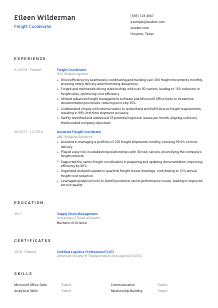
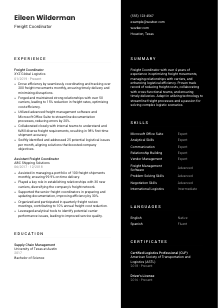
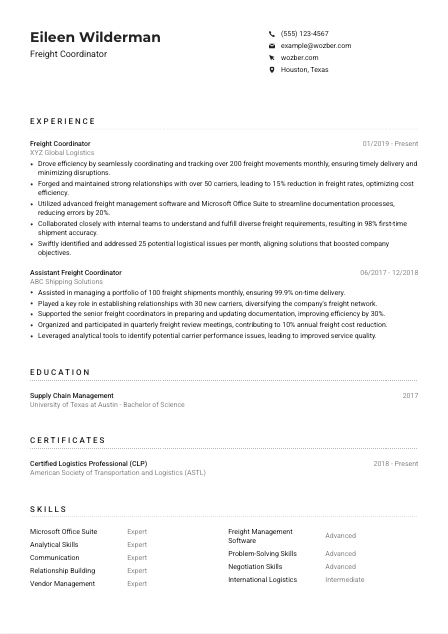
If the employer wants someone based in a specific market or able to relocate, state that clearly in your personal details. Here, listing "Houston, Texas" directly addresses a stated requirement and removes guesswork about availability. Keep location to the city and state unless the employer asks for more.
If you include LinkedIn or a personal website, make sure it reflects your current roles, dates, and logistics responsibilities. A hiring manager who clicks through should see the same carrier management, freight tracking, documentation, and coordination work that appears on your CV, not an outdated profile with mismatched titles.
Your personal details should answer the immediate operational questions: who you are, how to reach you, and whether you meet basic location expectations. Keep it clean, accurate, and easy to scan.




This is where Freight Coordinator CVs usually rise or fall. Hiring teams look for proof that you have handled shipment volume, carrier communication, paperwork, cost control, and daily exceptions, not just that you have worked in logistics before.
Start with positions where you coordinated shipments, tracked loads, worked with carriers, resolved transit issues, or managed freight documentation. If your background includes broader supply chain or logistics work, pull forward the parts tied to transportation execution. Relevant scope matters more than generic responsibility lists.
List your jobs in reverse chronological order with company name, title, and dates. A clear timeline helps the reader see whether you have the 3+ years of freight-related experience this kind of role often asks for. It also shows progression, such as moving from an assistant coordination role into full ownership of freight activity.
Each bullet should show what you handled and what improved because of your work. Freight coordination bullets are strongest when they mention shipment volume, on-time performance, documentation accuracy, carrier relationships, or issue resolution. The example CV does this well with details like coordinating more than 200 freight movements monthly and maintaining 98% first-time shipment accuracy.
Numbers carry real weight in transportation hiring. Use metrics tied to freight performance, such as monthly shipment counts, rate reductions, error reduction, on-time delivery, first-pass accuracy, or number of carrier relationships managed. A line about reducing freight rates by 15% is far more useful than saying you "improved efficiency" because it shows commercial impact, not just effort.
Remove bullets that focus on unrelated administrative tasks unless they support dispatching, vendor coordination, shipping documentation, or logistics analysis. Space is better used on load planning, carrier negotiation, exception handling, customer or internal stakeholder updates, and process improvements that made freight movement more reliable.
Your experience section should make it easy to picture you managing freight from booking through delivery. If the reader can see shipment volume, carrier coordination, documentation control, and measurable results, you are giving them what they need.
Education matters most when it confirms the operational foundation behind your work. For Freight Coordinator roles, that usually means supply chain, logistics, transportation, business, or another field that supports shipping, planning, and process control.
If the posting asks for a bachelor's degree in Supply Chain Management, Logistics, or a related field, make sure your education section clearly answers that requirement. In the provided example, a Bachelor of Science in Supply Chain Management aligns directly with what the employer requested, which helps remove an easy screening question.
List your degree, field of study, school, and graduation year or date. Keep the layout simple so ATS parsing stays clean and the hiring team can confirm the credential quickly. This section does not need design flourishes. It needs accuracy and readability.
Use the exact wording from your diploma or university records. If your field is closely related rather than identical, such as Business Administration with a logistics concentration, write that clearly. Precision matters here because logistics employers often screen for field relevance before looking deeper into your experience.
If you are early in your career, you can include coursework, projects, honors, or student organizations tied to transportation, procurement, warehouse operations, or supply chain analytics. If you already have several years of freight experience, keep the section lean and let your work history carry more weight.
If you have logistics training or development that complements your degree, make sure it supports the picture your CV is already building. Formal education establishes the baseline. Continued learning shows you stay current with freight operations, documentation standards, and evolving supply chain practices.
This section should confirm that you have the academic background the role calls for without taking space away from operational achievements. For most Freight Coordinators, the degree is a checkpoint, not the headline.
Certifications are not always mandatory for Freight Coordinator roles, but the right ones can sharpen your profile, especially when they connect directly to transportation operations, compliance, or logistics process knowledge.
Prioritise credentials tied to logistics, transportation, customs, supply chain operations, or vendor management. If the job posting does not require a certification, treat this section as support rather than filler. A relevant certification such as Certified Logistics Professional can reinforce your subject knowledge and commitment to the field.
Lead with certifications that strengthen your fit for shipment coordination, carrier communication, freight documentation, or broader supply chain execution. Less relevant items can be omitted or moved lower. The section should help the reader understand your logistics background faster, not distract from it.
Show when each certification was earned and whether it is current if that status matters. In logistics and transportation, recency can matter when the credential touches compliance, documentation practices, or operational standards. Clear dates also help distinguish active professional development from older, less relevant training.
If you are pursuing additional freight, logistics, or supply chain certifications, include them when they are credible and near completion. This is especially useful if you want to move from an assistant or support role into broader freight ownership. It signals continued development in the operational side of the business.
A concise certification section can strengthen your logistics profile when the credentials are current and relevant. Keep the focus on certificates that support freight execution, coordination, or transportation knowledge.
The best skills sections for Freight Coordinators look like the actual toolkit of the job. They should reflect the systems, judgment, communication, and commercial awareness needed to move shipments on time and solve problems when the plan changes.
Review the job description line by line and match it to skills you have used in practice. For this role, that includes freight management software, Microsoft Office, analytical problem-solving, carrier and supplier communication, and negotiation. The value comes from accurate alignment, not from loading the section with every skill you have ever used.
Put the most role-critical skills first. In freight coordination, that usually means transportation systems, shipment tracking, documentation handling, rate negotiation, exception management, vendor or carrier relationships, and cross-functional communication. Soft skills belong here too when they directly support the work, especially negotiation and relationship building.
Organise your skills so both ATS systems and hiring managers can read them quickly. A focused list like the example's mix of freight management software, vendor management, negotiation, analytical skills, and Microsoft Office is much more useful than a long generic inventory. Every item should connect to an actual freight workflow or decision point.
When someone scans your skills, they should immediately recognize the profile of a person who can manage freight activity, carrier communication, and shipment issues without a long ramp-up.
Language ability matters in freight work when it affects daily coordination, documentation, carrier communication, or cross-border shipments. This section should stay practical and reflect the communication demands of the role you are targeting.
If the role requires the ability to work in English, list English prominently with an accurate proficiency level. That gives the employer a direct answer to a stated requirement and removes doubt about your ability to handle calls, emails, shipment updates, and operational documentation in the working language.
Order the list by relevance to the job, not by personal preference. For this posting, English belongs first because it is explicitly required. That simple ordering choice helps both ATS review and human scanning by putting the must-have language at the top.
If you speak other languages used with carriers, suppliers, customs contacts, or international partners, include them after the required language. In some freight environments, an additional language can support smoother issue resolution or relationship management, especially across regional or international lanes.
Use honest proficiency labels such as Native, Fluent, Advanced, or Intermediate only if they reflect how you actually work. Freight communication often involves time-sensitive calls, documentation review, and negotiation. Inflated language claims can create operational problems quickly.
Do not overstate the importance of languages if the job is primarily domestic and English-based. At the same time, if you have useful secondary language skills, they can still add value. The example CV lists Spanish after English, which broadens the profile without distracting from the core freight qualifications.
This section works best when it answers a communication need tied to the role. Lead with the required language, be honest about proficiency, and treat extra languages as added coordination value.
Your summary should sound like someone who understands freight execution, not someone reciting generic logistics buzzwords. In a few lines, it should show your level of experience, your operational strengths, and the kind of results you deliver across shipments, carriers, and internal coordination.
Read the posting closely and identify the two or three themes that define the job. Here, those themes include coordinating freight movement, managing carrier relationships, handling documentation, and solving logistical issues. Your summary should reflect that mix instead of trying to cover every detail in your background.
Start with your title or closest equivalent, years of experience, and a concise statement of your freight focus. The example summary does this effectively by leading with more than 4 years of experience and highlighting freight movement optimisation and carrier management. That gives the reader immediate context.
Follow with one or two concrete outcomes tied to the work, such as reducing freight costs, improving shipment accuracy, increasing on-time delivery, or resolving complex logistics issues. Keep the claims grounded in the kinds of results your experience section can support. Specific transportation outcomes are more convincing than broad claims about being "results-driven."
Aim for a summary that is brief enough to scan quickly but specific enough to separate you from other logistics candidates. Three to five lines is usually enough. Focus on freight coordination, carrier communication, documentation control, and problem-solving, then stop before it turns into a full paragraph of repeated keywords.
After reading these opening lines, a hiring manager should already understand your level, your freight focus, and the business value you bring. That makes the rest of the CV easier to trust and easier to place.
A Freight Coordinator CV works when it shows how you handle the moving parts that affect delivery, cost, and service. If your sections clearly connect shipment volume, carrier coordination, documentation accuracy, negotiation, and issue resolution, the hiring team can quickly see where you fit.
Use Wozber's free CV builder to organise that experience into an ATS-friendly CV template, then refine the language with the ATS CV scanner so your phrasing matches the job without sounding forced. The finished CV should make one thing easy to judge: you can keep freight moving when the work gets complicated.