



Use Wozber and land your dream job
Create CV
No registration required
Navigating fields, but your CV feels stuck in the mud? Ride along with this Tractor Driver CV example, built with Wozber free CV builder. Learn how to match your steering skills to job specifications, taking your tractor career on a smooth and fruitful journey!
Tractor driving jobs are built on reliability. Hiring teams want to see someone who can move materials safely, handle routine checks without being prompted, keep equipment in working order, and stay steady when schedules are tight. Your CV should make that operating standard visible fast, especially through driving history, maintenance habits, and safety results.
A tailored CV helps separate tractor experience from general driving work by showing the right details first, such as cargo handling, daily logs, CDL status, and maintenance responsibility. Wozber's free CV builder makes it easier to shape that into an ATS-compliant CV with the language employers already use, so the CV reads clearly as a match for real transport and equipment duties.
For a Tractor Driver, the top of the CV should do more than identify you. It should immediately confirm that you are reachable, properly positioned for the role, and easy to place against practical requirements such as location and CDL-related work history.
Use your full name in a larger, clean font so it stands apart from the rest of the page. Keep it simple and readable. In driving and operations roles, hiring teams often review CVs quickly, so basic clarity matters more than decorative formatting.
Place "Tractor Driver" under your name when that is the job you are pursuing. This helps frame the rest of the CV around tractor operation, equipment transport, maintenance, and safety compliance instead of leaving the reader to guess whether your background is in another kind of driving role.
List a phone number you answer, a professional email address, and only links that add real value. If you include a website or profile, it should support the application with transport credentials, certifications, or work history. One typo in your phone number matters a lot more than an extra design touch.
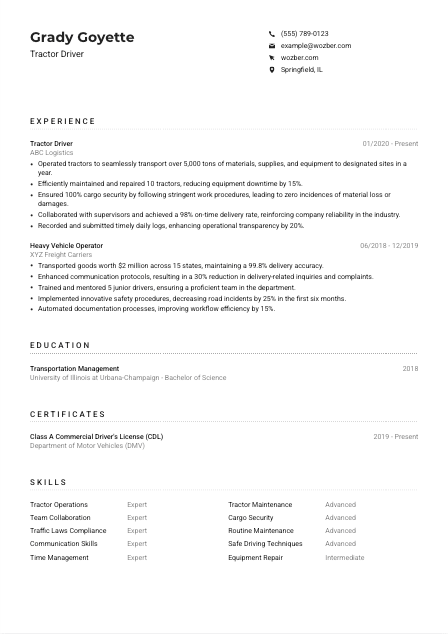
If a job specifies Springfield, IL or asks whether you are local or willing to relocate, include that clearly in your contact details. That removes a common point of hesitation early. In the example CV, listing Springfield, IL instantly supports a location-based requirement without taking up extra space elsewhere.
Optional details should connect back to the work. A LinkedIn profile that confirms commercial driving history, endorsements, or fleet-related experience can help. Skip anything that does not reinforce your record with tractors, heavy vehicles, maintenance, or transport operations.
The header should answer a few practical questions right away: who you are, what role you are targeting, how to reach you, and whether you meet basic application conditions. For a Tractor Driver, that kind of clarity helps the rest of the CV land faster.




This is where a Tractor Driver CV earns credibility. Employers look past generic duty lists and focus on the kind of equipment you handled, the loads you moved, how safely you worked, and whether you kept operations on schedule. Your bullets should reflect field reality, not vague responsibility statements.
Read the posting for the operational themes behind the role. Here, the key areas are tractor operation, routine maintenance, cargo security, teamwork, timely deliveries, and daily logs. Those are the themes your experience bullets should mirror, using accurate language from your own work history rather than copied phrases.
List positions in reverse chronological order with title, company, and dates. That format makes it easy to track how long you have operated tractors or similar heavy vehicles. If one role used a different title, such as Heavy Vehicle Operator, make the bullets do the work of linking it to tractor driving responsibilities.
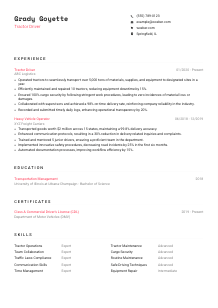
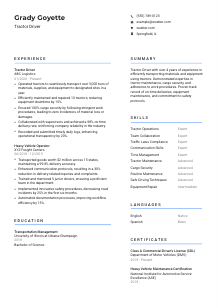
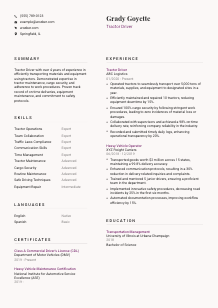
Hiring managers already know a Tractor Driver transports materials and performs checks. What matters is how well you did it. Replace flat tasks with outcome-based bullets, such as delivery volume, uptime improvements, cargo loss prevention, or on-time performance. The example CV does this well by showing over 5,000 tons transported and a 98% on-time delivery rate.
Quantify results with measures that fit the job: tons moved, number of tractors maintained, downtime reduced, delivery accuracy, incident reduction, or logs submitted on time. These are natural performance markers in fleet and materials transport work, and they help separate experienced operators from applicants who only describe responsibilities in broad terms.
Keep the section centered on vehicle operation, safety, maintenance, coordination, and recordkeeping. Experience from unrelated jobs can stay on the CV if needed, but it should not crowd out stronger evidence from heavy vehicle, farm equipment, freight, construction, or logistics work. The closer the bullet is to route execution and equipment responsibility, the more useful it is here.
After reading this section, a hiring manager should be able to picture you operating equipment, securing loads, coordinating with dispatch or supervisors, and keeping tractors road-ready. That is the level of specificity your experience section should deliver.
Education usually plays a supporting role for Tractor Driver positions, but it can still add useful context. A degree, diploma, or training entry can reinforce logistics knowledge, mechanical understanding, or broader transportation exposure when it is presented cleanly and kept in proportion to your hands-on experience.
If the posting does not require a specific degree, list your strongest completed education and move on. For most Tractor Driver applications, experience and licensing will carry more weight, but relevant study in transportation, diesel systems, logistics, or mechanics can still strengthen the picture.
Include the school name, degree or diploma, field of study, and graduation year or date range. This section should be quick to scan. Clean formatting helps both ATS parsing and human review without pulling attention away from driving credentials and job history.
If your education connects to fleet work, transport operations, equipment maintenance, or supply movement, make that connection obvious through the field of study. In the example, a degree in Transportation Management supports the candidate's broader understanding of the industry, even though the job itself is grounded in practical driving work.
If formal education is limited, relevant coursework or training can still help. Short programs in heavy vehicle maintenance, transportation safety, inspection procedures, or load handling are worth mentioning when they back up the requirements of the role.
Student projects, workshops, or extracurricular activities belong here only when they clearly relate to transport or equipment work. A logistics project, maintenance workshop, or operations-focused program can add context for early-career candidates. If it does not strengthen your tractor or heavy vehicle profile, leave it out.
For this kind of role, education should support the main story rather than lead it. Keep it clean, relevant, and brief, with enough detail to reinforce your background in transportation or equipment-related work.
Certifications matter more in driving roles when they affect legal eligibility, equipment knowledge, or safety confidence. For a Tractor Driver, your CDL and any maintenance-related credentials are not filler. They are core qualifications that should be easy to spot and up to date.
If the job asks for a valid Class A or B CDL with the appropriate endorsement, list that exactly and make sure the wording matches your current license. This is one of the first details many employers look for because it directly affects whether you can do the job.
List the certificates that strengthen your ability to operate tractors, inspect equipment, follow safety rules, or perform basic repairs. A heavy vehicle maintenance certification is a strong example because it reinforces one of the job's practical expectations beyond driving alone.
Add issue dates, renewal dates, or validity ranges where appropriate. For regulated driving work, current credentials matter. A valid date range makes it easier for the employer to see that your license or certification is active and relevant right now.
If you have recent safety, maintenance, or compliance training, include it when it supports the role. Transport employers value drivers who keep up with operational standards, inspection routines, and equipment care, especially when the role includes basic repairs and daily vehicle checks.
Your certifications should answer a practical question quickly: are you licensed, current, and prepared to handle the equipment safely? For a Tractor Driver, that answer should be obvious within a few seconds of reading.
The skills section works best when it reflects the actual mix of duties in the job. For Tractor Driver roles, that means balancing vehicle operation with maintenance awareness, safety discipline, communication, and coordination. A random list of soft skills will not carry much weight unless it connects back to route execution and equipment handling.
Start with the skills named or implied in the posting. Here that includes tractor operation, routine maintenance, basic repair, traffic law compliance, cargo security, communication, and teamwork. Those are stronger choices than broad filler because they map directly to how the job gets done each day.
Order the list around what the employer needs most. Operating tractors safely and maintaining them properly should appear before lower-priority additions. In the example CV, tractor operations, traffic laws compliance, communication, and maintenance all support the job description well.
Choose skills you can support elsewhere in the CV through experience, certifications, or training. A tighter list built around driving, inspections, repairs, delivery coordination, and documentation is usually stronger than a long list padded with generic traits. Every item should point back to real transport work.
A useful skills section should read like the operating profile of someone ready to take the tractor out, keep it safe, and work smoothly with the rest of the team. That is the standard to aim for.
Language skills matter in driving jobs when they affect instructions, logs, dispatch communication, and safe coordination on site. If the posting asks for high-level English, treat that as an operational requirement, not a side detail.
List English prominently and describe your level honestly. In a Tractor Driver job, strong English supports route communication, supervisor updates, safety instructions, and accurate daily logs. When the posting calls it out directly, your CV should do the same.
Additional languages can help in mixed crews, warehouse environments, or multi-site operations, but only include them if you can genuinely use them. A second language is a useful extra, not a substitute for the clear English communication many transport roles require.
Use straightforward labels such as Native, Fluent, Conversational, or Basic. That keeps expectations realistic. The example CV handles this cleanly by listing English as Native and Spanish as Basic.
If you speak another language, frame it as a practical benefit in team coordination or day-to-day communication, not as a decorative detail. It is most valuable when it helps with crews, customers, dispatch, or job-site interactions.
Most Tractor Driver jobs are won on safe operation, maintenance awareness, and dependable delivery performance. Language ability can strengthen the application, especially when English is required, but it should stay in proportion to the rest of your qualifications.
This section should confirm that you can understand instructions, communicate clearly, and complete logs without confusion. For a Tractor Driver, that kind of language clarity supports both safety and day-to-day reliability.
The summary sets the reading frame for the whole CV. In a Tractor Driver application, it should quickly establish your years of experience, the kind of equipment work you handle, and the operating strengths that matter most, such as safety, maintenance, and dependable delivery performance.
Open with your title and years of relevant experience. If you have operated tractors or similar heavy vehicles for 4+ years, say that clearly. This gives immediate context and helps the employer place your background in the right category from the first line.
Your opening should mention the work you are trusted to do, such as transporting materials, handling equipment safely, or maintaining reliable delivery schedules. Keep it grounded in real transport responsibilities rather than broad personality claims.
Use two or three specifics that align with the posting, such as routine tractor maintenance, cargo security, compliance with safety procedures, or timely log submission. The example summary works because it combines transport experience with maintenance knowledge and safety discipline in a compact way.
Aim for a concise paragraph that can be read in a few seconds. The summary is not the place to list every accomplishment. Its job is to introduce the kind of Tractor Driver you are and make the reader expect the right evidence in the experience section.
A well-written summary should make your application read like it belongs in the transport stack from line one. When it names the right equipment experience, safety habits, and operating reliability, the rest of the CV has a clear direction.
A Tractor Driver CV should make a practical case: you can operate the equipment, keep it maintained, protect the load, follow safety procedures, and stay reliable on schedule and paperwork. When each section supports that case, the CV becomes much easier to trust.
Use Wozber's free CV builder to shape your content into an ATS-friendly CV template, refine wording with role-specific language, and check alignment with an ATS CV scanner. The final result should make one thing clear fast: you are ready to handle the route, the tractor, and the day-to-day discipline the job requires.




