



Use Wozber and land your dream job
Create CV
No registration required
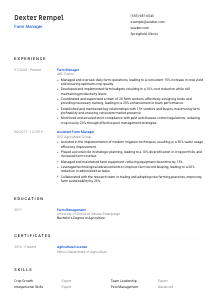
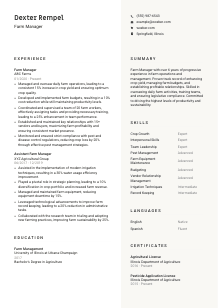
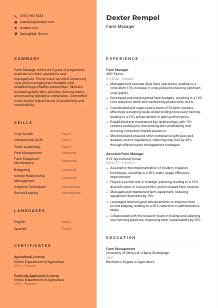
Tilling fields, but your CV yields no crop? Harvest inspiration from this Farm Manager CV example, created with Wozber free CV builder. Learn how to sow your agricultural expertise to meet job requisites, growing your career as bountifully as your harvests!
Farm managers are trusted with work that shows up in yield, crop quality, labour efficiency, compliance, and the condition of the land itself. A CV for this role needs to make those operating results visible quickly. Hiring teams want to see how you run planting and harvest cycles, manage crews, control pests and disease, and keep equipment, inputs, and budgets moving without losing productivity.
When that experience is tailored to the opening, the CV reads less like general agricultural work history and more like evidence that you can run a farm day to day. Wozber's free CV builder helps organise that experience into an ATS-friendly CV format, so terms such as irrigation, pest management, budgeting, and team supervision are easy to parse and easy to connect to field performance. That makes your ability to manage acreage, people, and output much clearer from the first scan.
This section is simple, but it still does useful work. For a Farm Manager application, it should confirm who you are, how to reach you, and whether practical requirements such as location are already covered.
Use your full name as the header in a clear, readable format. Keep it more prominent than the rest of the contact details so the document is easy to identify when a hiring manager is reviewing several applicants for operations-heavy roles.
Place "Farm Manager" directly under your name if that is the role you are pursuing. Matching the posted title helps frame the rest of your CV around farm operations leadership rather than broader agricultural support work, and it supports ATS matching as well.
Include a current phone number and a professional email address. Farm hiring can move quickly during seasonal planning or staffing periods, so make sure your contact details are accurate and easy to scan.
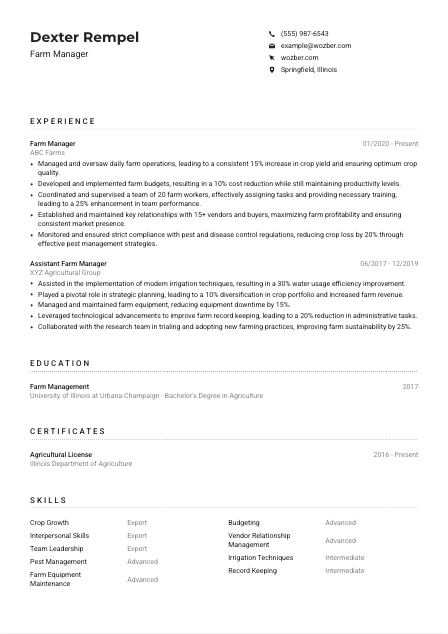
If the employer specifies a city or relocation requirement, include your city and state. In this example, listing Springfield, Illinois immediately answers a stated requirement and removes a common point of uncertainty early in the review.
If you have a LinkedIn profile or professional website, include it only if it supports your candidacy with aligned experience, certifications, equipment knowledge, crop results, or agricultural projects. Keep the information consistent with your CV so there are no gaps in dates, titles, or responsibilities.
Personal details should confirm logistics, not take up valuable space. For a Farm Manager CV, this section works best when it quickly supports contactability, role alignment, and any stated location requirement.




This is the section that carries the most weight for Farm Manager hiring. Employers want to see what scale you managed, how you improved output, how you handled crews and field operations, and whether you can keep a farm productive while controlling cost, compliance, and downtime.
Read the posting closely and mark the recurring themes. For Farm Manager roles, those often include planting and harvesting oversight, irrigation, pest and disease control, equipment maintenance, budgeting, record keeping, and crew supervision. Those are the areas your experience bullets should reflect first, especially if the employer is looking for progressive responsibility over 5+ years.
Start with your most recent position and work backward. For each role, include your job title, farm or company name, and employment dates. That structure helps show whether you advanced from support or assistant roles into broader operational ownership, which is a common hiring pattern in farm management.
Each bullet should connect a farm responsibility to a business or production outcome. Instead of saying you oversaw operations, show what happened because of your work. The sample does this well with lines such as increasing crop yield by 15%, reducing costs by 10%, and improving team performance by 25%. Those are the kinds of operational results that make experience credible.
Numbers are especially persuasive in agricultural operations because they tie your decisions to yield, water efficiency, crop loss reduction, labour output, cost control, or equipment uptime. If you managed irrigation changes, note water savings. If you handled pest programs, note reduced crop loss or compliance performance. If you led a team, show headcount, training impact, or productivity gains.
Cut bullets that do not strengthen your case for running a farm. Prioritise work tied to crop production, input planning, vendor coordination, maintenance oversight, financial control, regulatory compliance, and team leadership. Even if you have broader agricultural experience, the CV should emphasize the parts that show you can manage daily farm operations and protect profitability.
A Farm Manager experience section should read like a record of acreage, output, cost control, people leadership, and operational judgment. If the bullets show how you improved farm performance, the hiring team can picture you running the next season, not just participating in it.
Education matters here because it backs up technical judgment in crop planning, farm business decisions, and regulatory practice. Even experienced candidates should make it easy to spot whether their academic background aligns with agriculture or farm management.
Start with the degree standard named in the posting. Here, the employer asks for a bachelor's degree in Agriculture, Farm Management, or a related field. If your degree matches directly, make sure the wording is easy to find and not buried under less relevant details.
List the degree, field of study, school name, and graduation year or date. This section does not need extra framing. For a Farm Manager CV, clarity matters more than decoration because the reviewer is checking alignment with a stated baseline qualification.
If your degree title closely mirrors the posting, keep that wording visible. A degree such as "Bachelor's Degree in Agriculture" with a Farm Management focus lines up well with this opening and immediately supports your technical and operational foundation.
Most experienced Farm Managers do not need a long course list. Include relevant coursework only if it adds something useful, such as agronomy, soil science, irrigation systems, pest management, farm accounting, or agricultural business, especially when your degree title is broader than the role requirement.
Honors, research projects, student farm leadership, or agricultural clubs can help early-career candidates or those moving into management. For a more experienced applicant, keep only the items that reinforce farm operations knowledge, crop production exposure, or leadership development.
Your education section should confirm that your farm knowledge rests on formal training as well as hands-on work. Keep it concise, accurate, and aligned with the agricultural focus of the role.
Licenses and certifications can be a deciding factor in farm hiring, especially when the role includes pesticide application oversight, compliance responsibilities, or state-regulated work. This section should make those qualifications visible without forcing the reader to search for them.
Check whether the posting names a license, permit, or certification. In this case, a valid Agricultural or Pesticide Application License is listed if required by state regulations. If you hold one of these, place it prominently and use the exact credential name.
Prioritise certificates tied to farm operations, crop protection, equipment use, safety, or regulatory compliance. The example's Agricultural License and Pesticide Application License work well because they directly support pest control responsibility and state-level compliance.
Include issue dates, expiration dates, or "Present" where applicable. Farm employers need to know whether you can legally and practically step into regulated work without delay, especially during active growing or treatment periods.
Regulations, application standards, and best practices change. If you renew licenses or complete continuing education in crop protection, safety, or equipment operation, keep the section updated so your CV reflects current compliance status and professional discipline.
For Farm Manager roles, certifications are operational credentials, not decorations. List the ones that directly support legal compliance, crop protection responsibilities, and day-one readiness.
A Farm Manager skills section should mirror real farm decision-making. The best lists combine technical knowledge, people leadership, and business control, because the role sits between field execution and financial responsibility.
Look at the posting and identify the capabilities behind the responsibilities. Here, the employer points to crop growth knowledge, pest management, equipment maintenance, leadership, interpersonal skills, and budget handling. Those are stronger anchors than broad terms such as "hardworking" or "organised."
List skills that also appear in your experience, certifications, or summary. If you claim strength in irrigation, vendor management, or team leadership, your work history should show the water savings, supplier relationships, or crew supervision that prove it. The sample CV aligns skills such as Crop Growth, Pest Management, Budgeting, and Team Leadership with measurable accomplishments, which is the right approach.
Avoid turning the section into a catch-all inventory. Choose the skills most connected to field operations, yield management, labour oversight, compliance, maintenance, and profitability. A shorter list of job-specific skills is more useful to both ATS screening and human review than a long list of generic strengths.
The right skills section helps the reviewer connect your experience to the daily realities of farm management. Keep the list specific enough that each item points back to crop performance, crew leadership, equipment reliability, or financial control.
Language ability can matter more in farm management than candidates sometimes expect. Clear communication affects crew supervision, training, safety instructions, vendor coordination, and community relationships, so list languages in a way that reflects actual workplace use.
If the job requires a specific language, include it clearly. This posting asks for fluency in English, so English should appear in the section with an honest proficiency level.
If you speak another language commonly used by field crews, suppliers, or local stakeholders, include it. Spanish, for example, can be valuable in many agricultural settings because it supports training, task delegation, and day-to-day communication across the farm.
Additional languages can help, but they should be listed only if you can use them meaningfully in conversation, supervision, or relationship management. Keep the section practical rather than aspirational.
Use clear levels such as Native, Fluent, Intermediate, or Basic. Accuracy matters because language ability often affects safety briefings, equipment instructions, and coordination during planting or harvest windows.
For Farm Managers, language skills are most useful when they support labour management, vendor discussions, buyer communication, or community engagement. If a second language helps you lead crews more effectively or work across a diverse agricultural network, it strengthens your candidacy.
Languages belong on the CV when they improve communication on the farm or across the business. Present them clearly, rate them honestly, and keep the focus on practical use in operations.
The summary sits at the top of the page, so it should quickly establish your level, your operating strengths, and the kind of farm results you are known for. This is where you give context for the experience section that follows.
Start by identifying the few themes that define the role. For this Farm Manager opening, that includes daily farm operations, crop yield and quality, pest control, budgeting, equipment oversight, and team leadership. Those themes should shape the summary language.
Lead with your title and years of relevant experience. A line such as "Farm Manager with over 6 years of progressive experience in farm operations and management" works because it establishes level and progression immediately, which this employer specifically asks for.
Use the next sentence to show the kind of outcomes you produce. Crop yield improvements, budget control, labour supervision, regulatory compliance, and profitable vendor or buyer relationships all fit naturally here. The sample summary succeeds because it combines operational scope with measurable impact and sustainability focus.
Aim for 3 to 5 lines. That is enough space to establish your management profile without repeating the entire CV. Every phrase should point to real farm work, such as yield improvement, team oversight, irrigation efficiency, pest management, or financial stewardship.
A Farm Manager summary should quickly answer three questions: how much experience you bring, what parts of farm operations you manage well, and what results tend to follow. If those points are clear, the rest of the CV has a strong opening to build on.
A Farm Manager CV works when it connects your field knowledge to operational outcomes. Crop yield, cost control, crew leadership, irrigation efficiency, equipment reliability, compliance, and buyer or vendor relationships should all appear where they are backed by real experience.
Use Wozber's free CV builder to shape that experience into an ATS-compliant CV, and refine the wording with an ATS CV scanner so the language matches the opening without losing accuracy. The finished document should make one thing easy to judge: whether you can step in and run farm operations with confidence from the first season.




