



Use Wozber and land your dream job
Create CV
No registration required
Bridging breakthroughs, but your CV feels stuck in the lab? Mix up your formula with this R&D Manager CV example, created with Wozber free CV builder. Learn how to blend your visionary research skills with job specifics, propelling your career trajectory into the frontier of innovation!
R&D management sits at the point where technical judgment, commercial priorities, and team execution meet. Hiring teams want to see whether you have moved work from early investigation into usable products, process improvements, or scalable technology, while directing people, budgets, and decisions with discipline.
That is why CV tailoring matters so much here. Wozber's free CV builder helps you shape an ATS-compliant CV around the parts of your background that show commercialization, cross-functional leadership, and research depth, so both screening systems and decision-makers can quickly see whether you can lead complex R&D work from concept to market.
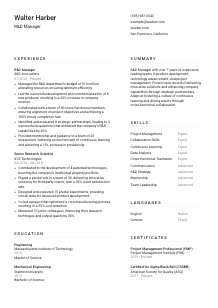
For an R&D Manager, the header should answer practical questions fast. Can this person be contacted easily, do they already present themselves at the right level, and do they meet any stated location or communication requirements without forcing the reader to search for them?
Use your full name in a larger, clean font so it is easy to find at the top of the page. In senior technical leadership hiring, a cluttered header can make the CV feel unfocused before the reader even reaches your product launches, patents, or budget ownership.
Place "R&D Manager" directly below your name when that is the role you are pursuing. It gives immediate context and helps frame the rest of the CV around department leadership, research direction, and commercialization responsibility rather than a purely individual contributor track.
List the phone number and email address you actively monitor. Senior roles often move through several interview rounds with HR, technical leaders, and executives, so missed calls or an unprofessional email address create avoidable friction.
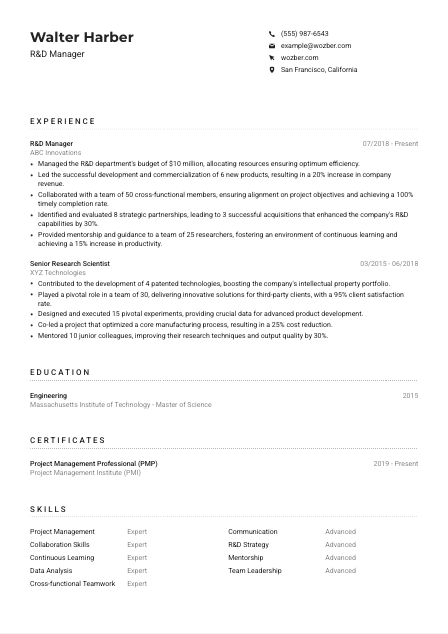
If the employer specifies a location requirement, make it visible in the header. In this example, listing "San Francisco, California" immediately addresses the stated requirement and removes uncertainty about relocation or onsite availability.
A LinkedIn profile or personal site can support your CV when it reinforces your leadership record, publications, patent work, technical portfolio, or speaking history. Keep the content aligned with the CV so the hiring team sees one consistent professional story.
Do not include age, gender, marital status, headshots, or other non-job-related personal data unless a specific market requires it. For an R&D leadership role, the focus should stay on technical scope, team leadership, commercialization outcomes, and strategic contribution.
Treat your personal details like the front page of an executive project brief. Clean contact data, the right title, and any stated location requirement make it easier to move straight into the work that matters.




This section does the heaviest lifting for an R&D Manager. It should show that you have led teams, directed resources, advanced research into deliverables, and influenced business outcomes through product development, process improvement, or strategic partnerships.
Look past the job title and identify the operating themes in the description. Here, the major themes are budget ownership, cross-functional leadership, commercialization, data-driven research, and team development. Those themes should guide which projects, results, and leadership examples you highlight first.
Start with your most recent role and include title, company, and dates. For R&D leadership hiring, progression matters. A move from senior scientist or technical lead into full department management helps the reader track your growth from hands-on research into broader ownership.
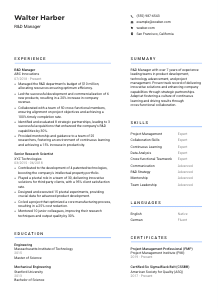
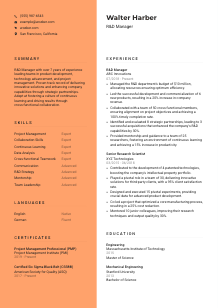
Replace generic task lists with accomplishments tied to innovation and delivery. Good R&D bullets show what you led, what moved forward, and what changed because of your work, whether that was a product launch, a patented technology, a process gain, or a stronger pipeline. The sample CV does this well by linking leadership to six commercialized products and strategic acquisitions rather than simply saying "managed R&D operations."
Quantify with numbers that reflect how this work is judged: budget size, number of products launched, team size, revenue impact, cost reduction, patent count, productivity gains, completion rate, or capability growth. The example's $10 million budget, 20% revenue increase, and 25-person team give a much clearer picture of management scope than vague claims about delivering innovation.
Prioritise work that supports the role you want now. For an R&D Manager position, bullets about experiment design, commercialization, process optimisation, stakeholder alignment, licensing evaluation, or mentoring researchers will usually matter more than unrelated operational tasks. If an older role was more technical, frame it in a way that shows the management foundation it built, such as mentoring, cross-functional delivery, or research outcomes adopted by the business.
Your experience section should make three things easy to see: the scale of research you led, the business value it produced, and the people or partners you directed along the way.
R&D hiring still pays close attention to academic background because the work often rests on scientific method, engineering rigor, and credibility with technical teams. Your education section should confirm that foundation without taking attention away from your leadership record.
Start by checking the educational baseline in the posting. Here, a bachelor's degree in engineering, science, or a related field is required, with a master's or Ph.D. preferred. If you meet that preferred level, make it easy to spot near the top of the section.
List each degree with the qualification, field of study, institution, and, if appropriate for your market or career stage, graduation year. Senior R&D CVs benefit from clean structure because the reader is usually scanning quickly for technical alignment rather than reading academic history in depth.
If you hold a Master's or Ph.D., place it first. For R&D leadership, advanced study can strengthen your credibility in complex product development, experimental design, or technically sophisticated industries. The example's Master of Science in Engineering is a strong match for an employer that prefers graduate-level education.
Most experienced candidates do not need to list coursework, but there are exceptions. If your specialization, thesis, lab research, or capstone project directly connects to the target field, a brief mention can sharpen relevance, especially when moving between adjacent technical sectors.
Honors, research fellowships, publications, or major academic projects can strengthen this section when they relate to innovation, experimentation, or technical leadership. Keep them brief. For an established R&D manager, professional results usually carry more weight than student activities.
Use education to confirm your technical grounding and, where relevant, your advanced specialization. Then let your experience show how that knowledge translated into products, processes, and team leadership.
Certifications are not always mandatory for R&D management, but the right ones can strengthen your case in areas that matter to hiring teams, especially program delivery, process improvement, quality, and operational rigor.
Focus on credentials that complement R&D management responsibilities. Project management, quality systems, process optimisation, product development, regulatory knowledge, or innovation-focused methodologies can all be relevant depending on the industry. The point is to reinforce how you run work, not to collect unrelated badges.
List certifications that add credibility to the exact type of leadership the employer needs. In this example, PMP and Six Sigma Black Belt strengthen the case for structured project execution, resource management, and process improvement, all of which fit an R&D manager's operating scope.
Include the year earned and, if applicable, the current validity period. This matters when the credential reflects current practice in project controls, quality systems, or regulated development environments where outdated certification may raise questions.
As your career develops, look for certifications that align with where your R&D work is heading, whether that means commercialization, agile product development, design controls, advanced analytics, or innovation portfolio management. Ongoing learning carries weight when it clearly supports the kind of programs you lead.
The best certifications on an R&D Manager CV strengthen how you are already leading work, improving processes, and delivering technical programs with structure.
A skills section for this role should read like a compact view of how you lead research, move projects forward, and work across scientific, engineering, and business teams. Keep it focused on capabilities that would matter in active product and technology programs.
Scan the posting for both explicit and implied capabilities. Here, that includes research methodologies, data analysis, project management tools, collaboration, communication, and team leadership. Those terms should shape your list, as long as they reflect experience you can support elsewhere in the CV.
R&D managers are usually hired for a mix of scientific or engineering depth and execution ability. Include hard skills such as data analysis, product development, experimentation, process improvement, or portfolio planning alongside leadership skills like mentoring, cross-functional coordination, and stakeholder communication. The sample skill list works best where it combines management capabilities with R&D-specific strengths such as data analysis and R&D strategy.
Avoid padding this section with broad qualities that could apply to any job. Use concise labels, group overlapping skills where possible, and prioritise the capabilities most relevant to the target role. A focused list helps both ATS optimisation and quick human review, especially when the same terminology appears naturally in your experience bullets.
Your skills section should confirm the tools, methods, and leadership capabilities behind your results, not repeat generic strengths without context.
Language skills matter in R&D when the work involves documentation, presentations, external partners, global teams, or executive updates. List them clearly, but keep the emphasis on languages that affect day-to-day performance in the target role.
If the posting names a required language, place it first and state your level directly. In this case, strong English proficiency is explicitly required, so it should be prominent and unambiguous on the CV.
Order the section by relevance, not personal preference. The hiring team should not need to search for the language that supports meetings, reporting, technical documentation, and cross-functional collaboration.
Additional languages can support international supplier work, research collaboration, licensing discussions, or global product teams. They are useful when they add practical range, as the example's German proficiency might in a multinational R&D environment, but they should remain secondary to core role requirements.
Choose consistent labels such as Native, Fluent, Intermediate, or Basic. These are easy to understand and set realistic expectations for workplace communication, presentations, and technical writing.
If a language supports vendor coordination, cross-border research, or stakeholder communication, that connection can be worth making, especially in internationally active R&D organizations. Keep the point brief and practical.
List language skills in a way that immediately clarifies whether you can handle the communication demands of the role, starting with the language the employer named.
The summary should quickly establish your leadership level, technical context, and record of moving research into business results. For an R&D Manager, it works best when it sounds grounded in delivered outcomes rather than broad claims about innovation.
Pull the main themes from the job description and decide which belong in your opening lines. For this role, leadership tenure, commercialization, cross-functional execution, and strategic partnership thinking all deserve attention if they match your background.
Start with a direct statement that places you in the right lane, such as your years in R&D and your current leadership scope. The sample summary does this effectively by identifying more than 7 years of relevant experience and anchoring the candidate in product development and technology advancement.
Choose strengths that are central to the role and support them with concrete language. Instead of saying you are innovative or collaborative, mention leading product commercialization, developing strategic partnerships, improving department capability, or mentoring technical teams to higher output.
Aim for three to five sentences that read like an executive snapshot, not a career autobiography. Every line should help the reader understand your management scope, technical credibility, and business contribution before they move into the detailed sections below.
A good R&D Manager summary gives a concise answer to one question: what kind of research leader are you, and what have you already moved into real results?
A competitive R&D Manager CV should make your leadership range visible in a few seconds: technical depth, team management, budget responsibility, commercialization results, and the ability to work across functions and external partners. Wozber's free CV builder helps you organise those strengths into an ATS-friendly CV format that stays clear under both human and ATS review.
Before you send it, run the document through an ATS CV scanner and tighten any missing terminology around research methods, product development, data analysis, partnerships, or team leadership that genuinely reflects your background. The finished CV should make it easy to judge whether you can lead R&D programs from investigation through market impact.




