



Use Wozber and land your dream job
Create CV
No registration required
Merging metals, but your CV feels burnt? Craft it anew with this Welder CV example, created with Wozber free CV builder. Learn how to fuse your welding expertise with job requirements, forging a career as strong as the welds you lay!
Welding CVs are reviewed through the lens of production quality. Hiring teams want to see whether you can read drawings accurately, choose the right process, produce clean welds that pass inspection, and keep work moving safely alongside other trades or shop teammates. If your CV stays vague, they cannot tell whether you have handled real fabrication demands or simply held the title.
A tailored CV makes your welding scope easier to understand fast, especially when the employer needs specific processes such as MIG and TIG or wants proof that you can work from blueprints and hold quality standards. Wozber's free CV builder helps organise that experience into an ATS-friendly CV format, so the right terms, certifications, and measurable shop-floor results are easy to surface before a hiring manager decides who moves forward.
For welders, the top of the CV should answer a few practical questions immediately: who you are, what role you are targeting, how to reach you, and whether you meet any location requirement in the posting. Keep this section clean and functional, just like a setup that is ready for inspection.
Use your full name in a clear, readable format so it stands out at the top of the page. Avoid decorative styling. In a trade role, clarity matters more than branding language, and your name should be the easiest item to find when a supervisor or recruiter returns to your CV.
Place "Welder" directly beneath your name if that is the job you are pursuing. If your background is more specialised, you can use a more precise title when it reflects your actual experience, such as MIG Welder, TIG Welder, or Fabrication Welder. For this opening, staying with the broad title works because the posting asks for general welding experience across MIG and TIG processes.
List a working phone number and a professional email address, then check both for typos. Hiring in welding often moves quickly when production needs are urgent, so missed calls or bounced emails can cost you an interview. If you include a website or profile, make sure it supports your application with relevant project history, certifications, or fabrication work.
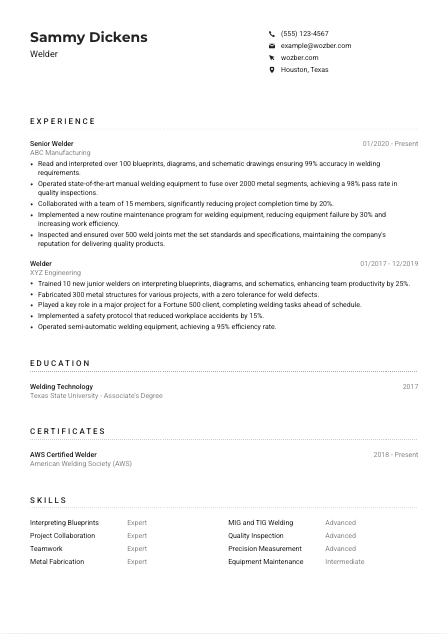
If a posting specifies a city or asks for relocation willingness, include your city and state. Here, "Houston, Texas" directly answers a stated requirement and removes uncertainty about availability. If you are relocating, make that equally clear instead of leaving the employer to guess.
A digital profile is useful when it adds job-specific value. For welders, that could mean a LinkedIn profile with certification details, project photos, metal fabrication work, or safety-related accomplishments. Skip social links that do not strengthen your case for production quality, blueprint work, or shop experience.
This section should confirm the essentials in seconds. When your name, title, contact details, and location are easy to scan, the reader can move straight to the weld processes, inspection results, and shop experience that matter most.




This is the section most likely to decide whether a welder gets a closer look. Employers are not only checking where you worked. They are looking for process knowledge, blueprint reading, output, inspection quality, maintenance habits, and whether you can contribute to production without slowing the crew down.
Before rewriting your bullets, identify the work the employer actually needs done. In this case, the essentials are reading blueprints and schematics, operating manual or semi-automatic equipment, inspecting welds to standard, maintaining equipment, and collaborating with a team. Your experience bullets should address those points directly instead of relying on generic statements like "responsible for welding tasks."
For every job, list your title, employer, and dates in a consistent format. Then use bullet points to show what kind of welding environment you worked in and what results you delivered. A clear structure helps the reader trace your progression from welder to senior welder, team lead responsibilities, or more complex fabrication work.
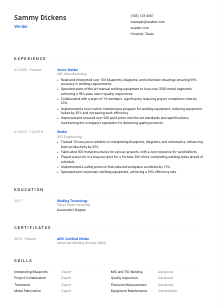
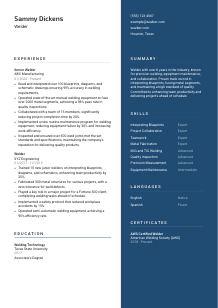
Focus each bullet on a task plus a result. Strong examples for this trade include interpreting blueprints accurately, fabricating metal assemblies to spec, improving weld pass rates, reducing rework, or keeping projects on schedule. The sample CV does this well with a bullet about reading more than 100 blueprints with 99% accuracy, because it ties a core requirement to a measurable outcome.
Quantify the work in ways that make sense for welding. Good metrics include number of welds completed, pass rates, defect reduction, inspection success, project turnaround, safety improvement, or equipment uptime. For example, a 98% inspection pass rate or a 30% drop in equipment failure says far more than "performed quality welding."
Not every accomplishment belongs here. Prioritise achievements tied to welding processes, metal fabrication, reading drawings, precision measurement, maintenance, safety, or teamwork that improved output. Collaboration matters in this field, but connect it to something concrete, such as shortening project completion time, coordinating with fitters, or helping a crew hit delivery dates.
Your experience section should leave little doubt about your production value. When the bullets show process expertise, quality control, and measurable shop results, employers can picture you on the floor, on the line, or at the bench doing the work to standard.
Education carries a straightforward role in most welding CVs. It confirms that you meet baseline requirements and, when relevant, shows formal training in welding technology, fabrication, safety, or blueprint reading. Keep it clean, factual, and aligned with the level of schooling the posting asks for.
Start with the credential the employer specifically requests. Here, the requirement is a high school diploma or equivalent certification, so that baseline needs to be visible on your CV. If you also have trade school or an associate degree in welding, include that as added value rather than assuming it replaces the basic requirement.
List the school, credential, field of study, and graduation year or date. This section does not need long explanations unless your training is unusually specialised. Straightforward formatting works best because it lets the reader quickly confirm that you meet the educational standard.
If you completed an associate degree or technical program in Welding Technology, Welding Engineering Technology, or a related field, include it clearly. The sample CV's Associate's Degree in Welding Technology strengthens the profile because it supports hands-on experience with formal training in the trade.
You do not need to list classes by default, but they can help if they reinforce the role's requirements. Blueprint reading, metallurgy, fabrication, welding safety, or process-specific training in MIG and TIG can be worth mentioning when you are early in your career or when the posting emphasizes those capabilities.
Honors, student fabrication projects, or leadership in a technical program can add value if they relate to welding work, shop discipline, or safety. Leave them out if they distract from stronger professional experience. For most experienced welders, a concise education section is enough.
Education does not need to carry the whole CV for a welder, but it should remove any doubt about your foundation. Once that is clear, the rest of the CV can focus on process skill, inspection quality, and hands-on production results.
Certifications matter in welding because they speak directly to code awareness, process competence, and employability on real jobs. If a posting asks for a valid welding certification, do not bury it. Place it where the employer can confirm it quickly and see whether it is current.
When a posting names AWS Certified Welder or an equivalent credential, list that certification prominently with the issuing body. This opening does exactly that, so an active AWS certification should be easy to find on your CV. If you hold multiple welding certifications, put the most relevant one first.
Use this section for certifications tied to welding processes, safety, inspection, or code-based work. A shorter list of relevant credentials is stronger than a long list of unrelated training. For this type of role, welding certifications carry more weight than general professional development items.
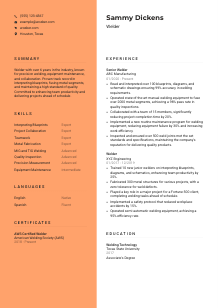
Include the issue date and, when applicable, renewal or active status. That matters for certifications employers may need to verify before assigning work. The sample CV handles this well by showing the AWS Certified Welder credential as active from 2018 to present.
Welders who keep certifications current show reliability and professional discipline. If you have added process-specific qualifications, safety training, or code-related credentials over time, include the ones that support the kind of shop, field, or fabrication work you are targeting. It shows that your skills are current, not dated.
For many welding roles, certification is not a bonus item. It is part of basic qualification. When your credentials are current, relevant, and easy to verify, the employer can move on to the quality and scope of your work with confidence.
A welding skills section works best when it mirrors the language of the work. That means listing actual welding processes, fabrication capabilities, inspection strengths, and technical competencies rather than broad traits that could belong on any CV. Keep it targeted and grounded in the way welding work is assigned and reviewed.
Start with the terms used in the posting. For this role, that includes MIG and TIG welding, blueprint interpretation, schematic reading, weld inspection, equipment operation, maintenance, and teamwork. These are the skills the employer is scanning for first, both in ATS screening and human review.
Only list skills you can back up with real examples in your work history or certifications. If you claim expertise in TIG welding or quality inspection, your experience section should show where you used those skills, what materials or projects you worked on, and what standards or outcomes you met. The sample CV does this well by pairing "MIG and TIG Welding" with strong inspection and blueprint-related achievements.
Group your strongest, most relevant skills instead of filling the section with every tool or soft skill you have ever used. A concise list featuring welding processes, metal fabrication, blueprint interpretation, precision measurement, equipment maintenance, and team collaboration gives a clearer picture of job readiness than a cluttered inventory.
This section should reinforce the technical story already visible in your experience. When the skills match the posting and connect to your actual shop performance, the employer gets a much clearer read on where you can contribute from day one.
Language ability matters in welding when instructions, safety procedures, work orders, and inspection notes need to be understood without confusion. Keep this section practical. Lead with the language required for the job, then include any others that genuinely add value in a team, shop, or field setting.
If the job asks for fluent English speaking and writing, list English at the top with an honest proficiency level. In welding environments, language affects safety, blueprint interpretation, reporting, and coordination with supervisors or team members, so this requirement should be easy to spot.
Additional languages can be useful in diverse crews, manufacturing plants, and field teams, especially when they improve day-to-day coordination. If you speak another language well enough to support work communication, include it. The sample CV's Spanish entry adds practical value because it suggests broader team communication capability.
Choose straightforward levels such as Native, Fluent, Intermediate, or Basic. Avoid vague descriptions. Employers need a realistic sense of how well you can handle spoken instructions, written documentation, and routine communication on the floor or at the site.
Even when only English is required, other languages may still support collaboration across crews, subcontractors, or mixed-language production teams. Include them when they are genuinely usable in a welding environment, not simply because you studied them years ago.
Do not overstate proficiency. A language section helps only when it reflects how you can actually communicate about safety, equipment, job sequencing, or quality issues. Accuracy here matters just as much as accuracy in the technical parts of your CV.
For welders, language ability is most valuable when it supports safe work, clear instructions, and steady teamwork. Keep this section honest and practical, and let it strengthen the overall picture of how you operate in a real work environment.
Your summary should quickly tell the employer what kind of welder you are, how much relevant experience you bring, and which parts of the work you handle well. Keep it short, but make every line useful. This is where you connect process knowledge, quality standards, and production value in a few sentences.
Read the posting closely, then identify the capabilities it emphasizes most. If the role is centered on MIG and TIG work, blueprint interpretation, equipment operation, and inspection quality, those ideas should shape your opening lines. The summary should sound like a welder applying for this kind of work, not a generic tradesperson profile.
Begin with a direct introduction such as "Welder with 6+ years of experience" or a similarly accurate line. That immediately sets your level. The sample CV does this effectively, then follows with strengths in precision welding, equipment maintenance, and collaboration, which helps frame the rest of the CV.
Use the next sentence or two to mention the technical strengths most relevant to the target job. For this posting, that includes interpreting blueprints, working with MIG and TIG processes, fusing metal segments accurately, and maintaining quality standards. Choose the requirements you can genuinely support elsewhere in the CV.
Aim for three to five lines with no filler. Skip broad statements about being hardworking or passionate unless you tie them to something concrete. A summary earns its place when it quickly communicates trade experience, process capability, and the kind of results an employer can expect from your welding work.
A welder's summary should make the reader expect solid process knowledge, clean execution, and dependable output. If those few lines point clearly to blueprint-driven work, quality inspection, and proven production results, the rest of the CV has the right setup.
A well-tailored welder CV shows more than job titles. It shows process experience, blueprint accuracy, inspection results, certification status, and the kind of production support you can bring to a crew or fabrication shop.
Use Wozber's free CV builder to shape that experience into an ATS-compliant CV, refine the language with the ATS CV scanner, and keep the format clean enough for both software and human review. The finished CV should make one thing easy to judge: whether you can step into the welding work and meet the required standard.




