



Use Wozber and land your dream job
Create CV
No registration required
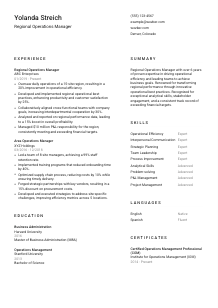
Balancing operations over state lines but your CV feels stuck at a regional checkpoint? Check out this Regional Operations Manager CV example, created with Wozber free CV builder. It shows how simple it is to align your cross-state stride with job criteria, propelling your career across all regional horizons!
Regional operations work is judged in results spread across multiple sites. Hiring teams want to see how you keep standards consistent, improve efficiency, support site leaders, and protect financial performance when conditions vary from location to location. Your CV should make that operating scope visible instead of reading like a generic management profile.
When a Regional Operations Manager CV is tailored well, the first scan quickly shows whether you have handled the same mix of regional oversight, process improvement, and P&L accountability the role calls for. Wozber's free CV builder helps you shape that story into an ATS-compliant CV by matching role language and keeping the structure easy to parse, so the reader can immediately connect your background to regional leadership demands.
This section is simple, but for a regional leadership job it still carries useful context. Clear contact details, the right target title, and any location detail the employer explicitly asks for remove friction before the reader gets to your operating record.
Use your full name in a clean, readable format that stands out from the rest of the page. Regional operations roles usually move through recruiters, senior leaders, and HR systems, so presentation should feel polished and straightforward from the first line.
Place "Regional Operations Manager" directly under your name if that is the role you are pursuing. This keeps your CV aligned with the opening and helps position you as a candidate with regional oversight experience rather than broader but less relevant operations leadership.
Include a reliable phone number and a professional email address. If you add a website or LinkedIn profile, make sure it supports the same executive-level operations story found in your CV, with consistent titles, dates, and scope.
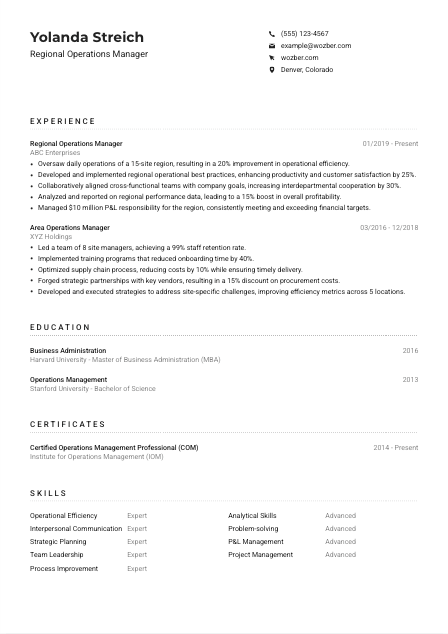
Some openings make location a direct requirement, as this one does with Denver, Colorado. In that case, list your city and state clearly. It answers an immediate screening question without taking up unnecessary space in other sections.
A professional profile can help when it shows regional scope, multi-site leadership, or operational achievements in more detail. Wozber's free CV builder makes it easy to place those links neatly within an ATS-friendly CV format, so they support the application instead of cluttering it.
Your personal details should confirm that you are accessible, professionally presented, and aligned with any stated logistics for the role. For a Regional Operations Manager, that means removing basic doubts early so the focus stays on your operational record.




This is the section that carries the most weight. For regional operations leadership, hiring teams look for scale, measurable improvement, team management across sites, and financial control, not just a list of responsibilities.
Before editing bullets, break the job description into the operating themes it emphasizes: multi-site oversight, process improvement, cross-functional coordination, performance analysis, and P&L ownership. Then choose examples from your own work that map cleanly to those themes. In the sample CV, each major bullet lines up with one of those priorities rather than describing day-to-day activity in general terms.
List positions in reverse chronological order and make the progression easy to follow. Titles such as Area Operations Manager, Regional Operations Manager, or similar leadership roles help the reader understand your growth in scope, team size, and business responsibility. Keep company name, title, and dates easy to scan.
Each bullet should show what you improved, led, reduced, increased, or stabilized. For this profession, strong bullets often reference site count, team leadership, service performance, process rollout, cost control, or profitability. "Oversaw daily operations" is a start, but "oversaw daily operations across 15 sites and improved operational efficiency by 20%" gives the reader a real picture of scale and result.
Metrics matter here because regional roles are accountable for throughput, productivity, retention, customer satisfaction, cost reduction, budget performance, and profit. The sample CV uses percentages and a $10 million P&L figure well because those numbers match how operations leaders are actually evaluated. Use your own metrics wherever possible, and keep them credible and tied to business outcomes.
Trim details that belong to a frontline supervisor CV and prioritise evidence of broader management judgment. Focus on items like implementing best practices across locations, aligning site managers, responding to performance trends, and making corrective decisions that changed results. Wozber can help you tighten this section around the job's language so your experience reads like a direct match for the opening.
By the end of your experience section, the reader should understand the size of the region you managed, the business improvements you delivered, and the financial accountability you carried. That is the core case for moving you forward.
Education is usually a screening checkpoint for this role, not the centre of the CV. Still, when the posting asks for a bachelor's degree in business, operations, or a related field, this section needs to answer that requirement clearly and without extra digging.
If the role calls for a bachelor's degree, make sure that credential is easy to find. A degree in Operations Management, Business, or a related field should be listed with complete details so the requirement is satisfied immediately. In the sample, the Bachelor of Science in Operations Management does that directly.
List degree, field of study, school, and graduation year in a consistent order. This is especially useful in ATS-friendly CV formats, where clear labeling helps both systems and human reviewers read the section quickly.
When you have multiple degrees, the one that best supports the job should stand out. For this kind of opening, a bachelor's in a directly related field carries screening value, while an MBA or other advanced degree adds leadership depth and commercial credibility.
Senior candidates usually do not need coursework or campus activities unless they directly support the target role. If an academic distinction connects to supply chain, finance, analytics, or operational strategy, it may be worth including. Otherwise, keep the section focused and brief.
Professional courses, executive programs, or recent training in process improvement, financial management, or operations strategy can reinforce that your knowledge has kept pace with the scale of the work. Use this selectively, especially if your formal education is older but your development is current.
Education should quickly show that you meet the stated academic baseline and, where relevant, that your training supports operational and financial leadership. After that, let your experience do the heavier lifting.
Certifications are not always required for regional operations roles, but the right one can strengthen your profile. They work best when they support the type of leadership, process discipline, or operational improvement the job emphasizes.
Choose credentials that reinforce skills such as process improvement, operations management, lean practices, quality systems, or financial oversight. A certification like Certified Operations Management Professional fits naturally because it supports the core work of running and improving regional performance.
Do not turn this section into an archive of every course you've completed. Include the certifications that add weight to your candidacy for a regional management seat, especially those that relate to operational excellence, multi-site management, or continuous improvement.
Add the issuing organisation and the date earned, or the active validity period if it applies. That extra detail helps the credential read as current and legitimate, especially in fields where employers value ongoing standards and formal training.
Operations leaders are expected to keep refining how they manage efficiency, cost, and execution. If you have maintained a certification or pursued updated training, include it to show that your methods are current and your development has not stalled.
Used well, certifications support the picture already built by your experience. They should reinforce your command of operational systems and improvement work, not compete with the achievements that matter most.
A Regional Operations Manager skills section should read like the operating toolkit behind your results. It needs to reflect how you lead sites, interpret performance, improve processes, and manage the business side of the region.
Start with the capabilities the employer names explicitly, such as analytical thinking, decision-making, problem-solving, communication, and operational efficiency. Mirroring this wording where it honestly matches your background improves alignment and helps ATS screening connect your CV to the role.
Regional operations roles sit at the intersection of people management and business performance. Include a mix of skills such as P&L management, process improvement, strategic planning, team leadership, and interpersonal communication. The sample CV handles this balance well by combining financial, operational, and leadership strengths instead of leaning on one category alone.
Choose skills that show up in your experience section and matter in regional operations decisions. Wozber's ATS-friendly CV format can help you keep the list tight and readable, which is better than adding every possible management term. A shorter, accurate list is more credible than a broad one with little support elsewhere on the page.
This section should echo the capabilities already proven in your work history. For this role, that means showing you can lead people, improve systems, read performance data, and manage financial outcomes across a region.
Language ability matters differently depending on the region, workforce, and reporting environment. For operations leadership, list languages in a practical way and tie them to actual communication demands rather than treating them as decorative extras.
If the posting asks for English proficiency or, as in this case, the ability to read complex texts in English, make that easy to confirm. Listing English with an accurate proficiency level handles the requirement cleanly.
Additional language ability can be valuable when you manage diverse teams, vendor relationships, or customer-facing operations across different communities. Spanish, for example, may strengthen communication in some regional environments, but include extra languages because they are genuinely useful, not just because they look impressive.
Use clear labels such as Native, Fluent, Intermediate, or Basic. Avoid overstating your level. In operations roles, language skill often affects training, escalation handling, and manager communication, so accuracy matters.
Some regional roles have a concentrated footprint, while others interact with broader markets or multilingual teams. Let the language section reflect the practical reach of the role. Keep it relevant to how communication happens in the business.
If a second language helps you coach managers, navigate local issues, or communicate with employees and partners more effectively, it belongs here. If it has no connection to the work, it can stay off the CV. Relevance matters more than variety.
Your languages section should confirm required proficiency and, when applicable, show added communication range that supports regional leadership. Keep it factual and tied to how the role is actually performed.
The summary should quickly establish the level at which you operate. For a Regional Operations Manager, that means signaling multi-site leadership, measurable operational improvement, and business accountability in a few well-chosen lines.
Start by identifying the themes that define the opening: operational efficiency, leadership across sites, performance analysis, cross-functional coordination, and budget responsibility. Those themes should shape the language of your summary so the top of the CV already sounds relevant.
Lead with a clear statement about your years in operations management and the scope of work you handle. The sample summary works because it immediately anchors the candidate in regional operations and efficiency improvement, rather than beginning with vague leadership language.
Include specific areas where you have delivered results, such as improving productivity, leading site managers, strengthening customer satisfaction, or exceeding financial targets. Keep these points broad enough to fit a summary, but concrete enough to distinguish you from a general operations candidate.
Aim for 3 to 5 lines that read with confidence and precision. This is not the place for generic adjectives or mission statements. A concise summary should tell the reader what kind of region you can run, what you improve, and what level of accountability you are used to carrying.
A well-written summary gives the hiring team a fast, accurate picture of your regional leadership range. It should prepare them to read the rest of the CV through the lens of scale, improvement, and financial responsibility.
A Regional Operations Manager CV works when it makes your operating scope easy to see: how many sites you supported, what you improved, how you led managers, and what financial outcomes you owned. Every section should reinforce that picture with clear language and relevant detail.
Use Wozber to turn that experience into a tailored, ATS-friendly CV that matches the role's terminology and keeps your strongest operational wins easy to find. The final read should make one thing clear: you can run a region, improve its performance, and manage the business behind it.




