



Use Wozber and land your dream job
Create CV
No registration required
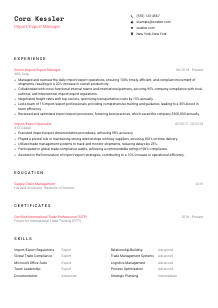
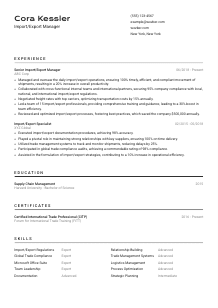
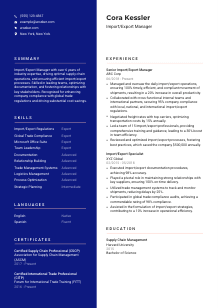
Juggling goods and global routes, but your CV feels stuck in customs? Freight no more, as this Import/Export Manager CV example, created with Wozber free CV builder, shows how to present your cross-border expertise in line with job criteria, ensuring your career journey is as smooth as an uninterrupted shipment!
Import/export managers work where cost, timing, and compliance meet. A CV for this profession needs to show that you can keep shipments moving, control documentation quality, negotiate with carriers and partners, and prevent customs or regulatory issues before they disrupt the supply chain.
When that experience is tailored well, hiring teams can quickly separate broad logistics experience from actual import/export leadership. Wozber's free CV builder helps you align your wording with the posting, maintain an ATS-friendly CV format, and make your trade compliance, freight negotiation, and team management background easier to recognize early.
This section is short, but it still carries practical information employers use right away. For an import/export manager, clear contact details and location can remove basic friction before anyone even gets to your shipment volumes, compliance work, or carrier negotiations.
Use your full name in a clean, readable font that stands out slightly from the rest of the page. Hiring managers reviewing logistics and trade CVs move fast, so your header should make identification immediate and professional.
Place the role title directly under your name if it matches your background, such as "Import/Export Manager." That simple alignment helps frame the rest of the CV around trade operations, customs documentation, and cross-border coordination instead of more general supply chain work.
Include one reliable phone number and a professional email address. Add LinkedIn or a relevant professional profile only if it supports your background in global trade, logistics, vendor management, or compliance. Accuracy matters here. A typo can cost you an interview.
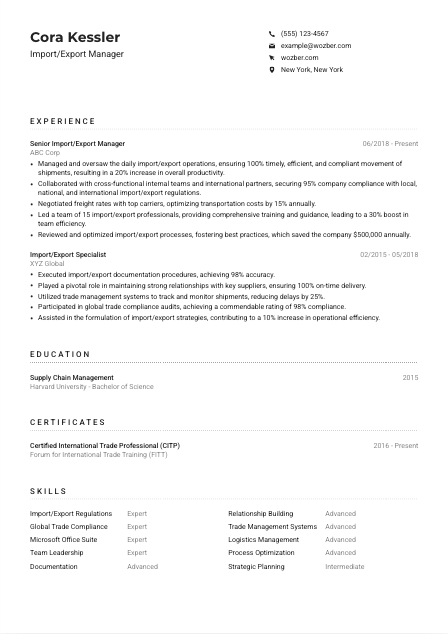
Some employers need a candidate already based in a specific market because the role involves local team leadership, office presence, or coordination with regional carriers and brokers. In the example, listing New York, New York directly supports the stated location requirement. If relocation is relevant, make that clear elsewhere rather than leaving the employer guessing.
Do not include age, marital status, photo, or unrelated personal details. For this role, the header should stay focused on professional identity and availability, not background information that does nothing to strengthen your case for managing international shipments and compliance workflows.
Your contact section should make it easy to reach you and confirm any practical requirement, such as location, without distracting from the operational and compliance strengths the rest of the CV will carry.




This is the section most hiring teams will study first. Import/export managers are usually hired on their ability to keep freight moving, maintain documentation accuracy, control costs, and lead people through a compliance-heavy process without delays or surprises.
Read the posting closely and mark the work that appears central to the role. Here, the emphasis falls on daily import/export operations, regulatory compliance, freight rate negotiation, team leadership, and process improvement. Those themes should shape which achievements you feature and how you phrase them.
List your most recent position first, followed by earlier roles. Include job title, employer, and dates in a format that is easy to scan. For import/export work, career progression matters because it shows movement from execution and documentation into oversight, vendor negotiation, and department leadership.
Each bullet should show what you handled and what changed because of your work. Instead of writing only that you managed shipments, show the result. The example does this well with lines like managing daily import/export operations while improving productivity, or leading a team while increasing efficiency. That kind of phrasing tells employers you owned the process and improved it.
Metrics are especially persuasive in this field because performance is tracked closely. Use figures tied to on-time movement, documentation accuracy, compliance rates, freight savings, delay reduction, productivity, audit results, or annual cost reduction. The sample's 15% transportation savings and $500,000 in process-related savings are strong examples because they connect directly to business performance.
Prioritise experience tied to import/export documentation, customs or regulatory knowledge, transportation management, supplier and carrier coordination, and team oversight. If part of your background is broader logistics, keep the bullets that support cross-border operations and trim those that do not add much to this target role.
By the end of the experience section, an employer should be able to tell that you can run day-to-day import/export activity, protect compliance, improve cost performance, and lead the people and partners involved in moving freight across borders.
Education will rarely outweigh solid operational experience in this field, but it still matters when the job calls for a specific academic foundation. For import/export management, degrees tied to business, supply chain, logistics, or related operations show you have formal grounding in how goods, cost, and compliance move together.
If the posting asks for a bachelor's degree in Business, Supply Chain Management, or a related field, make that easy to spot. The example's Bachelor of Science in Supply Chain Management aligns cleanly with the requirement and needs no extra interpretation from the employer.
List degree, field of study, school, and graduation year in a consistent order. Hiring teams often scan this section quickly, so clear formatting helps them confirm you meet the baseline requirement without slowing down on minor details.
Write the degree as it was awarded and include the specific field when it strengthens alignment. "Bachelor of Science in Supply Chain Management" says far more than a shortened or vague version because it ties directly to trade operations, logistics planning, and process coordination.
If you are early in your career or your degree title is broad, selected coursework can support your case. Focus on subjects such as global logistics, international business, customs compliance, transportation, procurement, or supply chain analytics. If you already have 5+ years of direct experience, this is usually optional.
Honors, projects, or student leadership are worth adding only when they connect to international trade, operations, analytics, or supply chain execution. Keep this section lean if your professional history already carries the heavier proof.
This section should confirm the required academic baseline and, when relevant, reinforce your understanding of supply chain and trade operations without competing with your experience section for attention.
Certifications can strengthen an import/export manager CV because they point to current knowledge in compliance, trade practice, and supply chain operations. They are especially useful when the role places weight on regulation, documentation control, or process improvement across international shipments.
Even when certifications are not required, list the ones that support the actual work. Credentials such as CITP or CSCP fit well because they reinforce knowledge in global trade, supply chain operations, and professional standards relevant to import/export leadership.
Include certifications that deepen your profile in customs compliance, logistics, trade operations, or process management. A short list of relevant credentials works better than padding the section with unrelated courses. The goal is to strengthen your case for managing regulated cross-border movement and improving operations.
Add issuance or active dates when they help show the certification is current. That is useful in trade-related work, where regulations, documentation rules, and best practices change over time and employers want current knowledge, not stale credentials.
If your role involves changing regulations, shifting carrier environments, or broader supply chain responsibility, continued certification or formal learning shows professional upkeep. This matters more in import/export than in many fields because compliance gaps can create immediate operational and financial risk.
Use this section to show continued investment in trade knowledge and operational credibility, especially in areas that support compliance, cross-border execution, and broader supply chain judgment.
An import/export manager needs a mix of technical knowledge and management ability. The skills section should quickly tell an employer whether you understand trade regulations, documentation flow, transportation cost control, and the people side of coordinating suppliers, carriers, brokers, and internal teams.
Start with the employer's language. In this case, that includes import/export regulations, global trade compliance, communication, negotiation, interpersonal skills, trade management systems, and Microsoft Office. These are not filler terms. They point to the daily decisions and tools the role depends on.
Add the skills you can support with real examples in your work history. If you list freight negotiation, there should be a bullet showing cost savings. If you include trade management systems, your experience should show shipment tracking, delay reduction, or documentation control. The sample handles this well by pairing systems knowledge with measurable operational gains.
Keep the list readable and focused. You can group skills mentally or visually around compliance, operations, systems, and leadership. For this profession, a balanced section often includes trade compliance, documentation, logistics management, process optimisation, relationship building, and team leadership, rather than leaning too heavily on generic soft skills.
After a quick scan, employers should be able to see that you bring the right mix of regulatory knowledge, logistics execution, systems familiarity, and leadership to run an import/export function effectively.
Language proficiency can matter more in import/export than in many operations roles because communication often crosses time zones, vendors, carriers, and customs-related documentation. This section should stay factual and reflect the language demands of the role you are targeting.
If the posting specifies English fluency, list English prominently with an accurate proficiency level. That makes it easy for the employer to confirm you can handle internal communication, documentation, negotiation, and partner coordination in the working language of the role.
List each language with a straightforward level such as native, fluent, professional, or conversational. In trade environments, vague language claims are less useful than a clear indication of whether you can negotiate, write, and coordinate shipment-related communication effectively.
Extra language ability can strengthen your profile when you deal with overseas suppliers, customers, freight partners, or regional operations. Spanish in the sample is a good supporting asset because it can help in relationship management and operational communication, even though the posted requirement focused on English.
Do not overstate proficiency. In import/export roles, language ability may surface quickly in vendor calls, email communication, documentation review, or issue resolution. It is better to present an honest level than to create a mismatch once interviews begin.
For positions centered on international coordination, multilingual ability can be a genuine advantage. For others, English may be enough. Tailor the section based on the actual partner network, regions served, and communication demands suggested by the posting.
A clear languages section shows whether you can communicate confidently in the operating environment of the role and whether you bring added range for international coordination.
Your summary should quickly establish your level, your area of trade expertise, and the kind of results you deliver. For an import/export manager, that usually means combining years of experience with a short view into compliance, cost control, process improvement, and team leadership.
Before writing the summary, identify the two or three themes carrying the most weight in the posting. Here, those include operational oversight, compliance with import/export regulations, freight cost optimisation, and team leadership. Build your opening around those priorities rather than writing a generic logistics profile.
Lead with your title or functional identity, then include your years of experience. A line such as "Import/Export Manager with 6+ years of experience in global trade operations" gives immediate context and positions you within the right level of responsibility.
Choose two or three strengths and connect them to outcomes. For example, mention global trade compliance, transportation cost reduction, documentation control, or leading import/export teams. The sample summary works because it ties expertise to outcomes like cost savings and more efficient processes instead of listing traits in isolation.
Aim for a short paragraph of 3 to 5 lines. Every phrase should pull weight. Remove vague claims and focus on what you actually manage, improve, or protect, whether that is shipment flow, compliance performance, partner coordination, or department efficiency.
Your summary should give the reader a fast, credible picture of you as someone who can lead import/export operations, manage compliance risk, and improve trade performance from day one.
You now have a clear structure for showing what matters most in import/export hiring: compliant shipment movement, freight and cost control, documentation accuracy, partner coordination, and team leadership.
Use Wozber's free CV builder to shape those details into an ATS-compliant CV, refine wording with role-specific terminology, and check alignment with the posting through its ATS CV scanner. The finished CV should make it easy to judge your ability to run cross-border operations with confidence.




