



Use Wozber and land your dream job
Create CV
No registration required
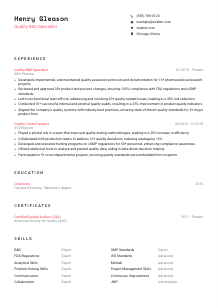
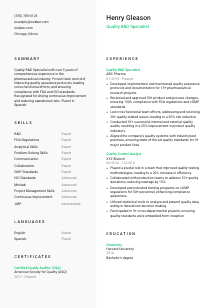
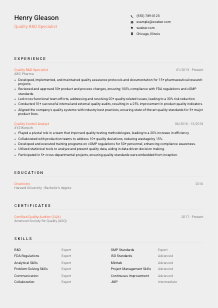
Innovating with precision, but your CV lacks clarity? Check out this Quality R&D Specialist CV example, created with Wozber free CV builder. It shows how to bring together your exacting research and development skills with job expectations, perfecting your career pathway from prototype to production!
Quality R&D work sits where product development, compliance, and risk control meet. Hiring teams want to see whether you can support research without letting documentation drift, process changes slip past review, or quality issues grow into audit findings. Your CV needs to make that operating discipline visible, not just list lab or quality titles.
A tailored CV helps separate candidates who only worked near regulated development from those who actively managed change control, CAPA follow-through, audit readiness, and quality documentation. Wozber's free CV builder helps you align that experience into an ATS-compliant CV so the first scan shows the right mix of regulatory knowledge, analytical judgment, and cross-functional execution.
In regulated R&D hiring, basic details matter more than many candidates assume. If your contact information is incomplete, your title is vague, or your location misses a stated requirement, you create friction before anyone reaches your work on audits, quality systems, or process changes.
Use your full name as the clearest identifier on the page. A clean header with readable formatting is enough. You do not need design flourishes. For a Quality R&D Specialist, the priority is professional presentation that feels as controlled as the documentation you would maintain on the job.
If the role is Quality R&D Specialist, use that title in your header when it accurately reflects your background. This immediately places you in the right hiring lane, especially when recruiters are sorting among quality assurance, quality control, validation, and broader R&D profiles.
List one phone number and one professional email address, then verify both. Quality roles are built on accuracy, and errors in basic information can undercut the reliability your CV is supposed to project.
Some openings include a location requirement or a strong local preference. In the example posting, Chicago, Illinois is explicitly requested, so listing Chicago, Illinois in the header removes an avoidable question about eligibility and logistics.
Include a LinkedIn profile, portfolio, or professional site only if it supports your candidacy. For this field, useful links might point to publications, technical project work, or a complete professional profile that reinforces your experience in regulated environments.
Do not add age, marital status, gender, or other personal identifiers unless a local hiring norm specifically requires them. Keep the section focused on employer-useful information that supports contact, identification, and stated eligibility.
Your personal details should confirm that you are reachable, professionally presented, and able to meet any stated requirement such as location. Then the reader can move straight to your quality and R&D experience.




For a Quality R&D Specialist, experience is where hiring teams look for practical command of regulated workflows. They want to see how you handled quality protocols, change reviews, audits, deviations, process improvement, and cross-functional issues in a pharmaceutical, biotech, or medical device setting.
Start by marking the responsibilities and requirements that define the role. Here, that includes quality assurance protocols, documentation control, product and process change review, audit activity, FDA and cGMP compliance, statistical analysis, and collaboration across functions. Your bullets should answer those needs directly with work you have actually done.
List your jobs in reverse chronological order and make the basics easy to scan. For each position, include title, company, and dates. In this profession, progression from analyst or QC roles into broader quality and R&D responsibility can tell an important story about scope and trust.
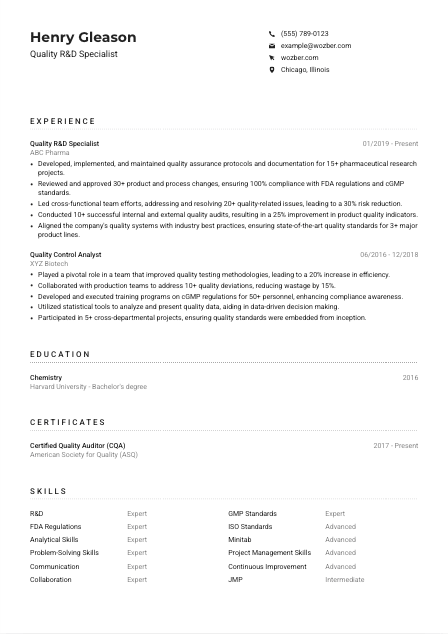
Focus each bullet on what you improved, reviewed, implemented, resolved, or maintained. Quality hiring managers respond to concrete contributions such as tightening protocol compliance, reducing risk, improving quality indicators, or strengthening audit performance. The sample CV does this well by tying protocol development, change approvals, and issue resolution to project counts and measurable results.
Use metrics that are native to quality and R&D work: number of projects supported, change controls reviewed, audits completed, deviations resolved, risk reduction achieved, training delivered, or efficiency gains from revised testing methods. Figures like "15+ research projects," "30+ product and process changes," or "25% improvement in product quality indicators" quickly establish scale and impact.
Prioritise work that shows regulatory knowledge, documentation discipline, analytical capability, and cross-functional problem solving. If earlier experience is less relevant, keep it brief or trim it. Space on the page should go to the achievements that show you can operate inside controlled development and quality systems.
The strongest experience sections show that you did more than participate in quality activities. They show that you improved controls, supported compliant development, and handled the kind of issues that surface in audits, change management, and continuous improvement.
This role usually starts with a scientific foundation. A degree in chemistry, biology, engineering, or another related discipline tells employers you have the technical grounding to work with regulated development data, quality systems, and product or process review.
If the posting asks for a bachelor's degree in a scientific discipline, make that information easy to find. Put the degree type and field in standard wording so there is no ambiguity for a recruiter or ATS.
List school, degree, field of study, and graduation date or year in a clean structure. Education sections in regulated-industry CVs do not need extra design. They need to be easy to parse and easy to verify.
When your degree aligns directly with the posting, let that connection stand out. In the sample CV, a Bachelor's degree in Chemistry maps neatly to the employer's preference for a scientific discipline and supports the candidate's move into pharmaceutical quality work.
Relevant courses can help if you are early in your career or if the role leans heavily on a specialised area such as analytical chemistry, microbiology, biostatistics, validation, or quality systems. If you already have several years of industry experience, coursework usually matters less than your audit, compliance, and process results.
Honors, research projects, publications, or lab-intensive capstone work can be worth mentioning when they connect to regulated product development, documentation, or analytical problem solving. Keep only the items that support your current target role.
Your education should confirm the scientific base the role requires and stay proportionate to your career stage. Once that foundation is clear, the CV can return to the regulated industry work that carries the most weight.
Certifications are not always mandatory for Quality R&D Specialist roles, but they can strengthen your profile when they speak directly to audits, compliance systems, risk management, or process quality. In regulated environments, a relevant credential can support the depth already shown in your experience.
Look for credentials that connect to the responsibilities in the posting. For this field, that often means certifications tied to auditing, quality systems, GMP environments, or continuous improvement. A credential such as ASQ's Certified Quality Auditor is especially useful when audit participation and corrective actions are part of the role.
A short list of well-chosen certifications is more persuasive than a long list of loosely related courses. Hiring teams are more interested in whether the credential supports work in compliance, CAPA, audits, or regulated quality operations than in how many badges appear on the page.
Include the year earned, renewal date, or active date range when it adds context. This helps readers understand whether the certification is current and whether you have maintained involvement in professional standards over time.
If you are moving deeper into pharmaceutical, biotech, or medical device quality, consider certifications that strengthen your credibility in audits, validation, supplier quality, or quality engineering. Ongoing development matters most when it clearly supports the work you want next.
Certifications work best when they reinforce the regulated quality experience already shown elsewhere on the CV. They should add professional depth, not distract from your hands-on record in R&D and compliance.
The skills section should read like a concise map of how you operate in a quality-driven development environment. That means combining technical knowledge, regulatory fluency, analytical tools, and the collaboration skills needed to work across R&D, manufacturing, quality, and operations.
Scan the job description for both stated and implied capabilities. Here, the obvious requirements include FDA regulations, cGMP standards, ISO knowledge, analytical problem solving, Minitab or JMP, communication, collaboration, and project management. Those are the skills to prioritise if they reflect your actual background.
Do not list only soft skills or only technical terms. A Quality R&D Specialist usually needs both. Pair regulatory and analytical strengths such as GMP, ISO, statistical tools, root-cause analysis, and quality documentation with practical team skills like cross-functional communication and project coordination.
Choose skills that hiring teams expect to see in this work and name them in standard language. The sample CV handles this well by pairing regulatory knowledge with tools and operating strengths, including FDA Regulations, GMP Standards, ISO Standards, Minitab, JMP, Continuous Improvement, and Collaboration. That combination gives a clearer picture than a crowded list of generic abilities.
Your skills should echo the work shown in experience and the language used in the posting. When the section is focused, it reinforces that you can manage regulated quality work rather than simply talk about it.
Language ability matters in quality roles because procedures, deviations, audit responses, and cross-functional communication all depend on precision. For many Quality R&D Specialist openings, strong written and spoken English is a baseline requirement because so much of the work lives in documentation and review.
If the posting specifies English proficiency, place English first and label your level clearly. That is especially important for jobs involving SOPs, change control documentation, audit findings, and regulatory correspondence.
List required or high-value languages first, then add others that may support collaboration across sites, suppliers, or global teams. Keep the ordering intentional rather than alphabetical if one language is clearly more important for the role.
Extra languages can strengthen your profile, particularly in companies with international quality operations, technical transfers, or multilingual teams. In the sample CV, Spanish adds useful range without distracting from English as the required language.
Choose clear descriptors such as native, fluent, professional working, or basic. Overstating language level can quickly become a problem in interview or workplace communication, especially in documentation-heavy environments.
If a second language has supported supplier communication, training, audit preparation, or coordination across regions, that context can be valuable. If not, a simple language listing is enough. Keep the emphasis on communication that supports quality execution.
For this profession, language details should clarify your ability to handle technical communication accurately. Lead with required English proficiency, then add other languages only where they strengthen the broader profile.
Your summary should quickly establish what kind of quality professional you are, which regulated environments you know, and what kind of results you have delivered. In a few lines, it should connect your background in quality control or R&D to the compliance, audit, and improvement work the employer needs.
Start with the needs that define the opening. For this role, that means regulated industry experience, quality systems knowledge, change review, audits, continuous improvement, and analytical problem solving. Use these themes to shape the summary instead of opening with generic self-description.
Name your role, years of experience, and industry setting in the first sentence. A line such as "Quality R&D Specialist with 5+ years in pharmaceutical quality and development" gives immediate context and is much more useful than broad claims about being results-driven or detail-oriented.
Choose highlights that show how you work. The sample summary points to improving quality assurance protocols, leading cross-functional efforts, and ensuring FDA and ISO compliance. You could also mention audit activity, risk reduction, CAPA work, statistical analysis, or support for multiple research projects if those are central to your background.
Aim for a short paragraph that can be read in seconds. Every phrase should earn its place by clarifying industry experience, regulatory knowledge, or measurable contribution. Save detail for the experience section, where project counts, compliance outcomes, and process improvements can be fully shown.
A focused summary helps the reader place you quickly in the right category of candidate. By the time they reach your experience section, they should already expect to see regulated R&D support, quality systems work, and measurable improvement results.
A Quality R&D Specialist CV works best when it shows how you supported development in a controlled environment. Lead with scientific grounding, regulated industry experience, audit and change-review work, and measurable improvements in quality performance, compliance, or risk reduction. Wozber's AI CV builder can help you tighten that alignment and present it in an ATS-friendly CV format.
Before you apply, run a final ATS optimisation check so the language in your CV reflects the posting naturally, especially around FDA, cGMP, ISO, audits, statistical tools, and cross-functional quality work. Using Wozber's ATS CV scanner for that review helps you submit a CV that makes your readiness for Quality R&D work easy to recognize.




