



Use Wozber and land your dream job
Create CV
No registration required
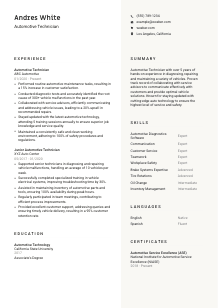
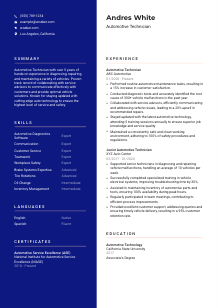
Fine-tuning cars, but your CV remains stuck in neutral? Check out this Automotive Technician CV example, built with Wozber free CV builder. Learn how to blend your mechanical skills with job specifications, paving the way for a dynamic career as an engine-savvy gearhead!
Automotive technician CVs get weak when they read like generic shop labour instead of skilled repair work. Hiring teams want to see how you handle diagnostics, routine maintenance, repair accuracy, safety standards, and customer-facing communication through the service lane. Your CV should make it easy to picture you moving from inspection to root-cause diagnosis to completed repair without wasting bay time.
A tailored CV also helps separate technicians who simply list tasks from those who can work to shop standards and document real results. Using Wozber's free CV builder to match the employer's language and keep an ATS-compliant CV cleanly structured makes your maintenance, diagnostic, and service-advisor collaboration easier to read and easier to trust at first pass.
The top of an automotive technician CV should work like a clean repair order. It needs the right identifying details, the right title, and no friction. Keep this section simple, accurate, and aligned with the opening so the reader can move straight to your shop experience and technical strengths.
Use your full name in a larger, readable font so it stands apart from the rest of the CV. In a field where hiring managers may review dozens of applicants for service bays, speed matters. Clear presentation helps them identify you quickly when they return to your file after reviewing your ASE certification, diagnostics background, or brake and maintenance experience.
Place your target title directly under your name. If the opening is for an "Automotive Technician," use that exact wording unless your background clearly fits a more specialised version such as "Brake Technician" or "Diagnostic Technician." Mirroring the posted title helps your CV line up with both ATS filters and the shop's real hiring need.
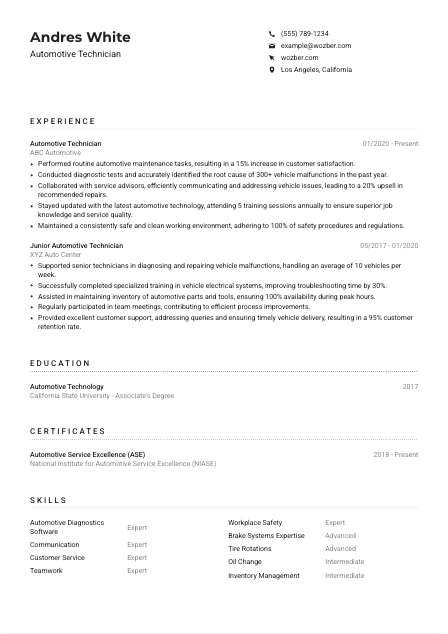
List a phone number you answer and a professional email address you check regularly. Accuracy matters here more than style. If a service manager wants to schedule a skills test or interview after seeing your experience with 300+ vehicle diagnostics or strong customer satisfaction scores, they need to reach you without delay.
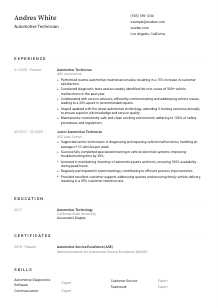
If the job calls for local availability or relocation, include your city and state. For the Los Angeles example, "Los Angeles, California" immediately answers a practical question about scheduling, commute, and start date. Use location as a tailoring detail when the posting asks for it, not as filler on every application.
A LinkedIn profile or personal site can help if it reinforces your work history, certifications, training, or manufacturer-specific background. Keep it current and consistent with the CV. For most automotive technician roles, a clean profile with your recent shop experience and credentials is more useful than a flashy link that adds no repair-related detail.
Your personal details should answer the basics in seconds and remove avoidable doubts. When the title, contact information, and location are aligned with the role, the reader can move straight to whether you can diagnose issues, complete repairs correctly, and work well with customers and service advisors.




This is the section most service managers will read first. They want more than a list of duties. They want proof that you can inspect vehicles, identify faults, complete maintenance and repairs efficiently, communicate findings clearly, and work safely in a busy shop environment.
Read the opening closely and mark the work that appears repeatedly. For this role, that includes routine maintenance, diagnostic testing, repair work, communication with service advisors, current technical knowledge, and safety practices. Those themes should shape your bullet points so the employer sees familiar shop priorities instead of a generic work history.
List positions in reverse chronological order with job title, employer, and dates. Put the most recent technician role first, especially if it includes hands-on repair, maintenance throughput, inspection work, or diagnostic software use. A progression from junior technician to automotive technician, as shown in the sample CV, also helps show growing independence in the bay.
Replace broad statements with bullets that show what you handled and what changed because of your work. "Conducted diagnostic tests and identified root causes for 300+ vehicle malfunctions" is stronger than simply saying you performed diagnostics. Good experience bullets in this field usually mention vehicle issues resolved, maintenance tasks completed, troubleshooting speed, repair accuracy, customer outcomes, or shop efficiency.
Quantify results where the metric fits the work naturally. Customer satisfaction, repair volume, upsell support through accurate recommendations, training completed, safety compliance, or reduced troubleshooting time all make sense for automotive technician CVs. The sample's 15% increase in customer satisfaction and 20% upsell in recommended repairs work because they connect technical work to service results.
If a past role included unrelated duties, trim them unless they support the target job. Prioritise bullets about diagnostics, brake inspections, oil changes, tire rotations, electrical troubleshooting, tool use, service advisor collaboration, and safe shop practices. Every line should help answer the same question: can you step into this shop and contribute with minimal ramp-up?
Your experience section should show that you are productive in the bay, reliable with diagnostics, and credible with customers. When your bullets combine hands-on repair work with measurable service outcomes, the CV reads like a technician who can handle real shop volume, not just someone familiar with the terminology.
Education usually sits behind experience in automotive hiring, but it still matters. It shows your technical base, formal training, and whether you built early knowledge in systems, diagnostics, and repair procedures before stepping into full shop responsibility.
Start by making sure the minimum qualification is visible. If the posting asks for a high school diploma or equivalent, your education section should make that easy to confirm. If you also have an Associate's Degree in Automotive Technology, list it prominently because it adds role-specific training beyond the baseline requirement.
List the school, degree, field of study, and graduation year. Clean formatting is enough here. Hiring teams reviewing technicians are usually scanning for whether your training aligns with automotive systems and whether your background supports the level of diagnostics and maintenance expected in the role.
If your degree or diploma is directly tied to automotive technology, diesel technology, electrical systems, or manufacturer training, make that clear. In the example, an Associate's Degree in Automotive Technology reinforces the candidate's repair background and supports the more advanced diagnostic work shown in the experience section.
Early-career technicians can use this section to show relevant preparation. Include coursework in engine performance, brake systems, electrical diagnosis, suspension, or shop safety if it adds context the experience section cannot yet provide. This is especially helpful if you are moving from training into a first full technician role.
Awards, scholarships, competition placements, or standout technical projects are worth mentioning when they reinforce your automotive ability. Keep them brief and relevant. A hiring manager will care more about an engine diagnostics project or technical training award than a generic campus activity unrelated to repair work.
Your education section should confirm that your hands-on ability rests on real training. For experienced technicians, it supports the story. For newer technicians, it helps bridge the gap by showing exposure to the systems, tools, and repair methods the job requires.
Certifications carry real weight in automotive hiring because they point to tested knowledge, current standards, and commitment to the trade. When a shop asks for ASE credentials or specialty-area certification, that is a practical hiring filter, not a decorative preference.
If the posting asks for ASE certification in at least one specialty area, list that clearly and early. This is one of the strongest matching signals for this job. The example CV handles this well by naming Automotive Service Excellence and showing that the credential is current.
Include certifications that support the type of vehicles, systems, or service work you perform. ASE specialties, emissions credentials, electrical systems training, brake certification, or manufacturer-backed training all add value when they connect to the role. Skip outdated or loosely relevant certificates that do not improve your technical profile.
Many automotive credentials require renewal or continuing education. Show issue dates or active date ranges so the employer can see that your certification status is current. In a field shaped by changing vehicle systems, scan tools, and repair procedures, recent certification dates matter.
Training matters in modern shops, especially with diagnostics software, electronics, hybrid systems, ADAS, or updated service procedures. If you regularly complete technical training, include the strongest examples. The sample's mention of attending five training sessions annually works because it shows ongoing development tied to better service quality.
Certifications tell a shop that your knowledge has been tested beyond day-to-day experience. For an automotive technician, the right credential can strengthen trust quickly, especially when the CV also shows solid diagnostics, maintenance output, and safe work habits.
The best automotive technician skills sections are targeted, not crowded. A hiring team should be able to scan this area and immediately see whether you can diagnose vehicles, complete common maintenance and repairs, work safely, and communicate clearly with service advisors and customers.
Use the job description to identify the mix of abilities the employer actually needs. Here, the technical side includes automotive diagnostic software and tools, maintenance tasks, and repair work. The people side includes communication and customer service. Automotive hiring often depends on both because technicians do not work in isolation from the front desk or the customer conversation.
List the abilities that show up in your work history and support the target role. Diagnostic software, brake inspection, tire rotation, oil service, electrical troubleshooting, shop safety, teamwork, and customer communication are all more valuable than vague filler terms. The example CV does this well by pairing technical skills with customer-facing strengths.
Do not overload this section with every tool or minor task you have touched. Choose the skills most likely to matter in the shop you are targeting, then order them by relevance. Wozber can help you align this section with the posting language and keep the layout in an ATS-friendly CV format that surfaces the right technical terms quickly.
This section should confirm that you have the practical toolset for the job, from diagnostics and maintenance to communication and safety. A focused list tells the reader you understand how the work is actually done and which capabilities matter most in a busy repair environment.
Language ability matters in automotive work when it affects customer explanations, repair authorization conversations, and coordination inside the shop. If the posting requires English fluency, treat that as an operational requirement, not a small detail.
Lead with English when the job specifically requires it. Shops rely on technicians to read repair orders, understand service information, communicate with advisors, and document findings clearly. If your English is native or fluent, state that plainly.
Additional languages can strengthen your application, especially in markets with diverse customers. Spanish, for example, may help with service explanations, intake conversations, or follow-up discussions, even when it is not listed as a requirement. Include it when you can genuinely use it on the job.
Use clear labels such as Native, Fluent, Intermediate, or Basic. Overstating language ability creates problems quickly in customer service settings where misunderstanding a symptom description or repair recommendation can affect trust and workflow.
Some technician roles involve very little direct customer contact, while others regularly require conversations with service advisors and vehicle owners. In shops with a broad customer base, bilingual ability can improve handoffs, reduce friction, and help customers understand recommended repairs.
Language skills are a supporting strength, not the centre of the CV. Include them when they add practical value to the role. In the sample, English and Spanish work well because the role emphasizes customer communication alongside hands-on repair work.
Language skills should support how the job gets done, especially where customer trust and clear repair communication matter. If they help you explain issues, coordinate service, or serve a broader customer base, they deserve a place on the CV.
A good automotive technician summary reads like a concise service snapshot. In a few lines, it should tell the employer your experience level, technical focus, and the kind of results or working style you bring to the bay.
Review the posting and identify the themes that deserve space in your opening lines. For this role, that means hands-on maintenance and repair, diagnostics, communication with service advisors and customers, and current technical knowledge. Build your summary around the parts of the job you can genuinely back up in the experience section.
Lead with a direct statement such as "Automotive Technician with 5+ years of experience" or a version that matches your level. This gives immediate context and helps frame the rest of the CV. If you are earlier in your career, you can still lead confidently with your technician title, training, and strongest technical area.
Choose strengths that reflect the actual work. Diagnostics, preventive maintenance, brake and inspection work, customer communication, and safe shop practices are all useful if they align with your background. The example summary works because it combines vehicle repair experience, collaboration with service advisors, and up-to-date technical knowledge.
Aim for a short paragraph that sounds like a technician, not a generic applicant. Avoid buzzwords and broad claims. A concise summary with one or two strong details will do more for you than a long introduction full of empty phrases. Save the proof for the bullet points that follow.
Your summary should give the reader a fast, accurate picture of the technician behind the CV. If it clearly shows your experience level, technical strengths, and service-minded approach, the rest of the document has a stronger foundation.
A well-tailored automotive technician CV should now show the essentials clearly: the maintenance and repair work you handle, the diagnostic judgment you bring, the way you support customer conversations, and the training or certification that strengthens your credibility.
Use Wozber's free CV builder to tighten the structure, align your wording with the job description, and present everything in an ATS-friendly CV template built for clear scanning. The finished CV should make one thing easy to judge: you can step into the shop, work safely, diagnose accurately, and keep vehicles moving.