



Use Wozber and land your dream job
Create CV
No registration required
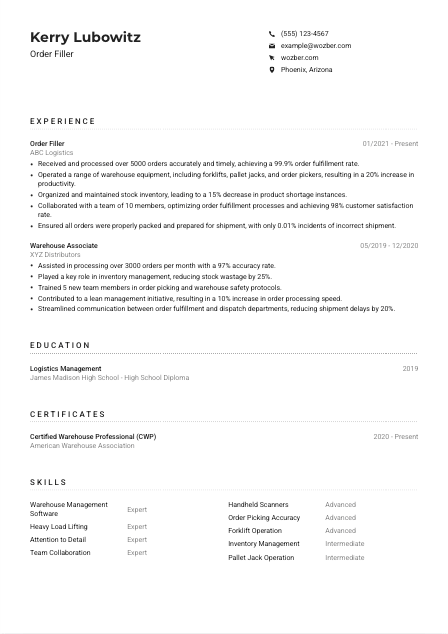
Packing precision, but your CV feels misplaced? Browse through this Order Filler CV example, made with Wozber free CV builder. Learn how to stack your fulfillment skills to match job requirements, delivering a career profile that's always in the right place at the right time!
Order filler work is measured in small details repeated all day. A missed SKU, a rushed scan, or a box packed incorrectly can slow shipping, throw off inventory counts, and create returns that cost the warehouse time and money. Your CV needs to show that you can keep pace without losing accuracy, whether you are picking orders, moving product, or preparing shipments at the end of the line.
A tailored CV helps separate general warehouse experience from actual order fulfillment strength. When the posting asks for handheld scanner use, warehouse management software, lifting capacity, and dependable picking accuracy, those terms need to appear in the right sections so both recruiters and ATS filters can connect your background to the job quickly. Wozber's free CV builder helps organise that language into an ATS-compliant CV that makes your day-to-day warehouse performance easier to recognize.
Warehouse hiring often moves quickly, so your contact information should remove friction immediately. In this section, keep the basics clean, professional, and aligned with any stated requirement that belongs here, especially location and role title.
Place your full name at the top in a clear, readable font. No nicknames, no decorative formatting. In warehouse hiring, clarity matters more than style, and your header should make it easy for a supervisor, recruiter, or staffing coordinator to identify your application fast.
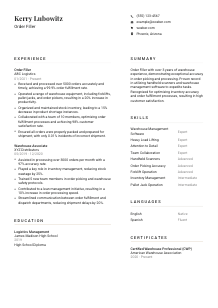
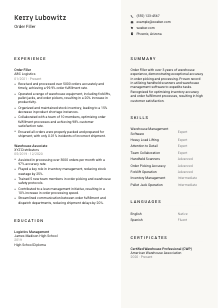
Add "Order Filler" directly under your name when that is the role you are applying for. This keeps your CV aligned with the posting and avoids confusion if your recent title was something broader, such as Warehouse Associate. In the example CV, using "Order Filler" up top immediately matches the target opening.
List a working phone number and a professional email address you check regularly. A straightforward format such as firstname.lastname@email.com is enough. Before you apply, test both. Fast-moving warehouse hiring often starts with a quick call or message to confirm availability, shift fit, or interview timing.
If the employer requires candidates to be in a specific area, include your city and state. Here, Phoenix, Arizona is relevant because the posting names that location. If you are relocating, say so clearly instead of leaving the employer to guess. This is one of the few sample-specific details that belongs in the Personal Details section.
A LinkedIn profile or personal site is optional for an Order Filler role. Include one only if it is current and consistent with your CV. If it adds no useful information about warehouse experience, certifications, or work history, leave it out and keep the header lean.
Your header should answer the practical basics at a glance: who you are, what role you want, how to reach you, and whether you meet the location requirement. That clears the way for the hiring team to focus on your warehouse experience next.




This is where hiring teams look for real warehouse output. For an Order Filler, experience should show volume, accuracy, equipment use, inventory handling, and how your work affected shipping speed or stock reliability. General labour bullets are not enough if they never show what you picked, moved, scanned, or improved.
Start by marking the duties and tools named in the posting. For this role, that includes receiving and processing orders, maintaining inventory accuracy, using handheld scanners and warehouse management software, operating forklifts and pallet jacks, packing shipments, and collaborating with the fulfillment team. Use these terms where they truthfully match your background so your CV reflects the actual warehouse workflow the employer needs.
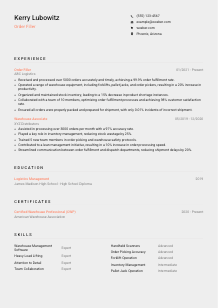
Start with your most recent role and include employer name, title, and dates. Under each job, write bullets that describe the work in operational terms, not vague summaries. "Processed over 5,000 orders with a 99.9% fulfillment rate" tells a hiring manager far more than "responsible for order picking." The sample CV does this well by tying daily duties to measurable output.
Order filling is one of those jobs where numbers matter. Include metrics that reflect how warehouses judge performance, such as order volume, pick accuracy, inventory variance reduction, shipment error rates, productivity gains, or customer satisfaction tied to fulfillment quality. The example bullets use 99.9% order fulfillment accuracy, a 20% productivity increase, and a 15% drop in shortages, which makes the candidate's impact easy to understand.
Rework your experience bullets so the strongest ones mirror the posting's main needs. If the employer cares about packing orders correctly and preparing them for shipment, make sure one of your top bullets covers packing accuracy or shipping readiness. If equipment operation is important, say which machines you used and in what setting. This helps distinguish true order fulfillment experience from general warehouse exposure.
Save space for the warehouse work that matters most. Side achievements that do not support order accuracy, equipment handling, safety, teamwork, or fulfillment speed can stay off the page. For this role, relevant details include scanner use, stock organisation, lifting demands, cross-team coordination, and training others on picking or safety procedures.
By the end of this section, a reader should be able to picture you on the warehouse floor handling orders accurately, working safely with equipment, and keeping fulfillment moving. That is the standard this section needs to meet.
Education is straightforward for most Order Filler CVs, but it still matters because the posting sets a minimum qualification. Present it clearly, meet the requirement, and use any relevant coursework or training to reinforce your warehouse background without overloading the section.
If the employer asks for a high school diploma or equivalent, list it clearly. That requirement is explicit in this posting, so make sure it is easy to find. A hiring team should not have to search the page to confirm a basic qualification.
Include the school name, credential, and graduation year or date if you want to show it. For most warehouse roles, that is enough. A clean entry is better than trying to make this section carry more weight than it needs to.
If your coursework, vocational training, or school program touched logistics, warehouse operations, supply chain basics, or inventory systems, include that detail. In the example, the field is listed as Logistics Management, which adds useful context even though the minimum requirement is a high school diploma.
Short courses in forklift safety, warehouse procedures, shipping documentation, or inventory control can sit here if you do not have a separate training section. These details help when your work history is still growing or when the employer wants evidence that you understand warehouse processes.
Academic awards, clubs, or unrelated coursework usually are not necessary unless they directly support the role. Keep the focus on qualifications that connect to fulfillment, safety, reliability, or operational discipline.
For an Order Filler CV, education should confirm the required credential and, when relevant, add a bit of logistics context. Keep it neat, factual, and secondary to your warehouse results.
Most Order Filler postings do not require certifications, but the right ones can strengthen your CV by showing safety awareness, equipment readiness, or deeper warehouse knowledge. Include them when they add substance, not just extra lines.
Start with the job ad. This role does not name a required certification, so treat certificates as supporting material rather than a substitute for experience. If another posting asks for forklift certification or safety training, move that credential higher and make it easier to spot.
Prioritise certificates that relate directly to fulfillment, inventory control, material handling, or equipment use. A credential such as Certified Warehouse Professional can strengthen your profile because it supports the kind of work the role involves, from stock organisation to shipping prep.
If a certificate is active, renewable, or recently completed, show the date or validity period. That gives the employer a better sense of whether your training is current, especially for safety or equipment-related credentials.
Warehouse work changes with new systems, scanning workflows, and process standards. Certificates can show that you keep building practical knowledge beyond day-to-day tasks. Keep the list focused on learning that supports productivity, safety, or inventory accuracy.
A certificate section should reinforce your warehouse credibility, not distract from it. If the credentials connect to fulfillment work, equipment, or process discipline, they earn their place.
For an Order Filler, the skills section should read like the tools and abilities you actually use in warehouse operations. Prioritise the capabilities that support accurate picking, safe movement of product, inventory control, and steady throughput.
Use the job description to identify the abilities the employer will search for first. Here, that includes handheld scanners, warehouse management software, heavy lifting up to 50 lbs, attention to detail, order picking accuracy, equipment operation, and written and spoken English. These belong in your skills section if you can back them up in experience.
Lead with the skills that matter most for daily performance in the role. For this type of opening, scanner use, order accuracy, warehouse systems, forklift or pallet jack operation, and inventory handling should appear before more general strengths such as collaboration. The sample CV gets this mostly right by focusing on warehouse software, lifting, detail, and picking accuracy.
Do not turn this into a full inventory of every ability you have picked up at work. A shorter list of relevant warehouse skills is more convincing than a long list padded with vague claims. Make sure each skill can be supported by your bullets, training, or certifications.
This section should confirm that you can step into the warehouse and handle the practical demands of the job, from scanning and stock handling to safe equipment use and precise order picking.
Language ability matters in warehouse settings because order tickets, shipping labels, scanner prompts, safety instructions, and team handoffs all depend on clear communication. Keep this section practical and aligned with the level of language the job actually requires.
If the posting specifically asks for English speaking and writing skills, list English first and state your level clearly. That requirement appears in this job description, so it should not be buried below optional languages.
After the required language, list any others you can genuinely use on the job. In some warehouses, another language can support smoother communication across shifts or teams, especially during receiving, picking, packing, or training.
Use realistic levels such as Native, Fluent, Advanced, or Conversational. Overstating language ability can create problems quickly in a workplace where safety instructions, shipment details, and order information need to be understood correctly.
Additional languages are not always a deciding factor for an Order Filler role, but they can still help. In the example CV, Spanish is listed alongside native English, which can be useful in many warehouse environments where team communication happens across multiple language backgrounds.
Do not overbuild this section unless language is a major part of the job. For most order fulfillment roles, clear English and accurate warehouse communication matter more than a long list of languages.
Your language section should quickly confirm that you can follow instructions, document work clearly, and communicate reliably in a busy warehouse setting.
Your summary sits near the top, so it should quickly explain the kind of warehouse professional you are. For an Order Filler, that usually means years of experience, order accuracy, scanner or warehouse system familiarity, equipment use, and one or two measurable results that reflect dependable performance.
Before writing the summary, identify the two or three things the employer needs to trust most. In this case, that is likely accurate order processing, comfort with warehouse systems and scanners, and the ability to keep shipments moving on time. Build your opening around those points, not generic statements about being hardworking.
Lead with your job title or closest equivalent plus your years of relevant experience. A line such as "Order Filler with over 3 years of warehouse experience" works because it establishes role alignment immediately. The example summary uses this structure effectively.
Follow with a few specifics that tie directly to the job description, such as order picking accuracy, handheld scanner use, warehouse management software, inventory control, or shipment preparation. If you have strong metrics, include one. For example, mention fulfillment accuracy, productivity gains, or improvements in stock reliability.
Aim for a short paragraph that can be scanned quickly. Three to five lines is usually enough. Skip filler words and focus on what you do well on the warehouse floor. If every sentence points to speed, accuracy, safety, or system use, the summary is doing its job.
Your summary should make it clear, within a few seconds, that you know how order fulfillment works and that you can perform it accurately under warehouse pace. With Wozber's free CV builder, you can shape that top section and the rest of the document into an ATS-friendly CV format that keeps your experience aligned with the posting and easy to review.
An effective Order Filler CV shows more than willingness to work hard. It shows that you can process orders accurately, use scanners and warehouse systems correctly, handle equipment safely, and keep inventory and shipments moving without costly mistakes.
Use each section to reinforce those points with clear language and real metrics. When you want a faster way to tailor wording, organise sections, and improve ATS optimisation, Wozber can help you build a CV that reflects the actual demands of warehouse fulfillment. The finished document should make one thing easy to judge: you can step into the operation and contribute from day one.