



Use Wozber and land your dream job
Create CV
No registration required
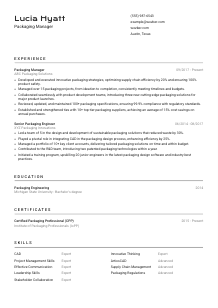
Mastering product presentation, but your CV feels like it's stuck in shrink-wrap? Unbox this Packaging Manager CV example, created with Wozber free CV builder. Learn how to pack your logistical and creative skills strategically, ensuring your career stands out on the shelf of opportunity!
Packaging managers sit at the point where product protection, manufacturability, cost control, and launch timing all meet. Hiring teams want to see whether you can move packaging from concept to rollout without creating damage issues, compliance gaps, or supply chain friction. Your CV should make that operating range visible, especially through project scope, supplier work, and measurable packaging results.
A tailored CV changes how quickly that range comes through in an ATS screen and a first review. When your wording reflects the posting's priorities, such as packaging strategy, specification control, design software, and cross-functional delivery, Wozber's free CV builder helps shape it into an ATS-compliant CV that reads clearly for both software and hiring teams. The point is simple. Your CV should make it easy to see that you can run packaging work with commercial, technical, and operational discipline.
This section is brief, but it still carries hiring value. For a Packaging Manager, clean personal details show that you understand business communication, location requirements, and professional presentation before the reviewer even reaches your project history.
Use your full name at the top in a clear, readable format. Keep it simple and professional. In a role tied to cross-functional coordination, supplier communication, and specification work, even the header should reflect order and clarity.
Place "Packaging Manager" under your name when that is the role you are pursuing. This immediately aligns your CV with the opening and supports ATS matching around the exact title the employer is searching for.
Hiring teams need fast, reliable ways to reach you, especially for roles that often move through several interview stages involving operations, engineering, and procurement leaders.
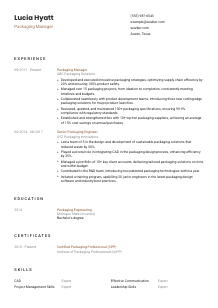
If the employer specifies a location requirement, show that you meet it. In the example, listing Austin, Texas directly supports a stated requirement and removes a common early-screen question. For other roles, handle location based on what the posting actually requests.
Include LinkedIn or a professional website when it adds useful context, such as packaging project work, product launch involvement, supplier-facing achievements, or industry credentials. Make sure the information matches your CV titles, dates, and scope.
Your personal details do not need flair. They need accuracy, professionalism, and any location detail that matters to the opening so the hiring team can move straight to your packaging experience.




This is the section that carries the most weight. Packaging Manager hiring usually turns on whether your CV shows control over packaging development, specifications, launch support, supplier relationships, and cost or performance outcomes in a real operating environment.
Read the job description for the work patterns behind the keywords. Here, the priorities include packaging strategy, project ownership from ideation to implementation, cross-functional collaboration, regulatory specification updates, and supplier negotiation. Those are the themes your experience bullets should mirror with real examples from your background.
Use reverse-chronological order and make each entry easy to scan with company, title, and dates. Under each job, focus first on packaging responsibilities that map to the target role, such as leading launches, reducing freight or material costs, improving product protection, or standardising specifications across SKUs.
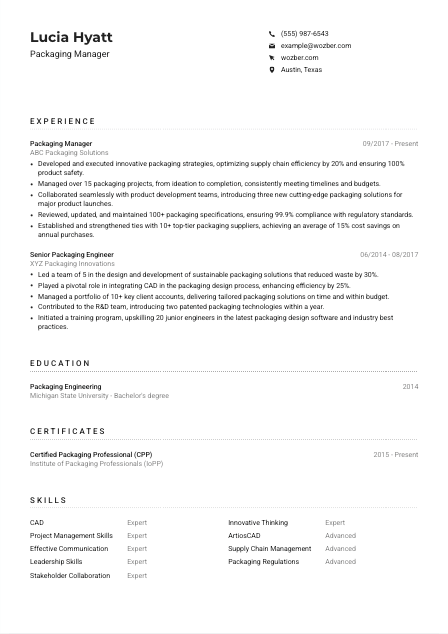
Metrics matter because packaging decisions affect cost, damage rates, throughput, compliance, and supplier spend. The example CV does this well by citing a 20% supply chain efficiency improvement, 15 managed projects, 100+ updated specifications, and 15% supplier cost savings. Use your own numbers wherever possible, whether the result was fewer defects, faster implementation, lower packaging spend, or smoother launches.
Name the systems, methods, and packaging work that prove you can handle the technical side of the role. If you use CAD, ArtiosCAD, packaging testing processes, specification management, or sustainability-driven redesign, place those details inside relevant bullets instead of leaving them abstract. That is especially useful when the posting asks for design software proficiency.
Each bullet should show what you owned, what changed, and why it mattered. "Managed packaging projects" is weaker than a bullet that shows project count, launch timing, budget control, and business result. The strongest bullets connect your decisions to operational outcomes such as safer transit, lower material usage, better line efficiency, or stronger supplier terms.
After this section, a reviewer should be able to picture you running packaging programs, not just participating in them. Lead with scale, tools, collaboration, and measurable results that matter in packaging operations.
Education matters here because packaging work often blends engineering judgment, production realities, and business tradeoffs. A degree section does not need much space, but it should quickly confirm that you have the academic grounding the role asks for.
If you hold a bachelor's degree in Packaging Engineering, Industrial Engineering, Business, or a related field, state it clearly. In the example, "Bachelor's degree in Packaging Engineering" lines up directly with the posting and strengthens role alignment immediately.
List school, degree, field of study, and graduation year or date in a clean order. Packaging roles often move through both ATS filtering and hiring-manager review, so straightforward formatting helps the credential land quickly.
If your degree is in a related discipline rather than packaging itself, include context that supports your fit. Relevant coursework, capstone projects, or academic work tied to materials, manufacturing, design, logistics, or supply chain can help connect the dots.
Short programs, workshops, or continuing education can add value when they relate to packaging development, CAD tools, project management, quality systems, or regulatory compliance. Use them to support your operating range, not to pad the section.
Academic distinctions are worth including if they are genuinely relevant and recent enough to matter. For experienced Packaging Managers, they usually stay secondary to project results, but they can still strengthen the section when space allows.
This section should confirm the qualification baseline and, where helpful, support your technical credibility. Save most of your proof for the experience section, where packaging decisions and outcomes carry more weight.
Certifications can sharpen your profile when they reflect current packaging knowledge, professional standards, or leadership in the field. They are especially helpful when they reinforce expertise in compliance, packaging practice, or continued development beyond your degree.
List certifications that directly support the role rather than every credential you have earned. A designation such as Certified Packaging Professional is immediately relevant because it speaks to recognized knowledge in packaging systems, materials, and industry practice.
Include the issue date, renewal range, or active period when applicable. For certifications tied to ongoing professional standing, current dates show that your knowledge has been maintained rather than left dormant.
If the role leans heavily toward design and development, prioritise credentials connected to packaging engineering or software capability. If it leans toward supplier management, operations, or compliance, highlight certifications that support those areas. Relevance matters more than volume.
Packaging standards, sustainability expectations, and tooling continue to evolve. Recent or active credentials can signal that you stay current on materials, regulations, testing, or process improvements that affect packaging decisions in the real world.
Use this section to reinforce expertise that the rest of your CV already suggests. A well-chosen packaging credential can strengthen your case, especially when it aligns with the technical or regulatory demands of the job.
A Packaging Manager skill section should reflect how the work actually gets done. That means combining technical tools, operational knowledge, and leadership capabilities that affect packaging performance, project flow, and supplier coordination.
Start with the posting and identify the capabilities that drive success in the job. For this opening, that includes CAD or ArtiosCAD, project management, cross-functional communication, leadership, regulatory awareness, and supplier collaboration. Use the wording naturally where it matches your experience.
Do not separate software from management realities. Packaging managers need both. A list that includes design tools, supply chain knowledge, packaging regulations, communication, and leadership gives a more accurate picture of someone who can move work from concept to implementation.
Place the most role-specific skills first, especially those named in the posting. In the example, CAD, project management, communication, leadership, ArtiosCAD, supply chain management, and packaging regulations all support the target role well. Keep the list tight enough that every skill adds hiring value.
When this section is done well, it supports the story told in your experience bullets. A reviewer should see the technical tools and operating strengths needed to manage packaging programs with control and consistency.
Language skills matter in packaging when the role involves supplier communication, documentation, or coordination across regions. They should be listed clearly, with realistic proficiency levels and direct relevance to the job.
If the posting specifies English communication, place English first and describe your proficiency accurately. In this case, strong English skills are an explicit requirement, so they should be easy to find on the CV.
Extra languages can strengthen your profile when they support vendor relationships, cross-border production, or collaboration across distributed teams. They are especially useful in packaging environments with global sourcing or regional manufacturing partners.
Terms such as Native, Fluent, Advanced, Conversational, or Basic work well when used honestly. Avoid overstating your level. Packaging managers are often expected to handle negotiations, specifications, and issue resolution, so accuracy matters.
Not every Packaging Manager role needs multiple languages, but some benefit from them in supplier discussions, plant coordination, or documentation review. Include languages that genuinely support your effectiveness in those settings.
Only list languages you could credibly use in a professional setting. The example's English and Spanish pairing works because it signals broader communication range without distracting from the core packaging qualifications.
Use this section to support the kind of communication the role actually requires, whether that is clear English documentation or smoother coordination with suppliers and partners across markets.
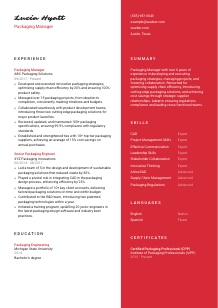
Your summary sits at the top of the CV, so it should establish level, specialization, and business impact quickly. For this role, that usually means packaging strategy, project leadership, cross-functional execution, and measurable operational results.
Start with your title, years of experience, and core area of expertise. A line such as "Packaging Manager with 6+ years of experience in packaging strategy, design, and implementation" tells the reader what lane you operate in right away.
Choose accomplishments that map closely to the target role. The example summary points to supply chain efficiency, new packaging solutions, compliance, and supplier cost savings, which fits this opening well. Use two or three outcomes that show your strongest commercial and operational contribution.
Use the language the employer is already using when it reflects your actual work. Terms like packaging strategies, project management, regulatory compliance, CAD, supplier relationships, or product launches can help both ATS matching and human review when placed naturally inside the summary.
Aim for three to five lines with no filler. Skip broad statements about being results-driven or dynamic unless you immediately back them up with packaging-relevant proof. Brevity works best when every phrase points to scope, tools, or outcomes.
A good summary gives the hiring team an immediate read on your level and your operating strengths. By the time they move into your experience section, they should already expect to see packaging strategy, execution discipline, and business results.
You now have a structure that highlights what matters most in Packaging Manager hiring: packaging strategy, technical tools, project delivery, compliance control, and supplier results. Each section should help the reader connect your background to real packaging outcomes such as safer product transit, lower costs, faster launches, or stronger specification management.
Use Wozber's free CV builder to organise that information into an ATS-friendly CV format, then refine the wording with its ATS CV scanner and AI features so your experience aligns closely with the posting. The final result should make one thing easy to judge. You can lead packaging work from concept through implementation with the discipline the role demands.