




Use Wozber and land your dream job
Create CV
No registration required
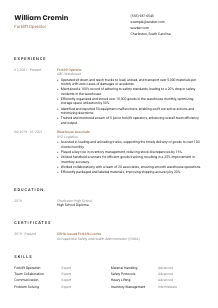
Nimbly maneuvering loads, but your CV feels stuck? Lift your spirits with this Forklift Operator CV example, built with Wozber free CV builder. It shows how to stack your skills to match job specifications, keeping your career trajectory as steady as your driving!
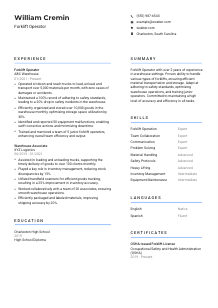
Forklift work is judged in motion. Hiring teams want to see someone who can move product safely, keep lanes clear, handle loading schedules without damage, and stay steady in a fast warehouse or manufacturing environment. Your CV should make that operational value obvious, especially around equipment types, safety habits, and the scale of materials you handle.
A tailored CV quickly shows whether your background matches the floor they run, from sit-down forklifts and reach trucks to inventory support and daily equipment checks. Wozber's free CV builder helps you shape that experience into an ATS-compliant CV by aligning your wording with the posting, so the employer can immediately see where you've already delivered safe, efficient material handling.
For a Forklift Operator, the contact section should confirm the basics without slowing the reader down. Keep it clean, accurate, and aligned with any practical requirement the employer has stated, especially when the posting includes a location requirement or asks for clear English communication.
Use your full name as the most visible text at the top of the page. In warehouse hiring, CVs move fast, so a clear header helps supervisors and recruiters identify your application quickly when they are reviewing candidates for shift-based or facility-based work.
Place "Forklift Operator" directly below your name if that is the role you are applying for. Matching the posted title helps both ATS screening and human review, especially when employers are sorting CVs across related jobs such as Warehouse Associate, Material Handler, and Forklift Operator.
Include a reliable phone number and a professional email address you check regularly. If a hiring manager needs to confirm interview availability, certification details, or shift flexibility, they should not have to work around missing or outdated contact information.
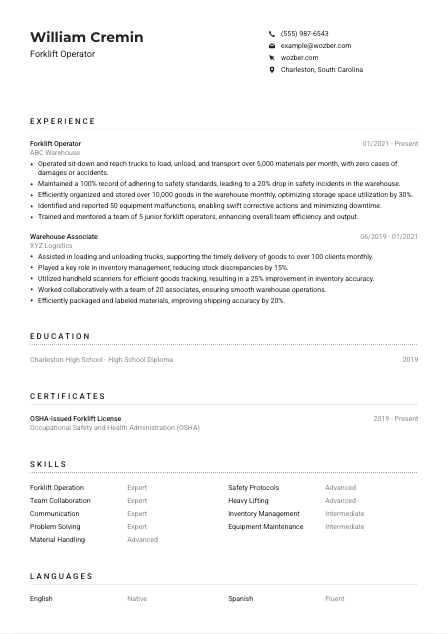
If the employer requires candidates to be based in a certain area, show that clearly in your location line. Here, listing Charleston, South Carolina supports the posting's stated requirement and removes an avoidable question early in the review process.
Include LinkedIn or a professional profile only if it supports your warehouse background with matching job titles, certifications, or endorsements. For a hands-on operations role, that profile should reinforce your CV, not distract from it with unrelated content.
This section should confirm that you are reachable, local when needed, and applying directly to the forklift role at hand. Keep it simple and accurate so the reader can move straight to your operating experience.




This is the section hiring teams look at hardest for a Forklift Operator. They want to know what equipment you have used, what volume you handled, how safely you worked, and whether you contributed to the pace and order of warehouse operations.
Start by identifying the operating tasks and conditions the employer cares about most. In this posting, that includes loading and unloading materials, transporting goods within the facility, handling sit-down and reach trucks, following safety standards, reporting malfunctions, and helping with inventory-related work. Those are the themes your experience bullets should reflect.
Show your most recent warehouse or manufacturing work first. For each job, include title, employer, and dates so the reader can track your progression from general warehouse support into direct forklift responsibility, as the sample CV does from Warehouse Associate to Forklift Operator.
Replace generic task lists with bullets that show pace, accuracy, and operational results. A line like "Operated sit-down and reach trucks to load, unload, and transport over 5,000 materials per month, with zero cases of damages or accidents" works because it connects equipment type, workload, and safety performance in one clear statement.
Forklift CVs benefit from practical metrics. Include shipment volume, goods stored, damage reduction, safety records, inventory accuracy, downtime prevented, or space utilization improved. The sample's 30% storage optimisation and 20% drop in safety incidents are strong examples because they show business impact, not just activity.
Focus on work that supports the role, such as forklift operation, staging, putaway, cycle counts, handheld scanner use, trailer loading, heavy lifting, and cross-team coordination on the floor. Leave out unrelated achievements unless they directly strengthen your case for warehouse efficiency, safety, or teamwork.
Your experience section should leave no guesswork about whether you can operate equipment safely, move product efficiently, and support warehouse flow under pressure. When those details are clear, your CV reads like someone ready to step onto the floor.
Forklift Operator roles usually lean more on operating experience, safety habits, and certification than on formal education. Still, your education section should be complete and tidy because it rounds out your background and answers a basic hiring checkpoint.
If the job description does not require a specific degree, do not overbuild this section. For many forklift openings, a high school diploma or equivalent is enough to list, while the real hiring weight stays on your equipment experience and certification.
List your school, credential, and graduation year or date in a straightforward format. For this role, clarity matters more than detail. A simple entry such as a high school diploma is usually sufficient unless you also completed logistics, manufacturing, or trade-related training.
If you completed coursework in warehouse operations, supply chain basics, OSHA safety, or industrial equipment, include it when it supports the target role. This is especially useful for candidates whose direct forklift experience is closer to the two-year minimum and needs a little more context.
If you have limited experience, a short mention of relevant classes or vocational programs can help show familiarity with material handling, safety procedures, or inventory processes. Once your work history is stronger, those details usually become less important than your on-the-job results.
School leadership, attendance awards, or team projects can stay off the CV unless they connect to work habits that matter here, such as reliability, teamwork, or safety awareness. Keep the emphasis where forklift employers place it, on floor performance and operational dependability.
Education should support your application without competing with the experience and certification that drive most forklift hiring decisions. Give it enough detail to be complete, then let your warehouse track record carry the CV.
For forklift roles, certification is often one of the first things an employer checks. If the posting asks for a valid forklift license or training completion, your CV should make that easy to find and easy to understand.
Start with the certificates the employer explicitly requests. Here, a valid forklift certification is required, so it belongs in its own section where a recruiter or supervisor can confirm it immediately rather than hunting for it in experience bullets.
Lead with the credential that directly qualifies you to operate forklifts. An OSHA-issued forklift license or recognized training completion should appear before less relevant certificates because it answers a core compliance and safety question right away.
List the certificate name, issuing body, and active dates or renewal status. This matters in equipment roles because expired credentials create hiring delays. The sample CV handles this well by showing an OSHA-issued forklift license with current validity.
If you have renewed your forklift training or completed additional safety instruction, include it. In warehouse environments, current certification suggests you take operating standards seriously and stay prepared for updated procedures, inspections, and equipment expectations.
When your forklift credentials are visible and current, you remove one of the fastest reasons an application gets passed over. This section should confirm that you are already cleared for the work the role requires.
A Forklift Operator skills section should read like the demands of a real shift, not a list of generic strengths. Focus on equipment handling, safety, warehouse support tasks, and the communication skills that keep product and people moving without confusion.
Start with the abilities the employer named directly, such as forklift operation, reach truck handling, safety protocol adherence, communication, teamwork, heavy lifting, and inventory support. This helps your CV line up with both ATS filters and the supervisor's practical checklist.
Lead with technical and operational skills before broader soft skills. Forklift operation, material handling, equipment checks, warehouse organisation, and scanner-based inventory work usually deserve top placement because they relate most directly to day-to-day performance.
Your skills list should stay concise, but the rest of the CV should prove those skills in action. If you list safety protocols or inventory management, your experience section should back that up with results such as reduced incidents, better accuracy, or faster goods movement.
A focused skills section helps the reader confirm that you can operate the right equipment, follow warehouse procedures, and work effectively with the team around you. Keep it specific to the floor, the load, and the pace of the job.
Language ability matters in forklift work because instructions, warnings, labels, and radio communication need to be understood the first time. In busy warehouses, clear communication supports safe movement, accurate staging, and better coordination across shifts and teams.
If the job description states that English fluency is a core requirement, list English first and show your actual proficiency level clearly. For forklift roles, this matters because safety instructions, equipment reporting, and supervisor communication often happen in real time.
If you speak another language used in warehouse environments, add it. A second language can support teamwork, training, and smoother day-to-day coordination, especially in facilities where crews are multilingual. The sample CV's Spanish fluency is a useful example of added value, not a universal requirement.
Choose levels that match what you can actually do in a work setting. If you say "Fluent," you should be able to understand instructions, explain issues, and communicate clearly during loading, receiving, or safety discussions without relying on others to fill gaps.
Some forklift jobs involve more than moving pallets. You may need to confirm counts, report equipment issues, coordinate dock timing, or help train newer staff. List languages that genuinely improve how you work in those situations.
If you are improving a second language, mention it only if it is useful and truthful. In warehouse hiring, language skills matter when they improve safety, team coordination, and day-to-day communication, not as filler at the bottom of the CV.
This section should help the employer understand how you communicate on the floor, during safety conversations, and with coworkers across the operation. For this role, practical fluency matters more than a long list.
Your summary should quickly tell the employer what kind of forklift environment you have handled and what results you bring with you. In a few lines, connect your experience level, equipment familiarity, safety record, and warehouse contribution.
Read the posting closely before writing this section. For a forklift role, that usually means years of operating experience, equipment types used, warehouse or manufacturing background, certification status, and safe material handling under physical demands.
Lead with a direct description such as "Forklift Operator with 2+ years of experience in warehouse environments." That kind of opening works because it immediately covers role identity and the minimum experience threshold without wasting space.
Follow your opening with specifics that match the job. You might mention sit-down and reach truck operation, a strong safety record, efficient goods movement, inventory support, or training newer operators. The sample summary works because it combines equipment handling, safety standards, and warehouse efficiency in language tied to the role.
Aim for three to five lines that can be read in seconds. This section should introduce your value clearly enough that the employer wants to inspect your experience section for volume handled, safety outcomes, and day-to-day warehouse contribution.
A good summary gives the employer a quick read on your operating background before they reach the detail below. Finish your CV with Wozber's AI CV builder, ATS-friendly CV format, and tailoring tools so your experience, certification, and warehouse results are easy to spot from the first scan.
A Forklift Operator CV works best when it shows the work clearly: equipment you have handled, safety standards you followed, warehouse volume you supported, and the results you helped deliver. With Wozber's free CV builder, ATS-friendly CV templates, and ATS CV scanner, you can align that information to the posting without turning your CV into a keyword list.
Once your sections reflect the actual demands of the role, the hiring team can quickly judge whether you are ready to operate safely, keep freight moving, and contribute from day one. That is the standard your CV should meet.