



Use Wozber and land your dream job
Create CV
No registration required
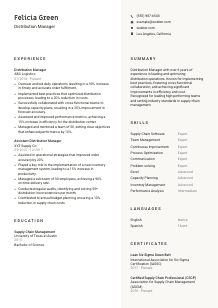
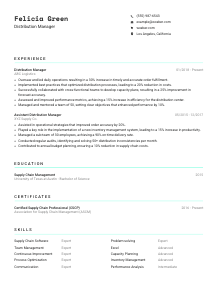
Routing supplies, but your CV hit a dead-end? Navigate this Distribution Manager CV example, created with Wozber free CV builder. Learn how to align your logistical leadership with job demands, ensuring your career reaches every delivery point with accuracy and efficiency!
Distribution management sits at the point where warehouse execution, inventory flow, labour performance, and customer service all meet. A CV for this role needs to show that you can keep orders moving accurately, improve throughput without losing control of costs, and lead a team that performs consistently under daily volume pressure.
When that story is tailored well, hiring teams can quickly separate broad logistics experience from hands-on distribution centre leadership. Wozber's free CV builder helps you shape an ATS-compliant CV around the language of the role, so metrics like fulfillment accuracy, process improvement, capacity planning, and team oversight are easy to spot early.
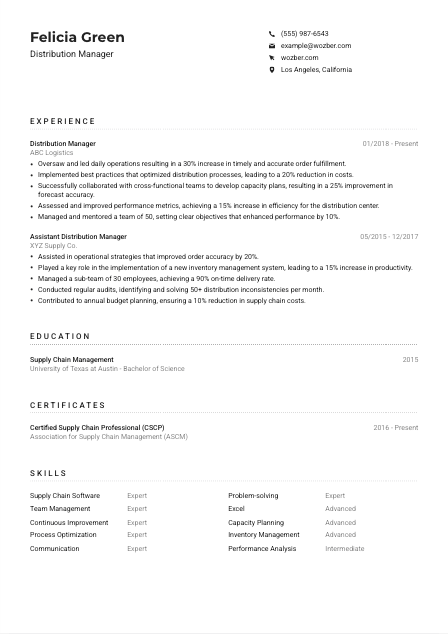
This section is simple, but it sets the tone for the rest of the CV. For a Distribution Manager, clear contact details and direct role alignment suggest the same operational order and accuracy expected in a distribution centre.
Use your full name as the most visible line on the page. Keep the formatting clean and professional. In operations roles, presentation matters because hiring teams often read it as a sign of how you handle reporting, documentation, and day-to-day discipline.
Place "Distribution Manager" beneath your name when that matches the role you are pursuing. This creates immediate alignment and helps both recruiters and ATS systems connect your background to warehouse leadership, order fulfillment, and distribution oversight instead of a broader supply chain label.
Include a phone number you answer, a professional email address, and check both carefully for errors. Small mistakes in this section can raise doubts about detail handling, which is a serious concern in work built around inventory accuracy, shipment timing, and operational reporting.
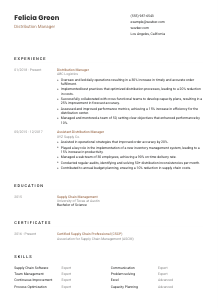
If the posting calls for a candidate in a specific area, include your city and state clearly. In the example, listing Los Angeles, California directly addresses the employer's location requirement and removes questions about relocation timing or local availability.
A LinkedIn profile or professional website can help if it reinforces your operations background with consistent titles, certifications, or career progression. Keep it current. If your online profile mentions distribution metrics, process improvement work, or team leadership scope, it should match the CV exactly.
Treat these details the way you would treat a shipping record or inventory report. Keep them accurate, current, and aligned with the role you want.




This section carries the most weight for a Distribution Manager. Hiring teams look for evidence that you have led daily distribution activity, improved process performance, managed people, and made decisions based on operating metrics rather than simply participating in warehouse work.
Before writing bullets, identify the operational themes in the posting. Here, the employer emphasizes daily distribution centre leadership, timely and accurate order fulfillment, cost reduction, capacity planning, performance analysis, and team development. Use those themes to choose which achievements deserve space on your CV.
List your most recent position first, followed by earlier relevant roles. For each entry, include your title, company, and dates. If useful, make the scale of the work visible through team size, facility activity, delivery volume, or area of responsibility so readers can judge the level of operation you handled.
Write bullets around what changed because of your work. Distribution leadership is measured through service levels, labour performance, inventory accuracy, throughput, and cost. The sample does this well by showing a 30% increase in timely and accurate order fulfillment, a 20% cost reduction, and stronger forecast accuracy through cross-functional planning.
Quantify results with metrics that matter in this field. Strong examples include on-time delivery rate, pick accuracy, dock-to-stock improvement, productivity gains, shrink reduction, cost savings, audit findings resolved, forecast accuracy, or headcount led. The point is not to add numbers everywhere, but to show the scale and business effect of your decisions.
Prioritise experience tied to distribution centers, inventory control, warehouse operations, process improvement, labour management, and cross-functional planning. Leave out unrelated duties that do not strengthen your case. Even if you have wider logistics experience, this section should keep the reader focused on your readiness to run distribution operations.
A strong experience section should leave little doubt about your ability to lead a facility, improve performance, and manage a team against measurable operating goals.
Education will not outweigh hands-on distribution results, but it still matters. For this role, it confirms formal grounding in supply chain, logistics, or business concepts that shape inventory flow, planning, and operational decision-making.
If you hold a bachelor's degree in Supply Chain Management, Logistics, Business Administration, or a related field, name it clearly. This job specifically asks for that academic background, so exact wording helps the employer confirm you meet a stated baseline requirement.
Include degree, field of study, school name, and graduation year or date range. Keep the layout straightforward so hiring teams can scan it quickly. In operations hiring, clean structure matters because it reflects disciplined communication.
If your degree is especially close to the role, make that visible. The example lists a Bachelor of Science in Supply Chain Management, which lines up neatly with the employer's requirement and reinforces technical familiarity with logistics and distribution principles.
This is most useful for early-career candidates or those changing lanes within supply chain. Include coursework or projects tied to inventory systems, transportation planning, warehouse operations, forecasting, or process improvement if they help explain your foundation.
Honors, relevant student organizations, or academic projects with a strong logistics focus can help if they support your distribution profile. Keep them brief and only include what strengthens your credibility for operational leadership.
Use education to confirm the required degree and support your distribution background, not to compete with your operating results. Relevance matters more than detail here.
Certifications matter in distribution management because they can strengthen your credibility in process improvement, supply chain planning, and operational discipline. They are especially useful when a posting names a preferred credential.
When a posting names a preferred certification, make sure it appears clearly if you have it. In this case, Certified Supply Chain Professional "CSCP" is called out, so placing it prominently helps match the job's preferred qualifications.
Focus on credentials that connect to warehouse efficiency, supply chain planning, inventory control, continuous improvement, or operational excellence. A certification such as Lean Six Sigma Green Belt can support claims about reducing costs, improving process flow, or fixing recurring performance issues.
List the issue date, renewal period, or active status when relevant. This is especially useful for certifications that remain current over time. Clear dating makes professional development easier to read and supports credibility.
Distribution environments change with systems, reporting expectations, labour models, and process standards. Relevant certifications show that you continue to build expertise beyond your original degree, particularly in areas such as supply chain strategy, continuous improvement, or quality management.
The right credentials back up your CV with formal training in the same areas employers care about most: process control, supply chain judgment, and performance improvement.
A Distribution Manager skill section should read like the toolkit of someone who can run a facility, manage people, and improve output. That means a mix of systems knowledge, planning ability, analysis, and leadership rather than a long list of generic strengths.
Start with the technical and managerial capabilities named in the job description. Here, that includes supply chain management software, Excel, leadership, team management, performance analysis, capacity planning, and distribution or inventory management experience. These should shape the section before you add anything else.
Include the tools and operational skills that support execution, then pair them with the people-management skills the role requires. For this kind of position, software proficiency and Excel matter, but so do coaching, setting objectives, conducting performance reviews, and coordinating with planning or inventory teams.
Avoid turning the section into a generic keyword dump. Choose skills you can support through experience, such as process optimisation, continuous improvement, inventory management, capacity planning, and team leadership. The sample list works because it combines operational tools with practical management strengths instead of unrelated traits.
Every skill listed here should connect back to a real accomplishment in your experience, whether that is better order accuracy, lower costs, stronger team output, or improved planning decisions.
Language ability matters in distribution management because the job relies on clear instructions, performance discussions, and coordination across teams. If a posting names a required language, address it directly and present proficiency levels honestly.
Some distribution roles include a specific communication requirement. This one asks for the ability to articulate clearly in English, so your CV should show English proficiency plainly rather than leaving it implied.
Start with the language most relevant to the job and label your level clearly. That makes it easy for a hiring team to confirm you can handle team direction, reporting, shift communication, and cross-functional coordination in the working language of the operation.
Additional languages can be valuable in distribution centers with diverse teams, vendor contacts, or regional customer networks. For example, Spanish may strengthen day-to-day communication in some warehouse environments, but it should be presented as an added advantage rather than a universal requirement.
Terms such as "Native," "Fluent," "Intermediate," and "Basic" are enough. Avoid vague wording. Operations leaders need to communicate instructions, resolve issues, and run reviews clearly, so precision here matters.
If the position involves multi-site coordination, external partners, or a multilingual workforce, language skills can carry more weight. Include them when they improve your ability to lead teams, reduce misunderstandings, or support smoother execution across the supply chain.
For a Distribution Manager, language skills are valuable when they help you lead people, keep operations aligned, and communicate clearly under pressure.
Your summary should sound like someone who understands how distribution performance is measured. In a few lines, show your level of experience, the kind of operation you have led, and the results you are known for delivering.
Review the posting and identify the few themes that matter most. For this role, those are distribution centre leadership, fulfillment accuracy, cost control, capacity planning, metric-driven improvement, and team management. Those themes should shape the opening lines of your summary.
Start with your title or professional standing, then add years of experience and your core area of strength. For example, a Distribution Manager with 6+ years in warehouse operations, process improvement, and team leadership gives a much clearer picture than a broad supply chain introduction.
Choose achievements that show business value in distribution terms. Improvements in order fulfillment, operating efficiency, cost reduction, forecast accuracy, or team performance all work well. The sample summary succeeds because it points to operational optimisation, cross-functional collaboration, and measurable efficiency gains without turning into a full job history.
Aim for a concise paragraph, usually three to five lines. Skip vague claims and make every sentence pull weight. By the end of the summary, a hiring manager should already understand your operating scope, leadership profile, and the kind of results you typically produce.
A well-built summary gives an immediate read on your distribution leadership style, your command of performance metrics, and your ability to improve day-to-day operations.
A Distribution Manager CV works best when it makes the operation visible. Show the scale you handled, the metrics you moved, the processes you improved, and the teams you led.
Use Wozber to organise that experience into an ATS-friendly CV format, align it with the job description, and tighten the language around fulfillment, inventory, cost, and leadership. The finished CV should make it easy to see that you can run a distribution centre with control and consistency.