



Use Wozber and land your dream job
Create CV
No registration required
Navigating property laws, but your CV feels like it's under eminent domain? Peruse this Real Estate Attorney CV example, created with Wozber free CV builder. Learn how to present your legal prowess in line with job requirements, so your career never hits a zoning setback!
Real estate attorneys are trusted with deals that move quickly, documents that carry serious financial exposure, and disputes where a missed issue can stall a closing or trigger litigation. Your CV needs to show that you can handle transactional detail, negotiate contracts with precision, and advise clients within the realities of zoning, land use, title, and financing.
When that experience is tailored to the target opening, the first scan becomes much clearer. Wozber's free CV builder helps you shape an ATS-compliant CV around the language of the role, so terms such as property transactions, contract negotiation, closings, and real estate litigation are easy to find in the right sections. That makes it easier for a hiring team to quickly see whether your background matches the legal work they need covered.
Law firms and in-house teams expect your header to be clean, accurate, and immediately usable. For a Real Estate Attorney, this section should confirm professional identity, contact reliability, and any location requirement without clutter.
Place your full name at the top in a clear, readable format. This is the identifier attached to your bar membership, deal history, court filings, and professional reputation, so keep it formal and consistent with your LinkedIn profile, email, and other application materials.
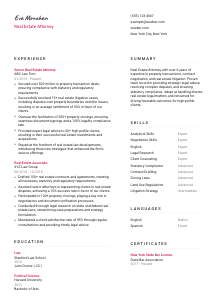
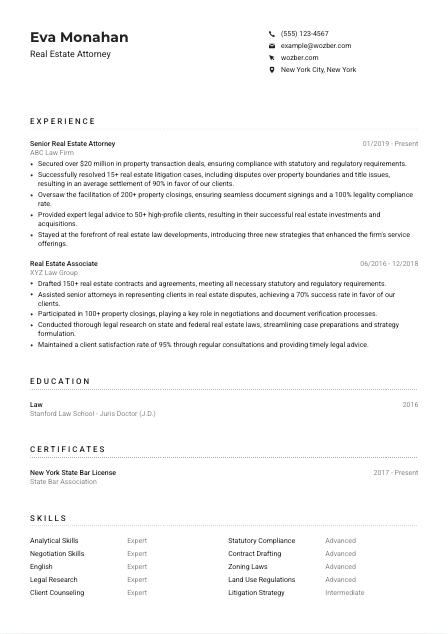
Use a title that reflects the position you are pursuing, such as "Real Estate Attorney." That immediately frames the rest of the CV around property transactions, contract drafting, closings, land use matters, and related disputes instead of leaving the reader to infer your practice area.
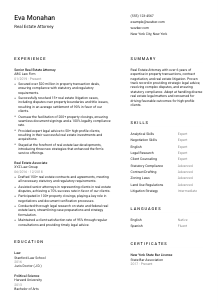
If the employer specifies a location requirement, list your city and state clearly. In the example, "New York City, New York" directly answers the posting's requirement and removes doubt about local availability for client meetings, closings, or court-related work.
A polished LinkedIn profile can reinforce your practice focus, bar status, and career progression. If you include it, make sure the titles, dates, and scope of your work match the CV exactly, especially for legal roles where credibility depends on consistency.
Your personal details should tell an employer three things right away: who you are, how to reach you, and whether basic logistical requirements are already covered. Keep it precise and professional.




This is where a Real Estate Attorney CV earns attention. Hiring teams look for the kind of legal work you handled, the complexity of the matters, the business or client outcome, and the mix of transactional and dispute-related experience behind your title.
Start by marking the work the employer emphasizes most. For this opening, that includes drafting and reviewing real estate contracts, advising on acquisitions and financing, handling closings, and supporting litigation when property disputes arise. Those are the themes your experience bullets should reflect first.
List your most recent role first and make the progression in your legal practice easy to follow. Titles such as "Senior Real Estate Attorney" and "Real Estate Associate" help show increasing responsibility across client counseling, negotiation, document review, and matter ownership.
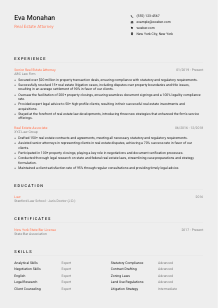
Focus each bullet on legal work that matters in real estate practice: contracts drafted, closings overseen, disputes resolved, research used to support strategy, or client advice tied to acquisitions and investments. The example does this well by citing $20 million in transaction deals and more than 15 litigation matters, which quickly signals both volume and scope.
Quantify work with measures that make sense for this field. Deal value, number of closings, contract volume, litigation outcomes, settlement rate, client portfolio size, or compliance record all help the reader gauge your level. "Oversaw 200+ property closings" is stronger than a generic claim about closing experience because it shows sustained exposure.
Prioritise experience that supports real estate law directly. If a bullet does not strengthen your case in transactions, negotiation, regulatory compliance, land use, title matters, financing, or real estate disputes, shorten it or remove it. Every line should reinforce your ability to step into a real estate docket and contribute quickly.
By the end of this section, the reader should understand the kinds of matters you have handled, the scale of your work, and how you perform in both deal execution and legal problem-solving. That is what makes your experience credible for a Real Estate Attorney role.
For attorneys, education is a credentialed requirement, not background decoration. This section should make your legal qualification easy to confirm and keep the focus on the degree that enables practice.
Lead with your Juris Doctor when the role requires it. A Real Estate Attorney posting that asks for a J.D. from an accredited law school should be answered directly in your education section, with no ambiguity about the degree earned.
List the school, degree, field, and graduation year in a simple structure. Legal employers do not need a creative layout here. They need to confirm your academic background quickly and move on to bar status and practice experience.
If the posting calls for a J.D., make that degree easy to spot. In the example, "Juris Doctor (J.D.)" from Stanford Law School immediately aligns with the requirement and helps the CV pass both ATS filtering and initial review.
Most experienced attorneys do not need a long coursework list. Include academic detail only if it adds something useful, such as real estate law, land use, property, contract drafting, or finance-related study that supports the position.
Awards, law review, moot court, or academic honors can help, especially earlier in your career. For more experienced candidates, keep them brief and only include distinctions that add professional weight without distracting from active legal practice.
Your education section should confirm that you hold the legal credential required to practice and, where relevant, show a foundation connected to property law. Keep it direct and easy to verify.
In legal hiring, licenses and professional credentials carry immediate practical weight. For a Real Estate Attorney, this section should confirm that you are authorized to practice and, if relevant, show continued engagement with the regulatory side of the field.
The most important credential here is your active bar membership and license status. If the job requires admission in a specific state, place that first. For this opening, a New York State Bar license is central, not optional context.
Beyond bar admission, include only certifications or formal training that support your work in property law, contract negotiation, zoning, land use, compliance, or related finance matters. Skip marginal items that do not strengthen your legal profile.
Include the issue date or active range where relevant. An entry such as "2017 - Present" for a bar license quickly communicates current standing and avoids any uncertainty about whether your authorization is active.
If you complete CLEs, industry certifications, or specialised training relevant to real estate transactions or land use, refresh the section periodically. In a field shaped by regulatory change, ongoing education supports your credibility with clients and employers alike.
Your certificates section should remove any doubt about your right to practice and underline your connection to current real estate law requirements. In this profession, those details matter immediately.
A Real Estate Attorney skills section works best when it reflects actual legal work, not generic strengths. Focus on the capabilities you use to structure transactions, interpret regulations, negotiate terms, and protect clients when deals or disputes become complicated.
Read the job description closely and extract both explicit and implied capabilities. Here, analytical ability, legal research, negotiation, contract drafting, and knowledge of zoning and land use regulations are all worth reflecting if they match your experience.
Order the section around the work the employer needs done. For a real estate opening, that usually means contract negotiation, statutory compliance, legal research, client counseling, property transaction support, due diligence, land use analysis, and litigation support where applicable. The example's mix of contract drafting, zoning laws, and client counseling is a useful model.
Avoid packing in every soft skill you have ever used. A tighter list reads better in ATS systems and to human reviewers. Choose skills you can support elsewhere on the page with deal volume, closing work, dispute outcomes, research tasks, or client advisory experience.
This section should read like the toolkit of a practicing real estate attorney. If the listed skills match the legal work shown in your experience, the CV feels far more convincing.
Language ability is rarely the lead qualification for legal roles, but in real estate practice it can expand client communication and transaction support, especially in markets with diverse buyers, sellers, investors, and tenants. Keep this section accurate and proportional to the role.
If the employer specifies language ability, mirror it clearly. This job explicitly asks for excellent English skills, so English should appear in a way that leaves no doubt about your professional command of legal communication.
For legal drafting, negotiation, and client advice, English proficiency is fundamental. Label it honestly using a clear level such as "Native" or "Fluent," depending on your background and actual writing ability.
If you speak another language well enough to advise clients, support negotiations, or manage communications in a transaction, include it. In the example, Spanish is a useful addition because it may broaden client access, even though it is not a universal requirement for every real estate attorney role.
Terms like "Native," "Fluent," "Intermediate," and "Basic" are usually enough. They set realistic expectations and are easier to read than vague descriptions.
List only languages you would be comfortable using in professional contexts. For attorneys, language claims should reflect real communication ability, especially when contracts, negotiations, or sensitive client discussions are involved.
Handled well, this section adds useful context about client communication without distracting from your legal qualifications. Accuracy matters more than variety.
Your summary should give a quick, focused read on your practice area, years of experience, and the kinds of matters you handle well. For a Real Estate Attorney, that usually means combining transactional work, contract negotiation, regulatory knowledge, and, if relevant, dispute experience in a few sharp lines.
Before writing, identify the legal work the opening emphasizes most. In this case, the summary should speak to property transactions, contract review and drafting, client counsel on acquisitions and financing, and the ability to address litigation issues when they arise.
Start with a direct statement such as "Real Estate Attorney with 6+ years of experience." That quickly places you at the right seniority level and gives context for the rest of the CV.
Use the next line or two to highlight the work you actually do well, such as negotiating purchase agreements, managing closings, advising on investments, resolving title or boundary disputes, or interpreting zoning and land use regulations. The sample summary succeeds because it stays anchored in real estate law rather than generic legal language.
Aim for three to five lines with no filler. Every phrase in the summary should connect to something proven later through transaction value, number of closings, litigation outcomes, bar status, or regulatory knowledge. If the body of the CV cannot back it up, revise it.
A good summary gives the reader a fast, accurate picture of your real estate practice before they reach the detail. It should position you for the role in a few lines and make the rest of the CV feel consistent.
A Real Estate Attorney CV should make your practice area, licensing, deal work, and legal judgment easy to identify within seconds. That means clear titles, focused experience bullets, and language that matches the employer's needs in transactions, closings, compliance, and dispute work.
Use Wozber's free CV builder to organise that experience into an ATS-friendly CV format and tighten the wording around the target job description. The final result should make one thing clear right away: you are ready to handle the legal demands of the real estate matters on the employer's desk.