



Use Wozber and land your dream job
Create CV
No registration required
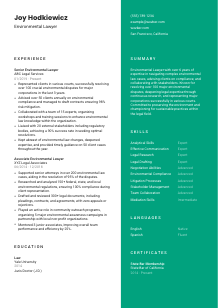
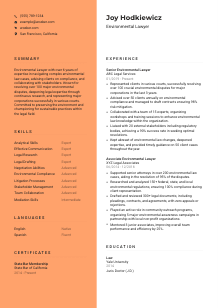
Defending nature, but your CV feels unnatural? Check out this Environmental Lawyer CV example, created with Wozber free CV builder. Learn how to present your legal advocacy with eco-integrity in line with job requirements, guiding your green career to flourish as naturally as the landscapes you protect!
Environmental law work is reviewed through the quality of your judgment under pressure. Hiring teams want to see whether you can move between regulatory interpretation, compliance advice, negotiated resolutions, and formal disputes without losing precision. Your CV should make that range visible through the matters you handled, the forums you worked in, and the client outcomes you influenced.
For this profession, tailoring changes which part of your background becomes legible first. A generic legal CV can bury environmental litigation, agency-facing work, or compliance counseling under broad attorney language. Wozber's free CV builder helps you shape that experience into an ATS-compliant CV that reflects the posting's wording and surfaces the environmental law strengths a firm or in-house team needs to spot quickly.
In environmental law, small omissions can raise unnecessary questions before your case experience is even read. Your header should confirm who you are, how to reach you, and whether you meet practical requirements tied to the role. Keep this section clean, accurate, and aligned with the position you are targeting.
Place your full name at the top in a format that is easy to scan. For attorneys, this is the anchor of your professional identity, so keep it more prominent than the rest of the contact information without adding clutter.
Add "Environmental Lawyer" under your name when that is the role you are pursuing. This immediately frames the rest of the CV around environmental litigation, regulatory counseling, and compliance work rather than general legal practice.
Include a reliable phone number and a professional email address. If you maintain a LinkedIn profile or professional site with publications, bar details, or representative matters, make sure it matches the CV exactly before linking it.
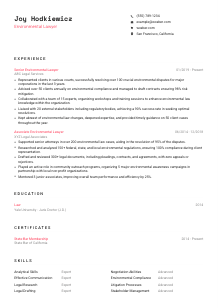
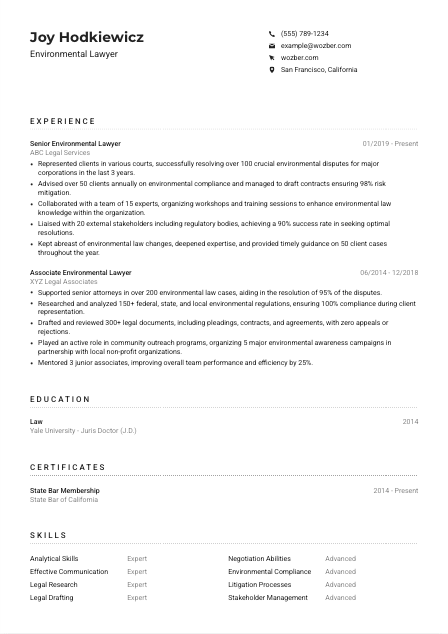
If a job specifies a jurisdictional or city-based requirement, include your location plainly. In the example, listing "San Francisco, California" directly supports the employer's stated location requirement and removes doubt about local availability.
A LinkedIn page, law firm bio, or personal legal profile can help if it shows environmental matters, speaking engagements, articles, or bar information. Skip it if it is outdated or too thin to add substance.
Your personal details should answer logistical questions immediately and keep the reader focused on your environmental law experience. Clean contact information and any required location detail are enough.




This section carries the most weight for an Environmental Lawyer. Employers look for proof that you have handled disputes, interpreted regulations, drafted legal documents, and advised clients in ways that reduced exposure or moved matters toward resolution. The strongest entries show what kind of environmental work you handled and what happened because of it.
Read the job description closely and mark the legal work it emphasizes. Here, the core themes are environmental disputes, compliance advice, drafting pleadings and agreements, stakeholder coordination, and current knowledge of federal, state, and local regulations. Those are the threads your bullet points should bring forward.
Start with your most recent position and present each entry with title, employer, and dates. This format helps a hiring team quickly understand your level of responsibility, whether you progressed from associate work to lead counsel responsibilities, and how long you have been practicing in the field.
Focus each bullet on legal work that matters in environmental practice. Court representation, agency proceedings, compliance counseling, contract drafting, permit-related issues, negotiations, and cross-functional advisory work all belong here. The example does this well by tying representation to more than 100 environmental disputes and compliance advice to measurable risk mitigation.
Quantify where the figures are meaningful and defensible. Strong measures for this field include number of disputes resolved, clients advised, documents drafted, regulatory issues researched, stakeholder groups managed, or success rates in negotiated outcomes. Metrics like "300+ legal documents reviewed" or "50 clients advised annually" add concrete scale without overstating the work.
Prioritise experience that proves environmental law depth. General litigation bullets, unrelated corporate work, or administrative tasks should only stay if they support transferable strengths such as negotiation, regulatory analysis, or stakeholder management. Keep the section centered on the work that shows you can handle environmental disputes and compliance issues from day one.
Your experience section should show more than legal employment history. It should make clear what environmental matters you handled, how you worked with clients and agencies, and what results followed. Wozber's ATS CV scanner can help you align that language with the posting so the right work rises to the top.
For an Environmental Lawyer, education is a threshold item before it becomes a differentiator. The CV needs to show quickly that you hold the required legal degree, and then present it in a straightforward format that supports the rest of your practice record. Keep this section direct and easy to verify.
If the posting calls for a Juris Doctor, make sure your J.D. is impossible to miss. This is a baseline requirement, so it should appear clearly and in standard legal credential language.
List the degree, field, school, and graduation year. For most mid-career environmental lawyers, that is enough. The example handles this efficiently with the J.D., institution, and year, which keeps the section credible and easy to scan.
Use the same recognizable terminology the employer uses when it reflects your actual credential. If the role asks for a "Juris Doctor (J.D.) degree," present it that way rather than using shorthand alone.
If you are earlier in your legal career, or if your academic work included environmental law, administrative law, natural resources, land use, or related clinics, selected coursework can help. For an experienced attorney, practice outcomes usually matter more than class lists.
Continuing legal education, environmental law programs, or specialised academic study can strengthen this section if they connect directly to your practice. Use them selectively and place them where they add context rather than noise.
The education section should quickly establish that you meet the legal training requirement and then get out of the way. Clear presentation helps the hiring team move straight to the part that matters most, your environmental law record.
In law, credentials are not decorative. They establish whether you are currently authorized to practice and whether your professional standing supports immediate hiring. For an Environmental Lawyer, this section should confirm bar status first and then include any additional credentials that sharpen your specialization.
When a posting asks for active bar membership and good standing, list that credential clearly. In this case, state bar membership is far more important than optional certificates because it directly addresses eligibility to practice.
After bar admission, include only certifications or formal credentials that strengthen your environmental law profile. That might include environmental mediation training, compliance-related programs, or recognized legal specializations if they are relevant to your jurisdiction and practice focus.
Include the year earned and, where appropriate, indicate that the credential is current. For bar membership, wording such as "2014 - Present" or "Active" makes current standing easier to read at a glance.
Environmental law changes with legislation, agency rulemaking, and litigation trends. Recent credentials or formal training can support the impression that you stay current with evolving standards, especially if your recent experience does not show that on its own.
For this profession, the most important credential is the one that confirms you can practice law in the relevant jurisdiction. Add any extra certifications only when they strengthen your environmental law profile in a concrete way.
A skills section works best when it reads like a concise map of how you practice. For Environmental Lawyers, that means balancing legal analysis with courtroom, negotiation, drafting, and regulatory capabilities. The skills you choose should reinforce the experience section, not repeat generic attorney language.
Start with the capabilities the employer actually named. In this posting, that includes research and analytical strength, communication, negotiation, and knowledge of environmental regulations and litigation processes. These should shape the core of your list.
Feature the skills you can prove through your casework and advisory history. If your background includes court representation, agency interaction, compliance guidance, and legal drafting, move those higher than broad soft-skill labels. The example's mix of legal research, legal drafting, environmental compliance, and stakeholder management is a useful model.
Choose skills that hiring teams would expect to see applied in environmental matters. Strong options include regulatory analysis, environmental compliance, administrative proceedings, litigation strategy, negotiation, stakeholder management, contract review, and risk assessment. Skip filler terms that could belong to almost any profession.
Every skill on the page should connect to actual work you have done, whether that is researching regulations, negotiating settlements, drafting pleadings, or advising clients on compliance risk. Targeted language also improves ATS optimisation without turning the section into a keyword list.
Language skills matter in legal practice when they affect client communication, negotiations, community engagement, or cross-border environmental issues. For many Environmental Lawyer roles, English is the only stated requirement, but additional languages can still strengthen your profile when they support the type of clients or stakeholders you work with.
Check whether the posting names a required language and list it clearly. Here, English proficiency is explicitly required, so it should appear prominently in the section.
Add any other languages that help you work with clients, agencies, community groups, or nonprofit partners. In environmental matters, multilingual ability can be useful in outreach, negotiations, and matters involving diverse local stakeholders.
List other languages only when you can use them in a meaningful professional context. A second language can be especially relevant in regions or practices where community engagement or international environmental issues are part of the work.
Use honest labels such as native, fluent, professional, conversational, or basic. Overstating language ability can become a problem quickly in client calls, negotiations, or document review.
If your environmental law work touches cross-border regulation, multinational clients, or local advocacy groups, language ability may carry more weight. Tailor this section to the type of matters and stakeholders the employer is likely to handle.
When languages support legal communication or stakeholder work, they add real value. Present them plainly, starting with any required language and then any additional fluency that strengthens your practice profile.
The summary should quickly establish your level of practice, your environmental law focus, and the kind of matters you are equipped to handle. For this profession, a useful summary mentions years of experience, core legal scope, and one or two concrete achievements or strengths that match the target role.
Before writing, identify the few requirements that define the role. In this case, those include environmental law experience, regulatory knowledge, litigation capability, drafting strength, and communication with clients and outside stakeholders. Use those to decide what belongs in the opening lines.
Start with a direct introduction such as your title, years of experience, and environmental law concentration. That gives immediate context and helps distinguish you from general litigators or attorneys whose environmental work is only occasional.
Bring in the core capabilities the employer is hiring for, such as advising on compliance, handling disputes, researching regulations, or negotiating outcomes. The example summary works because it names both case resolution and compliance counseling rather than staying abstract.
Aim for a few sentences that say something concrete. A concise summary with one or two measurable points will usually land better than a paragraph of broad claims about passion or dedication. Save the detail for your experience section.
Your summary should tell the reader, within a few lines, what kind of Environmental Lawyer you are and what matters you are ready to handle. Wozber's AI CV builder and ATS-friendly CV template can help you tune that wording to the posting while keeping the summary sharp and easy to read.
A persuasive Environmental Lawyer CV shows how you operate in real matters. It connects your legal credentials, regulatory knowledge, drafting ability, dispute work, and stakeholder coordination in a way that makes your practice easy to understand.
Use Wozber to build an ATS-friendly CV format that reflects the language of the role and keeps your strongest environmental law experience in clear view. When the sections work together, a hiring team can quickly see your readiness to advise clients, manage risk, and handle environmental disputes with confidence.