



Use Wozber and land your dream job
Create CV
No registration required
Defending the accused, but your CV can't make bail? Check out this Criminal Lawyer CV example, created with Wozber free CV builder. Learn how to present your legal prowess to match job specifics, and build a profile that doesn't require an appeal!
Criminal law CVs are read through the lens of case responsibility. Hiring teams want to see whether you can research quickly, draft clean motions and pleadings, negotiate under pressure, and stand up in court with sound judgment. A vague list of duties does not help much here. Your CV needs to show the kinds of matters you handled, the legal work you owned, and the outcomes you influenced.
A targeted CV also helps separate broad legal experience from real criminal practice. When the posting calls for criminal litigation, bar admission, and strong written and oral advocacy, Wozber's free CV builder helps you align that experience in an ATS-compliant CV with the right terminology, section structure, and emphasis. That makes it easier for a legal employer to see your courtroom background, drafting ability, and client-facing credibility early.
In legal hiring, the top of the CV should look precise and professional. For a Criminal Lawyer, this section needs to identify you clearly, confirm you are reachable, and quickly address any practical requirement that affects whether your application can move forward.
Place your name at the top in a clean, prominent format. This is standard in legal CVs and should match the name you use for bar records, court filings, and professional profiles so there is no confusion during screening or conflict checks.
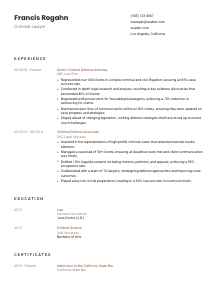
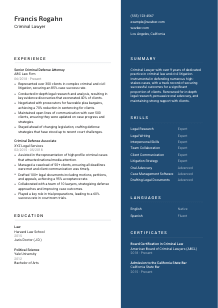
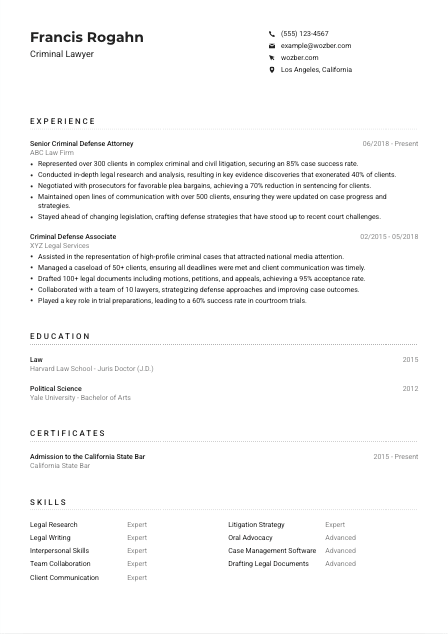
Add "Criminal Lawyer" beneath your name if that is the role you are pursuing. If your recent title is more specific, such as "Senior Criminal Defence Attorney," you can use that when it strengthens your positioning. The sample CV does this well by immediately anchoring the candidate in criminal defence work.
List a reliable phone number and a professional email address. Accuracy matters here. One typo can cost you an interview. If you include a website or LinkedIn profile, make sure the content supports your litigation background, writing credentials, speaking engagements, or case-related professional activity.
If the employer wants someone based in a specific market, put your city and state in this section. For this opening, Los Angeles, California matters, so stating it directly removes an early question. Keep in mind that location is often posting-specific, not a universal requirement for every criminal lawyer role.
A polished LinkedIn page, firm bio, or professional website can add context on practice areas, bar standing, publications, or trial work. Skip personal links that do not support your candidacy. Everything here should reinforce professional credibility and make follow-up easier.
This section should do its job quietly and well. Clear identity, correct contact information, and any required location detail let the employer move straight to your litigation record.




This is the section that carries the most weight for an experienced Criminal Lawyer. Employers want to see the scope of your practice, the kind of legal work you handled, and whether your record points to sound courtroom judgment, strong drafting, and reliable client advocacy.
Start by pulling out the work this employer actually needs: criminal law experience, legal research, legal writing, oral advocacy, negotiation, and client communication. Then make sure those themes appear across your bullets in concrete terms. If the posting asks for 5+ years in criminal law, your dates and role titles should make that timeline obvious.
List your most recent legal position first, then work backward. Include firm or employer name, title, and dates. For criminal practice, that order helps the reader quickly assess current litigation level, whether you have moved from associate work into lead responsibility, and how long you have been handling criminal matters.
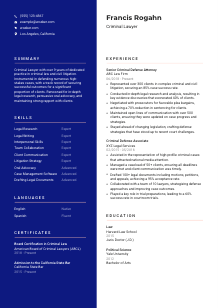
Each role should show what you actually did and what changed because of it. Mention representations, hearings, motions, plea negotiations, trial preparation, appeals, or client counseling where relevant. The example CV is effective because it does not stop at "handled cases." It specifies representing 300+ clients, drafting key documents, negotiating reduced sentences, and maintaining active client communication.
Numbers work well when they reflect real legal outcomes or workload. Caseload volume, trial success rate, motion acceptance rate, sentencing reductions, number of clients advised, or size of matters handled all help a reader understand your level. Use metrics honestly and in context. In the sample, figures such as an 85% case success rate and 70% sentencing reduction immediately tell the reader how the candidate performed under pressure.
If you have worked across practice areas, prioritise bullets tied to criminal defence, prosecution, litigation strategy, evidentiary research, plea bargaining, and courtroom advocacy. Civil litigation can stay if it supports the role, especially when the posting includes it, but criminal practice should remain the centre of gravity. Choose examples that show you can manage case progression, advise clients clearly, and respond to changing case law.
A hiring partner or legal recruiter should be able to scan this section and understand your practice level, courtroom exposure, drafting strength, and client load without guessing. That is what turns experience into credibility.
For a Criminal Lawyer, education establishes the formal legal foundation behind your practice. It needs to confirm that you hold the required degree and present your academic history in a format that legal employers can scan quickly.
A Juris Doctor is a baseline requirement for this role, so make it prominent. List the law school, degree, and graduation year clearly. If you hold additional relevant academic credentials, place them below the J.D. rather than letting an undergraduate degree take the lead.
Use a simple structure with school, degree, field, and year. Legal hiring does not reward decorative formatting here. It rewards clarity. The sample CV handles this well by presenting the law degree first and keeping each entry easy to read.
If your background includes criminal procedure, trial advocacy, evidence, appellate advocacy, or other coursework closely tied to criminal litigation, include that selectively. This is most helpful for earlier-career lawyers or candidates whose academic work directly supports the target role.
Moot court, mock trial, law review, criminal defence clinics, judicial internships, or notable academic honors can strengthen this section when they relate to advocacy, writing, or litigation training. These details are especially useful if you want to reinforce oral advocacy or research credentials beyond your work history.
If you already have years of criminal practice, keep education concise and let experience do the heavy lifting. If you are closer to the minimum experience threshold or shifting into a more specialised criminal role, a bit more educational detail can help round out your profile.
This section should confirm your credentials without slowing the reader down. Once your J.D. and relevant academic context are clear, the spotlight should return to your practice record.
Licensure and professional credentials matter in legal hiring because they speak directly to eligibility and standing. For a Criminal Lawyer, this section should focus on bar admission and any certifications that genuinely strengthen your criminal practice profile.
If a posting requires admission to the state bar, list that first. For this role, admission to the California State Bar is a core qualification, so it belongs near the top of your credentials. Make sure the wording is accurate and current.
After bar admission, include certifications that deepen your authority in criminal law, trial advocacy, or a related specialty. A board certification in criminal law can add weight. A general seminar or short workshop usually does not need space unless it is unusually relevant to the target role.
Dates help show when you were admitted and whether a credential is active. That matters more in law than in many other fields because employers often need to confirm present eligibility, not just past completion.
Criminal law changes with legislation, appellate decisions, and procedural updates. Relevant credentials and ongoing education show that you stay current in the areas that affect defence strategy, research quality, and courtroom preparation.
This section should quickly answer two questions: can you practice, and have you continued building expertise in criminal law. If the answer is clear, the section is doing its job.
A Criminal Lawyer's skills section should reflect how the work is actually done. Legal employers look for a mix of litigation ability, writing strength, research depth, client management, and courtroom communication, not a generic list of soft skills.
Start with the exact competencies named in the job description. Here, legal research, legal writing, oral advocacy, interpersonal skills, teamwork, and English communication are central. Mirroring that language helps both ATS screening and human review when those skills reflect your real experience.
Include a mix of hard and applied skills such as legal research, drafting pleadings, motion practice, trial preparation, plea negotiation, case strategy, client counseling, and case management software if relevant. The example CV does this well by pairing core advocacy skills with practical tools and collaboration strengths.
Avoid loading this section with every capability you have picked up across your legal career. Choose the skills most likely to matter in criminal defence or prosecution settings. A tighter list gives clearer direction and makes your profile easier to read in both ATS scans and attorney review.
Your skills list should reinforce what appears in your experience section. When the same abilities show up in both places, your CV reads as consistent and well-grounded.
Language ability can matter in criminal practice because client trust, courtroom communication, and case preparation all depend on precision. This section is most useful when it reflects languages you can use confidently in legal or client-facing settings.
If the posting requires effective English communication, place English at the top with an honest proficiency level. For a Criminal Lawyer, this supports written advocacy, oral argument, negotiation, and client counseling.
If you can work with clients in another language, list it. In many jurisdictions, Spanish can be a practical asset for intake, case explanation, and rapport-building. That does not make it mandatory everywhere, but it can strengthen your profile where client populations are multilingual.
Extra languages are worth including if they help with client communication, witness interaction, or community-facing legal work. Leave out languages you studied casually but could not use in a professional setting.
Use clear labels such as "Native," "Fluent," or "Advanced." Avoid overstating ability. In legal work, accuracy matters because misunderstandings can affect advice, trust, and case preparation.
A second language is most meaningful when it improves how you serve clients or coordinate with others involved in a case. If your language skills have helped with consultations, document review, or explaining legal options to clients, that added context can reinforce the value elsewhere in the CV.
Keep this section factual and useful. If a language helps you communicate more effectively with clients or communities you serve, it belongs here.
The summary should frame your criminal law background in a few lines that feel specific and credible. It needs to establish your practice level quickly and point the reader toward the strengths that matter most for the role, such as litigation experience, written advocacy, negotiation, and client representation.
Read the posting closely before writing the summary. If it emphasizes criminal law experience, legal research, oral advocacy, and client communication, those should shape the opening lines rather than broad statements about passion or dedication.
Start with a direct introduction such as "Criminal Lawyer with 9+ years of experience in criminal law and civil litigation." That immediately establishes seniority and practice area. The sample summary does this effectively by grounding the candidate in years of practice and litigation scope.
Choose capabilities that are central to the role and supported later in the CV. Strong examples include trial preparation, legal research that influenced case strategy, persuasive oral advocacy, favorable plea negotiations, or client management across a large caseload. If you mention outcomes, make sure they are echoed in your experience bullets.
Aim for 3 to 5 lines. Avoid generic phrases that could fit any attorney. A concise summary with clear practice focus, years of experience, and one or two meaningful results gives the reader a sharper first impression than a paragraph full of broad claims.
When this section is working, a reader understands your level, your practice focus, and the strengths you bring to criminal litigation before they reach the first job entry.
A Criminal Lawyer CV should present the same qualities you bring to a case: precision, judgment, and command of the facts. When your sections are tailored around criminal practice, bar eligibility, courtroom work, legal writing, and client advocacy, employers can quickly see whether your background matches the matters they need handled.
Wozber's free CV builder can help you organise that experience into an ATS-friendly CV format, and its ATS CV scanner can help surface missing requirements, sharpen role-specific wording, and improve alignment with the posting. The final result should make one thing easy to judge: whether you are ready to take responsibility for clients, strategy, and courtroom outcomes from day one.