



Use Wozber and land your dream job
Create CV
No registration required
Roundtable legal advice, but your CV feels like a solo act? Check out this In-House Counsel CV example, created with Wozber free CV builder. It shows how to align your corporate counsel brilliance with job directives, scripting a career path that resonates with in-house legal leadership!
In-house counsel work sits at the point where legal judgment meets business execution. Hiring teams look quickly for lawyers who can move from contract language to operational risk, advise non-legal stakeholders clearly, and keep compliance from slowing the business down. Your CV should make that range visible through the matters you handled, the documents you negotiated, and the decisions you influenced.
A tailored CV changes how your background is read in the first scan. When your experience mirrors the posting's language around contracts, risk assessment, outside counsel management, and cross-functional support, it is easier for both people and ATS filters to place you in the right legal lane. Wozber's free CV builder helps you shape that alignment in an ATS-friendly CV format, so the hiring team can quickly see whether your legal experience matches the company's day-to-day counsel needs.
This section is simple, but it carries practical hiring signals in legal recruiting. For in-house counsel roles, your contact block should immediately show a professional identity, a reliable way to reach you, and, when relevant, whether you already meet a location requirement.
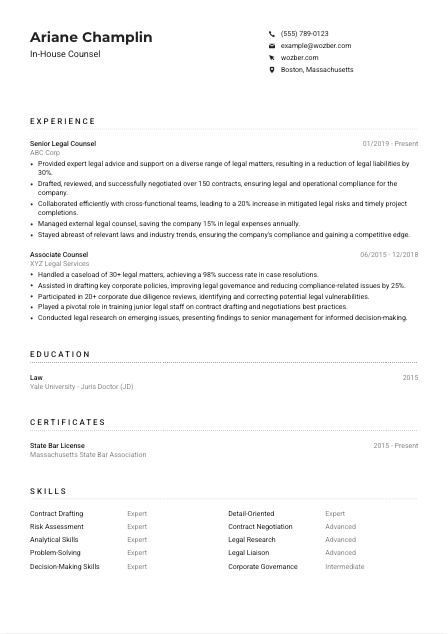
Place your full name at the top, followed by the title "In-House Counsel" or a closely related title that matches your current level, such as "Senior Legal Counsel" if that is how your recent work has been scoped. This helps frame you as a business-facing lawyer rather than a general legal applicant.
Use the target title directly under your name when it accurately reflects your background. For this opening, "In-House Counsel" works well because it aligns with a role centered on contracts, compliance, and legal support across business functions.
Legal hiring often moves quickly once a shortlist is formed, so accuracy matters here.
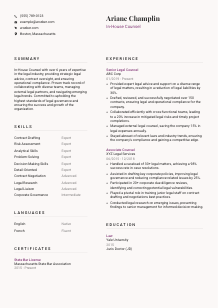
If a company requires local presence, show it clearly in your contact details. Here, listing "Boston, Massachusetts" removes a basic screening question right away. Only do this when it reflects your actual situation, not as a default for every application.
A LinkedIn profile can support your application if it is current and consistent with your CV. Make sure titles, dates, bar admission details, and major legal responsibilities match, especially if your profile highlights contract work, compliance, or corporate governance.
For in-house counsel, contact details should confirm professionalism and remove avoidable friction. A precise header lets the reader move straight to the substance of your legal experience.




This is the section that carries the most weight for experienced counsel. Companies want to see how you handled legal work in motion: what kinds of matters you covered, what you negotiated, how you reduced exposure, and how well you worked with finance, HR, operations, leadership, and outside counsel.
Before rewriting bullets, identify the work patterns in the job description. Here, the repeated themes are contract drafting and negotiation, risk assessment, regulatory compliance, broad legal support, and external counsel management. Those themes should shape which matters and outcomes you foreground.
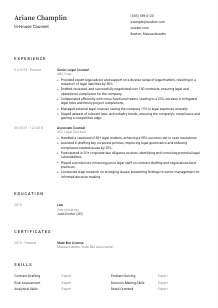
List positions in reverse chronological order and make each one show the level of legal ownership you had. For in-house and corporate roles, that often includes advising internal teams, reviewing commercial documents, supporting policy decisions, or overseeing outside firms. The sample CV does this well by separating senior counsel work from earlier associate counsel experience and showing increased responsibility over time.
Generic phrases like "reviewed contracts" do not tell much. Instead, show volume, complexity, and result. "Negotiated over 150 contracts" says far more because it points to drafting load, stakeholder coordination, and operational support. If you worked across employment, IP, compliance, or vendor agreements, name those areas when they are relevant to the target role.
Numbers work especially well in legal CVs when they reflect real business outcomes: reduced liabilities, faster contract turnaround, savings from managing outside counsel, audit findings resolved, disputes avoided, or compliance issues reduced. In the example, a 30% reduction in legal liabilities and 15% annual savings on legal spend make the counsel's contribution easy to understand.
Prioritise work that shows business-facing legal judgment. Litigation-heavy details, academic legal work, or unrelated early experience can be shortened unless they directly support the job you are targeting. Every bullet should help the reader see you operating as trusted counsel inside an organisation.
The best experience sections make clear that you did more than interpret law. They show that you negotiated effectively, controlled risk, and helped the company move forward with fewer legal surprises.
For an in-house counsel role, education is straightforward but essential. The employer needs to confirm that you hold the expected legal degree, and your CV should make that easy to find without extra wording or formatting clutter.
If the posting asks for a Juris Doctor, list your JD clearly and use the standard wording. That direct match matters in legal hiring, especially when degree requirements are used as an early screening filter.
Include the school name, degree, field, and graduation year in a simple structure. For most in-house counsel candidates, that is enough. The example handles this efficiently with Yale University, Juris Doctor, Law, and the graduation year.
If the posting says "Juris Doctor (JD) degree from an accredited law school," your CV should use comparable wording rather than abbreviations alone. Small alignment choices like this help both ATS parsing and human review.
Most lawyers with 5+ years of experience do not need coursework listed. If you are earlier in your legal career, selected coursework in contracts, employment law, securities regulation, intellectual property, or compliance can help connect your training to the work the company needs covered.
Honors, law review, moot court, or notable academic awards can support your profile, especially if they reinforce writing strength, research discipline, or subject-matter depth. Keep them brief and relevant so the section stays focused on qualifications that matter for practice.
This section does not need heavy detail. It needs to show, quickly and clearly, that you have the formal legal training the role requires.
In legal hiring, this section is less about optional badges and more about practice eligibility. For in-house counsel, bar admission and standing are often non-negotiable, so list them in a way that removes doubt about your authorization to practice.
Give priority to bar admission, active license status, and any certification directly tied to the legal work you perform. If a posting names state bar membership, that belongs at the top of this section.
When a company asks for admission in a specific state, name that bar clearly. In this case, a Massachusetts bar license is directly relevant because the role is tied to that jurisdiction. If you hold multiple admissions, list the most relevant one first.
Licenses should show the year of admission or active period, especially if the employer wants someone in good standing. The sample CV's "2015 - Present" format works because it confirms current continuity without overexplaining.
If you have certifications or formal training in compliance, privacy, employment law, corporate governance, or industry-specific regulation, include them when they strengthen your case for the role. This is especially useful when the in-house position touches specialised regulatory areas.
For counsel roles, bar status is a practical hiring checkpoint. A clear certification section tells the employer you can step into legal work without uncertainty about qualification or standing.
A skills section works best when it reads like the operating toolkit of a business-facing lawyer. Focus on the legal capabilities and judgment areas that show up repeatedly in in-house work, not broad traits that could belong on any professional CV.
Start with the skills the posting explicitly names, then add the closely related abilities required to do that work well. For this role, contract drafting, negotiation, risk assessment, analytical judgment, decision-making, and communication are central. Compliance support, legal research, and cross-functional advising are also natural additions when they reflect your experience.
Every skill listed should be backed up somewhere else on the CV through a matter, document type, stakeholder group, or measurable result. If you claim strength in contract negotiation, the experience section should show negotiated agreements, deal volume, or business outcomes tied to that work.
A shorter list of high-value legal skills is stronger than a crowded section full of generic terms. The sample CV is on the right track with skills such as Contract Drafting, Risk Assessment, Contract Negotiation, and Corporate Governance. Keep the emphasis on legal work product, decision quality, and business partnership.
This section should help the reader picture you reviewing contracts, advising stakeholders, assessing exposure, and supporting compliant business decisions. If a skill does not connect to that picture, leave it out.
Language matters differently in legal roles than in many other jobs. Precision, nuance, and the ability to communicate advice clearly are part of the work itself, so list languages in a way that supports the kind of legal communication the role requires.
If the job description specifically calls for strong English communication, list English prominently with an accurate proficiency level. For an in-house counsel position, this supports expectations around drafting, negotiation, policy review, and executive communication.
Start with the language most important to the role, then add others that could be useful in negotiations, cross-border matters, or internal collaboration. English should lead for this posting, with any additional languages following.
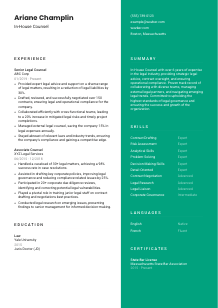
Additional languages can strengthen your profile if the company works with international vendors, foreign affiliates, or multilingual teams. The example lists French, which may be useful depending on the company's footprint, though it is not a universal requirement for in-house counsel.
Be precise with labels such as Native, Fluent, Professional, Conversational, or Basic. Legal work depends on exact language use, so overstating proficiency can create problems later in interviews or on the job.
Only emphasize multilingual ability when it supports the position's legal work. For some in-house counsel roles, English drafting and negotiation are the real priority. For others, language range can help with international contracts, regulatory research, or subsidiary support.
For counsel roles, language proficiency should support credibility. Show clearly where you can draft, advise, negotiate, or collaborate without ambiguity.
Your summary should frame your practice quickly: years of experience, the kinds of legal work you handle, and the business context you support. For in-house counsel roles, this is where you establish that you are comfortable balancing legal protection with operational reality.
Read the posting closely and identify the few responsibilities that define the role. In this case, that means broad legal support, contract work, risk assessment, compliance, and collaboration with internal teams. Those are the themes your summary should echo in natural language.
Begin with a direct statement of who you are as a lawyer, including years of experience and your core area of practice. "In-House Counsel with 6+ years of experience" or "Corporate Counsel with experience across contracts and compliance" gives immediate context.
Use the middle of the summary to highlight the legal work you are best known for and the results you delivered. The example does this effectively by pointing to strategic legal advice, contract oversight, operational compliance, and cross-functional collaboration. If you can add a short outcome such as reducing liabilities or managing legal spend, even better.
Aim for three to four sentences that sound like a lawyer who understands business context. Avoid vague claims about passion or excellence. Focus instead on advising clearly, negotiating effectively, supporting compliance, and helping leadership make sound decisions.
A well-written summary should position you as counsel who can handle contracts, guide stakeholders, and manage risk in a live business environment. That is the standard the rest of your CV should reinforce.
Once your CV reflects the legal work you actually do, it becomes much easier for a company to picture you inside the business. Keep the emphasis on contract judgment, risk management, compliance support, stakeholder advising, and the measurable outcomes of your counsel.
Use Wozber's free CV builder to refine wording, strengthen ATS optimisation, and organise your background into an ATS-compliant CV that matches the role's legal requirements. The finished document should make one thing clear fast: you can provide sound legal guidance in a business setting from day one.




