



Use Wozber and land your dream job
Create CV
No registration required
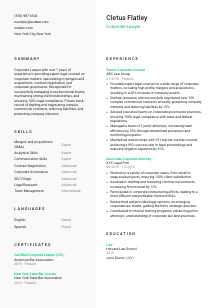
Drafting legal documents, but your CV seems to be in session? Check out this Corporate Lawyer CV example, created with Wozber free CV builder. Learn how to present your corporate law expertise clearly to match job criteria, keeping your legal career in favorable motion!
Corporate law CVs are reviewed through the lens of business risk. Hiring teams want to see whether you have handled the work that keeps transactions moving, contracts defensible, governance clean, and leadership informed when legal exposure is high. A generic legal CV usually misses that standard because it talks about duties instead of showing deal scope, negotiation depth, regulatory judgment, and the business outcomes shaped by your advice.
When your CV is tailored to the position, the first read becomes much more specific. A team looking for corporate counsel can quickly connect your background to M&A, SEC filings, contract negotiation, corporate restructuring, and cross-functional legal support. Wozber's free CV builder helps you present that experience in an ATS-friendly CV format, align your language with the posting, and make it easier for reviewers to recognize where your corporate practice matches the legal work on their desk.
This section should confirm the basics fast. For a Corporate Lawyer, that means a clear professional title, reliable contact information, and any location detail the employer has explicitly asked for. Keep it clean so the reader can move straight to your transactions, governance work, and contract portfolio.
Place your full name at the top, followed by a title that matches the work you are pursuing. If the target job is for a Corporate Lawyer, use that title or a close equivalent such as Corporate Counsel when it reflects your actual background. This gives both ATS software and legal hiring teams an immediate read on your practice focus.
Add a phone number you answer and an email address that reads professionally, ideally in a simple firstname.lastname format. Corporate legal hiring often moves through direct outreach from recruiters, general counsel, or HR partners, so accuracy matters. One typo in your contact details can stall an otherwise strong application.
Some corporate law roles are tied to a specific office or state-based practice requirement. Here, the employer asks for someone located in New York City, New York, so listing "New York City, New York" directly in your header helps remove doubt early. Keep this kind of location tailoring tied to the posting rather than treating it as a universal CV rule.
A LinkedIn profile or professional website can support your application if it is current and consistent with your CV. For legal candidates, that usually means matching job titles, dates, bar status, and major practice areas such as M&A, governance, or commercial contracting. Include it only if it strengthens your professional record.
Do not add age, marital status, photo, or other personal details unrelated to legal practice. They do nothing to support your ability to advise on transactions, manage outside counsel, or negotiate complex agreements. Keep the header focused on information that moves your candidacy forward.
Your contact section should answer practical questions quickly: who you are, what kind of legal work you do, how to reach you, and whether you meet any stated location requirement. Once that is clear, the rest of the CV can focus on the substance of your corporate practice.




This is where corporate legal hiring decisions are usually made. Employers want more than titles. They want to see the matters you handled, the scale of your contract work, the governance issues you advised on, the stakeholders you supported, and the outcomes your counsel influenced.
Start by identifying the legal work the employer has emphasized. In this case, that includes mergers and acquisitions, SEC filings, contract negotiation, corporate governance, corporate restructuring, compliance, and coordination with outside counsel. Use those priorities to decide which matters, bullets, and keywords deserve space on your CV so your experience tracks closely with the role's actual legal workload.
List your most recent legal position first, then work backward. That format lets the reader follow your progression from earlier corporate law work into higher-responsibility counsel roles with greater deal ownership, client exposure, and governance responsibility. For lawyers with more than 5 years of experience, recent practice usually carries the most weight.
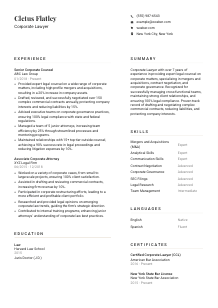
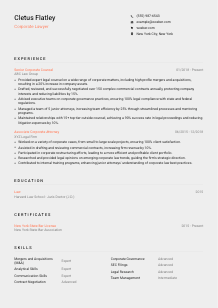
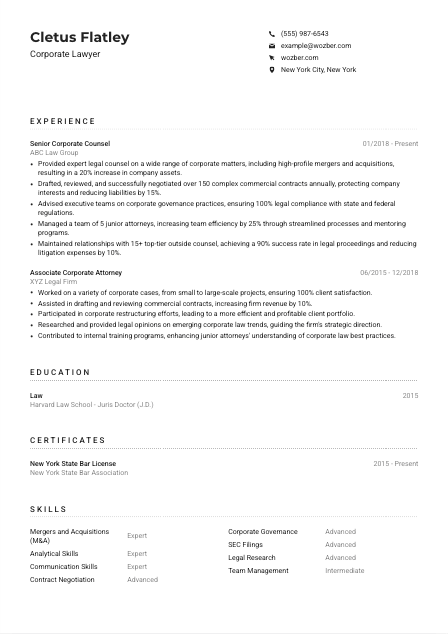
Each bullet should show what you handled and what changed because of your work. Instead of saying you "reviewed contracts," specify the volume, complexity, counterparties, or business result. The sample CV does this well by citing more than 150 complex commercial contracts negotiated annually and a 15% reduction in liabilities. Those details give hiring teams a clearer picture of pace, scope, and judgment.
Corporate lawyers rarely work in isolation. Highlight where you partnered with executives, finance, compliance, operations, investor relations, or outside counsel to move transactions forward or keep governance on track. If you managed several matters at once, say so through concrete examples such as coordinating restructuring workstreams, supporting SEC-related activity, or overseeing a portfolio of external legal partners.
Keep this section tightly connected to corporate legal work. Litigation details, unrelated internships, or generalized legal tasks should only stay if they support the target position through transferable experience such as contract drafting, regulatory analysis, or stakeholder management. Every line should reinforce your ability to advise on corporate matters and protect business interests.
A strong experience section lets a legal hiring team see your practice in action: the transactions you supported, the contracts you negotiated, the compliance issues you handled, and the business functions you advised. That is the level of detail that moves a Corporate Lawyer CV from plausible to compelling.
For a Corporate Lawyer, education is an eligibility checkpoint first and a differentiator second. Your law degree needs to be easy to find, accurately listed, and presented in a way that supports your professional credibility without taking space from your legal experience.
If the posting requires a Juris Doctor, list your J.D. exactly and place it prominently in the education section. That direct match matters because legal hiring teams and ATS filters may look for the degree by name. The example does this cleanly with "Juris Doctor (J.D.)" from Harvard Law School.
Include the institution, degree, field of study if helpful, and graduation year. Legal CVs do not need decorative formatting here. A simple structure makes your academic history easy to scan while keeping attention on your transactional work, contract experience, and governance record.
For practicing lawyers, the law degree is the central credential in this section. If you include undergraduate education, place it after your J.D. and keep it brief unless it adds a strong business or finance angle relevant to corporate practice. The legal degree should remain the focus.
Moot court, journal work, securities law coursework, or business law concentrations can help if you are earlier in your career or your practice history is still developing. Once you have substantial post-qualification experience, those details become optional and should stay only if they strengthen your corporate profile.
Student leadership, transactional law clinics, or corporate law societies may be worth adding when they connect directly to the practice you want. Keep these entries concise. They should support your development as a corporate lawyer, not distract from your professional work.
Your education section should confirm the legal foundation behind your practice with no extra effort from the reader. Once your J.D. is clear, the CV can return to the work that matters most in experienced corporate legal hiring.
In corporate law, bar admission carries more weight than optional certifications. This section should first confirm your authority to practice, then add any credentials that sharpen your relevance in areas such as governance, securities, compliance, or transactional work.
If the role requires a valid license to practice law in the state of operation, place that credential at the top of this section. For this position, a New York license is especially relevant. That is a hiring requirement, not a bonus, so it should never be buried below optional certificates.
Corporate law CVs do not benefit from a long list of unrelated courses. Prioritise credentials tied to corporate governance, deal work, securities, compliance, or commercial contracting. In the example, the New York State Bar License is essential, while a corporate-law-focused certification adds useful specialization.
Dates are especially useful when they show that a bar license is current or that a certification remains active. For legal roles, that can matter more than the original award date because employers need confidence that your credentials are in good standing.
Regulations, disclosure obligations, governance standards, and market practice change over time. If you have recent training or certifications in SEC reporting, compliance, or corporate transactions, include them when they show current knowledge that supports the role. Keep the section focused on relevance, not volume.
This section should quickly answer two questions: are you licensed, and have you built any added expertise that strengthens your corporate legal work? If the answer is obvious at a glance, the section is doing its job.
A corporate lawyer's skills section should read like an accurate index of practice capability. Focus on the legal functions, regulatory areas, and business-facing strengths that show you can handle transactions, governance, contract risk, and cross-functional counsel.
Pull the key terms from the job description and compare them with your actual experience. For this role, that means M&A, contract negotiation, corporate governance, SEC filings, analytical strength, communication, and collaboration across teams. Use those exact or closely related terms where they truthfully describe your practice so both ATS matching and human review improve.
Corporate legal work depends on both legal depth and stakeholder management. Pair hard skills such as commercial contract drafting, securities filings, restructuring support, or legal research with practical strengths like executive communication, negotiation, and project coordination. The sample CV gets this balance right by combining M&A and SEC filings with analytical and communication skills.
Do not turn this section into a catch-all list. Choose the skills most likely to matter in the target role and use wording that reflects real legal work. "Corporate governance" says more than "compliance," and "contract negotiation" is stronger than a vague phrase like "contracts." Precision matters in law and on the CV.
When this section is well chosen, it reinforces the same message as your experience section. You are showing the legal disciplines, transaction support, and business judgment the role depends on, not just a generic list of lawyer traits.
Language ability matters differently depending on the employer, client base, and transaction footprint. For a Corporate Lawyer, English proficiency is often mandatory because contracts, board materials, legal opinions, and regulatory communications depend on exact wording.
If the posting states that you must speak, read, and write in English, list English first and label your proficiency accurately. Legal drafting and negotiation rely on precision, so this is more than a formality. It tells the employer you can work confidently with agreements, filings, and executive communications.
Additional languages can strengthen your profile when they are relevant to cross-border matters, international counterparties, or diverse stakeholder groups. A language like Spanish, as shown in the example, can be useful in client-facing or multinational corporate environments even when it is not a formal requirement.
Choose labels such as "Native," "Fluent," or "Intermediate" carefully. In legal settings, overstatement can create problems quickly if the role involves negotiations, document review, or direct client communication in that language. Accuracy protects your credibility.
If another language has helped you support international contracts, cross-border diligence, or communication with overseas counsel, that context can make the entry more meaningful. Keep it brief, but show how the language supports corporate legal work rather than listing it as an unrelated personal detail.
Languages are valuable, but they usually sit behind legal expertise, licensing, and matter history in the hiring order for corporate counsel roles. Include them clearly, then let the rest of the CV do the heavier work of proving your transactional and governance capability.
A concise, accurate language section adds useful context without distracting from your practice record. It should show communication range where relevant and reinforce your ability to operate clearly in the legal environments the job requires.
The summary sits at the top of the CV, so it needs to establish your corporate legal profile in a few lines. Focus on years of experience, core practice areas, and the kind of business or legal outcomes your work supports. Skip broad adjectives and make the first impression substantive.
Before writing, identify the legal themes the role emphasizes most. Here, the priority mix includes M&A, contract negotiation, corporate governance, SEC filings, restructuring, and collaboration across business teams. Your summary should bring forward the parts of your background that overlap most directly with that workload.
Begin with a direct statement that places you in the field. A line such as "Corporate Lawyer with 7+ years of experience" works because it immediately answers two questions: what kind of lawyer you are and how long you have practiced. That opening belongs near the top because it anchors everything that follows.
After the opening, name the practice areas where you have depth and connect them to results when possible. The example summary does this by highlighting mergers and acquisitions, contract negotiation, corporate governance, liability reduction, and legal compliance. That combination tells the reader what work you handle and what business impact your counsel has had.
End with a concise line about the value you bring to the target employer, such as supporting executive decision-making, protecting company interests, or managing complex corporate matters across teams. Stay focused. A summary should invite the reader into the experience section, not repeat it in full.
A well-written summary gives immediate shape to your candidacy. It tells the employer that you are a practicing corporate lawyer with relevant deal, contract, and governance experience, and it sets up the rest of the CV to prove that claim. Build the final version in Wozber's free CV builder, use its ATS CV scanner and AI-powered tailoring to align your wording with the posting, and present your background in an ATS-compliant CV that makes your legal fit clear from the first screen.
Your CV should now make the core questions easy to answer. Are you licensed, do you have the right years of corporate law experience, have you handled the kinds of transactions and governance matters this employer cares about, and can you work effectively with business leaders and outside counsel?
Use Wozber to tighten that alignment, improve ATS optimisation, and present your experience in a clean ATS-friendly CV template. The final result should show a lawyer who can protect the company, move complex matters forward, and bring sound legal judgment to the business.