



Use Wozber and land your dream job
Create CV
No registration required
Dishing out advice, but your CV seems conflicted? Check out this Counsel CV example, created with Wozber free CV builder. Learn how to merge your legal wisdom with the job's legal needs, keeping your career path well-grounded and defensible!

Counsel hiring usually turns on judgment you can show, not legal vocabulary alone. A CV for this level needs to make your legal range visible fast: the matters you advised on, the contracts you handled, the compliance issues you navigated, and the business risk you helped reduce. If those details stay vague, even solid legal experience can read as generic support work instead of trusted counsel.
Screening gets sharper when the CV reflects the employer's legal priorities in the same language they use. Wozber's free CV builder helps you shape an ATS-compliant CV around requirements such as contract review, negotiation, compliance guidance, and risk management, so hiring teams can quickly see where your practice lines up with their workload. That clarity matters when they need someone who can advise with confidence from day one.
Law is detail-sensitive work, and your header should reflect that standard immediately. In a Counsel application, this section needs to confirm professional identity, clean contact information, and any practical requirement the employer flagged, without clutter or filler.
Your name should be the most visible text in the header, set in a clean, readable style. For legal roles, that simple choice matters. It signals order, professionalism, and the kind of document discipline expected from someone who reviews agreements and advises on formal matters.
Place "Counsel" under your name when it accurately reflects the role you are pursuing. Matching the posted title helps position your background correctly, especially if your prior titles vary between Legal Counsel, Senior Counsel, or similar in-house and firm settings.
Hiring teams should not have to hunt for basic information. Include a reliable phone number and a professional email address that looks current and business-ready.
If the employer asks for a specific location, show it clearly in your personal details. Here, listing Los Angeles, California addresses a stated requirement right away and removes doubt about local availability or relocation timing. For other Counsel roles, only include location when it helps answer a practical hiring question.
A current LinkedIn profile, attorney bio, or professional website can support your application if it reinforces your legal background. Keep it useful. Publications, representative practice areas, speaking work, or bar admissions can add depth, while an outdated profile can undercut credibility.
Treat the header like the first clean page of a legal filing. It should confirm who you are, how to reach you, and whether you already meet the posting's practical requirements.




The experience section carries the most weight for a Counsel CV. Employers are looking for the kind of legal work you handled, the level of autonomy you had, and whether your advice improved contract terms, compliance posture, dispute exposure, or business decision-making.
Read the job description closely and build bullets around the work it emphasizes. For a Counsel opening, that often means legal advice, contract drafting and negotiation, legal research, collaboration with outside counsel, and risk management. The strongest entries do not describe a job in broad terms. They show how your past matters overlap with the employer's actual needs.
Use reverse chronological order so the hiring team sees your current legal scope first. For someone with more than 4 years of experience, recent roles should quickly establish whether you have been advising business partners, handling commercial documents, supporting compliance, or managing outside counsel relationships at the expected level.
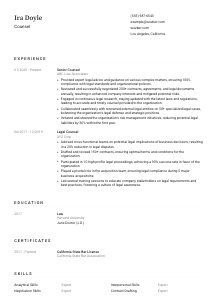
Avoid filling this section with duty lists. Write accomplishment statements that show what changed because of your work. The sample CV does this well by tying contract negotiation to volume, compliance guidance to full adherence with standards, and risk initiatives to a measurable drop in legal exposure. That kind of framing tells the reader how you practice, not just what sat in your job description.
Numbers help when they reflect real legal scope. Contract volume, reduction in disputes, number of matters supported, turnaround improvements, success rate in proceedings, outside counsel coordination, or liability reduction all add substance. Metrics are especially useful in-house, where legal impact is often judged through business outcomes as much as technical legal analysis.
Prioritise work that supports this level of legal role. If you have a long history, trim older or less relevant entries that do not strengthen your case for advising on compliance, negotiating agreements, or supporting risk management. A focused record reads better than a longer one that blurs your legal specialty and level of responsibility.
By the end of your experience section, a hiring manager should understand the matters you handled, the decisions you influenced, and the business risk you helped control. That is the core of a Counsel CV.
For Counsel roles, education is usually straightforward, but it still matters because it confirms your legal foundation fast. A hiring team needs to see the J.D. clearly and move on to the experience that shows how you have applied it in practice.
If the posting requires a Juris Doctor from an accredited law school, list that degree clearly and without abbreviations that could be missed. This is a threshold qualification for Counsel, so it should never be buried or phrased casually.
Use a standard format with school, degree, field, and graduation year. For experienced attorneys, that is usually enough. The example's Harvard J.D. is a strong credential, but the broader lesson is clarity: legal education should be instantly recognizable on the page.
Write out "Juris Doctor (J.D.)" so there is no ambiguity. That wording aligns with how many legal postings state the requirement and helps both ATS parsing and human review.
If you are early in practice or changing specialty, selected coursework can help connect your academic background to the target role. Subjects such as corporate law, contract law, employment law, compliance, or intellectual property can be relevant depending on the employer's business. If you already have substantial experience, keep this brief.
Law review, moot court, journals, or notable research can strengthen the section when they support your legal profile. They matter most for junior candidates, clerkship-focused paths, or roles where writing and legal analysis are central differentiators.
This section needs to confirm the required legal education quickly and cleanly. For most Counsel candidates, the real differentiation happens after the J.D. line.
In legal hiring, credentials are less about collecting certificates and more about showing you are authorized to practice and current in your field. For a Counsel role, bar admission is usually the first item a hiring team wants to confirm after education.
When a posting requires an active license to practice in a specific state, lead with that admission. In this case, a California bar license is directly relevant because the employer wants counsel licensed and based in California. That is different from listing general professional development items that do not affect your ability to practice.
List licenses, bar admissions, and legal credentials that support the work you will be doing. A short, relevant section is stronger than a long one filled with unrelated training. For many Counsel applications, one active state bar admission may be the most important credential on the page.
Include dates where they clarify active standing or duration. A line such as "2017 - Present" for a bar license gives immediate context and helps the reviewer confirm ongoing eligibility.
If you add another admission, compliance certification, privacy credential, or industry-specific legal qualification later, keep the section current. That matters most when the role touches regulated industries or specialised advisory work.
This section should answer one practical question fast: are you licensed and current for the legal work this employer needs done?
A Counsel skills section works best when it mirrors how legal work gets done. Employers expect to see legal analysis, negotiation, contract handling, and stakeholder communication, but they also want signs that you can operate inside a business, not just interpret doctrine.
Use the job description to identify the capabilities the employer chose to emphasize. Here, that includes analytical strength, problem-solving, negotiation, interpersonal skill, and collaboration. Bring those terms into your skills section when they match your background, then support them in your experience bullets with real legal work.
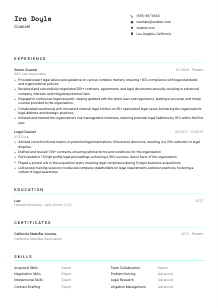
Lead with abilities that connect to actual Counsel responsibilities, such as contract drafting, legal research, compliance advising, risk assessment, stakeholder management, and outside counsel coordination. The sample CV's mix of contract drafting, negotiation, legal research, and risk assessment is a useful example because each skill points to a concrete legal workflow.
Organise the section so a reviewer can scan it in seconds. Avoid padding it with broad traits that are already assumed at this level. Ten focused skills tied to advisory work, document review, negotiation, and cross-functional collaboration are more persuasive than a longer list of vague strengths.
Your skills list should echo the legal work you want to keep doing. When it aligns with your experience, it strengthens your case for handling the employer's contracts, compliance questions, and business-facing legal issues.
Language ability can matter in legal work, but only when it has practical value for the role. For Counsel positions, list languages with the same care you use elsewhere on the CV and focus on proficiency you can actually use in advising, drafting, or client-facing communication.
If English is essential, include it clearly with an honest proficiency level. That confirms your ability to review documents, advise internal teams, and communicate on legal matters in the language the role requires.
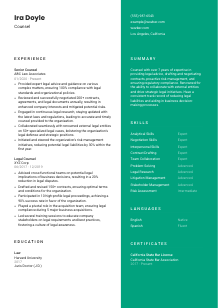
Additional languages can be useful when the employer serves multilingual clients, operates across borders, or works in a diverse market. In Los Angeles, Spanish may be an asset in some organizations, but it should be listed as added value, not assumed to be required for every Counsel opening.
Choose straightforward terms such as Native, Fluent, Intermediate, or Basic. Legal communication depends on precision, so do not overstate your level if you would not be comfortable reviewing complex documents or conducting sensitive discussions in that language.
If your work includes international agreements, foreign counterparties, or multinational compliance issues, language capability can support your case. Mention it when it connects to the type of legal matters you handle, not simply as a personal detail.
If you are multilingual, think about how that affects your work. It may help with client communication, document review, negotiations, training sessions, or internal guidance across regions. That practical connection is what makes language skills relevant on a Counsel CV.
Language ability helps when it supports real legal communication. Keep the section accurate and relevant to the scope of work you want to handle.
The summary should give a concise read on your legal scope and level. For Counsel, that usually means years of practice, the kind of advisory work you handle, and one or two outcomes that show business impact beyond technical legal knowledge.
Start with the legal work the employer needs most. For this posting, that means legal advice, contract review and negotiation, compliance support, legal research, and risk management. Those themes should shape the language of your summary so the relevance is obvious in the first few lines.
Introduce yourself in terms that quickly establish seniority and scope. A line like "Counsel with 7+ years of experience advising on contracts, compliance, and business risk" is stronger than a generic statement about being a motivated legal professional.
Use a few high-value details to make the summary believable. The sample summary works because it mentions contract negotiation, regulatory compliance, collaboration with external entities, and reduced legal liabilities. Pick the points that best match your own background and the employer's priorities.
Aim for a short paragraph that can be read in moments. Four focused lines are usually enough to establish your practice area, years of experience, and business-facing legal impact without repeating the entire experience section.
A good summary should quickly tell the reader what kind of counsel you are, what matters you handle, and why your advice is likely to hold up in their environment.
A polished Counsel CV should now show the legal matters you handle, the contracts and compliance work you can own, and the level of business judgment behind your advice. That is what hiring teams need to see before they trust you with sensitive decisions.
Use Wozber to tighten the language, check ATS optimisation, and shape your experience into a clear ATS-friendly CV format that reflects the role you are targeting. When the document is tailored well, it becomes much easier to judge whether you can step into the Counsel seat and contribute immediately.




