



Use Wozber and land your dream job
Create CV
No registration required
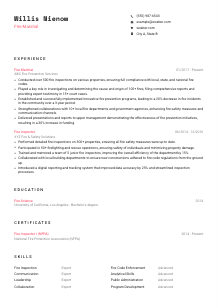
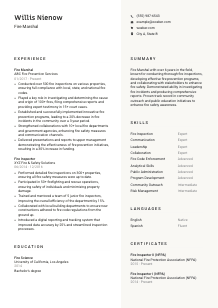
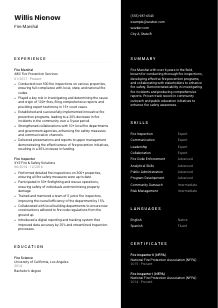
Enforcing fire safety but your CV feels burnt out? Check out this Fire Marshal CV example, created with Wozber free CV builder. It shows how to channel your safety strategies to match job requisites, setting your career path ablaze with success and not with false alarms!
Fire Marshal work sits at the point where public safety, code interpretation, and incident accountability meet. Hiring teams look for people who can move comfortably between property inspections, fire cause investigations, prevention planning, and public-facing reporting. Your CV should make that operating range clear, with concrete examples of enforcement decisions, inspection volume, investigation work, and community outcomes.
A tailored Fire Marshal CV also changes how quickly reviewers can separate inspection-heavy experience from broader fire service backgrounds. Using Wozber's free CV builder helps you present that experience in an ATS-friendly CV format, so certifications, code enforcement work, and prevention leadership are easy to track from the first scan. That matters when the role depends on proving you can enforce standards, document findings, and represent the department with confidence.
For Fire Marshal roles, the personal details section does one practical job first. It confirms that you are reachable, professionally presented, and aligned with any location or title requirements before the reader gets into inspections, investigations, or code enforcement history.
Use your full name in a clean, readable format at the top of the page. Fire Marshal hiring often moves through municipal, agency, or compliance-driven review processes, so clarity matters more than design flourishes.
Place "Fire Marshal" directly under your name when that is the position you are pursuing. Matching the posted title helps frame the rest of your CV around fire inspections, prevention programs, investigations, and reporting rather than around a broader firefighting background.
Include your phone number and a professional email address that uses your name. This role can involve interview panels, agency follow-up, and document requests, so make sure your contact information is current and easy to use.
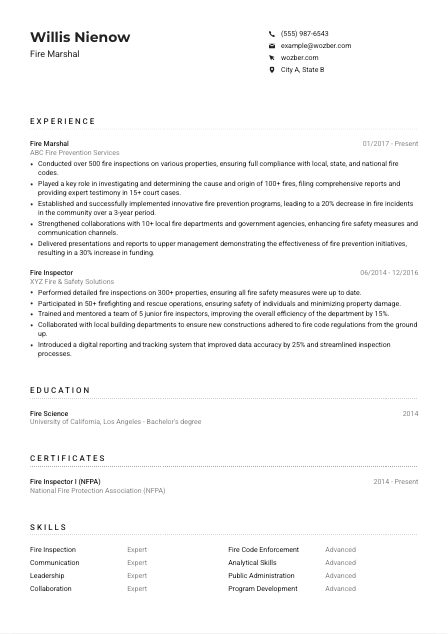
If the employer requires local residency or an in-area candidate, list your city and state exactly. In the example, "City A, State B" directly addresses a stated requirement, which removes a common screening question early.
A LinkedIn profile or professional website can support your application if it reflects the same certifications, roles, and dates shown on your CV. For Fire Marshal candidates, that profile is most useful when it reinforces inspection experience, code enforcement scope, public safety leadership, or speaking engagements.
This section should confirm that you are a local, professional, and role-aligned candidate before the hiring team reviews your technical qualifications. Keep it clean and factual.




This is the section that carries the most weight for a Fire Marshal. Employers need to see whether your background covers the actual mix of inspection work, code enforcement, fire investigation, interagency coordination, and prevention programming the position demands.
Before you write or revise bullets, identify the experience categories the employer emphasizes. Here, the main themes are fire inspections across property types, cause-and-origin investigations, code enforcement, public education, agency coordination, and reporting to leadership or government. Those should shape what rises to the top of each job entry.
List your most recent and most relevant positions first, including title, employer, and dates. For Fire Marshal applications, recent roles in fire prevention, fire inspection, life safety compliance, or marshal-level oversight should lead, because they show current familiarity with inspection workflows and code application.
Numbers help hiring teams understand scale and consistency. Good Fire Marshal metrics include inspection volume, number of fire investigations, reduction in incidents, court testimony count, number of agencies coordinated with, or funding tied to prevention programs. The sample CV does this well with figures like 500+ inspections, 100+ fire investigations, and a 20% reduction in community fire incidents.
General emergency response work can still belong on the CV, but it should not crowd out inspection and enforcement achievements if you are applying for a Fire Marshal opening. If you include broader fire service experience, connect it to safety outcomes, regulatory knowledge, training, or incident analysis that supports marshal-level responsibilities.
Avoid repeating generic phrases such as "responsible for inspections" or "handled reports." Instead, show what you inspected, what standards you enforced, what changed because of your work, and who relied on your findings. Strong bullets might describe bringing properties into compliance, improving reporting accuracy through a digital system, or presenting prevention results that influenced funding or policy decisions.
By the end of this section, the reader should understand your inspection depth, your command of code enforcement, and your ability to turn field findings into reports, prevention action, and defensible decisions. That is the core of Fire Marshal credibility.
Education matters here because Fire Marshal roles often combine technical fire protection knowledge with public-sector judgment, documentation, and policy awareness. Your degree should be presented in a way that quickly confirms you meet the academic baseline for the position.
If the posting asks for a bachelor's degree in Fire Science, Public Administration, or a related field, list that qualification clearly. In the example, a bachelor's degree in Fire Science directly supports the technical and regulatory side of the role.
Use a straightforward structure: degree, field of study, school, and graduation year. Fire Marshal hiring often involves fast review against minimum qualifications, so this section should answer the education requirement in one glance.
If your degree aligns closely with the posting, use the employer's language naturally. "Bachelor's degree in Fire Science" is more useful here than a shortened or overly casual version because it maps directly to the requirement and supports ATS matching.
Most experienced Fire Marshal candidates do not need to list classes, but coursework can help if your degree is in a related field or if you are early in your prevention and inspection career. Prioritise subjects like fire behaviour, building construction, fire protection systems, code administration, investigation methods, or public administration.
Honors, research, or projects are worth adding when they relate to fire safety, regulatory compliance, emergency management, or community risk reduction. Keep them brief, especially if your work experience already carries most of the application.
Your education section should confirm the required degree without slowing the reader down. For this profession, it works best when it supports your technical foundation and public safety judgment in a concise format.
Certifications are central in Fire Marshal hiring because they show formal qualification to inspect, interpret code, and enforce standards. If a posting names specific credentials, make them impossible to miss.
List required credentials first, especially when the posting names them explicitly. For this role, Fire Inspector I and II issued by NFPA are core qualifications, so they should appear ahead of optional or less relevant certifications.
Do not dilute this section with unrelated training. Fire Marshal applications benefit most from inspection, investigation, code enforcement, fire prevention, instructor, or incident management certifications that support the actual duties of the role.
Include the year earned and, when relevant, active or renewal status. That tells the employer your credentials are current and that your knowledge of code standards and inspection practice has been maintained.
Fire codes, reporting practices, and prevention standards evolve. If you have completed recent training in areas like fire investigation, life safety systems, hazardous materials awareness, or public education, include it when it adds value to the target role.
This section should tell the reader, quickly and without ambiguity, that you hold the credentials needed to perform inspections and enforce fire code at the level the role requires.
A Fire Marshal skills section should read like the toolkit behind your fieldwork and reporting. It needs to show that you can interpret code, communicate findings, work across agencies, and lead prevention efforts without turning into a long generic list.
Start with the language the employer already uses. In this posting, that includes analytical skills, communication, interpersonal ability, leadership, and fire code interpretation and enforcement. If those reflect your background, use them in the wording of your skills and reinforce them in your experience bullets.
Fire Marshal roles require both operational and people-facing strengths. Include hard skills such as fire inspection, code enforcement, fire investigation, report writing, prevention program development, and risk assessment alongside skills like leadership, public communication, and interagency collaboration.
Every skill listed should be supported by your experience, certifications, or summary. For example, if you claim program development, your work history should show prevention campaigns or outreach initiatives. If you list analytical skills, your bullets should reflect code interpretation, investigation findings, or reporting accuracy improvements.
The best Fire Marshal skills lists are short, specific, and tied to real work. They should reinforce your capacity to inspect, enforce, investigate, and communicate in a public safety setting.
For Fire Marshal work, language proficiency matters most when it affects compliance communication, public education, community outreach, and formal reporting. Present languages in a way that makes practical workplace use immediately clear.
If the job states English proficiency as a condition of employment, list English first with your actual proficiency level. That removes doubt about your ability to write reports, explain violations, testify if needed, and present information to leadership or the public.
Extra languages can strengthen your application when the jurisdiction serves multilingual neighborhoods, businesses, or community groups. In Fire Marshal work, this can be especially useful for prevention campaigns, safety education events, and on-site communication during inspections.
Use honest labels such as Native, Fluent, Conversational, or Basic. Overstating language ability is risky in a role that may require precise explanation of fire safety issues, legal testimony, or public instruction.
When a second language is relevant, think about where it adds value. It may help with school outreach, residential fire safety education, business compliance discussions, or coordination during investigations in diverse communities.
Only include languages you could reasonably use in the field or in official communication. A concise, believable list is more effective than a long section that does not connect to inspection, prevention, or outreach responsibilities.
Language skills are most valuable when they strengthen public communication and safety education. For a Fire Marshal, that can expand your reach in the community and improve how clearly fire safety guidance is delivered.
The summary should give a hiring team an immediate read on your level, specialty, and track record. For Fire Marshal candidates, that usually means years in prevention and inspection work, the scope of your enforcement experience, and one or two outcomes that show authority and results.
Start with a direct statement such as "Fire Marshal with 6+ years of experience" or, if more accurate, a prevention and inspection profile that leads naturally into marshal-level work. This quickly places you at the right level for a role that asks for significant field and enforcement experience.
Choose accomplishments that reflect the employer's priorities. For this kind of role, that could mean high inspection volume, fire investigation work, community prevention results, code enforcement history, or reporting to government and senior leadership. The example summary works because it highlights inspections, prevention programs, investigations, and outreach rather than staying generic.
Aim for 3 to 5 sentences with specific language, not broad claims. Replace vague descriptions like "dedicated safety professional" with terms tied to the work, such as residential and commercial inspections, cause-and-origin investigations, code compliance reporting, or public fire prevention initiatives.
Close with the kind of contribution you can make in the role, whether that is strengthening code compliance, reducing incidents through prevention programs, improving reporting quality, or coordinating effectively with fire departments and building officials. Keep it practical and role-specific.
After reading your summary, the employer should already understand that you have the inspection background, code enforcement judgment, and public safety perspective expected of a Fire Marshal. That gives the rest of the CV a clear frame.
A Fire Marshal CV needs to show more than time in the fire service. It should make your inspection record, code enforcement authority, investigation work, prevention programs, and reporting experience easy to trace from top to bottom.
Wozber can help you build that structure faster, whether you are refining sections in an ATS-compliant CV, improving wording with its AI CV builder, or checking alignment with an ATS CV scanner. The final result should make one thing clear without extra interpretation: you are prepared to protect the community, enforce fire code, and lead prevention efforts with confidence.




