




Use Wozber and land your dream job
Create CV
No registration required
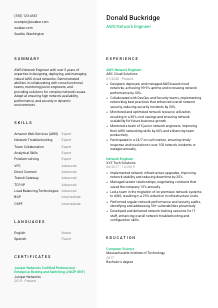
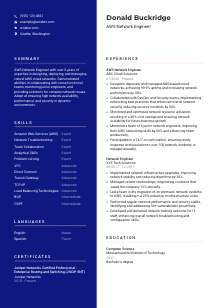
Building AWS networks, but your CV seems disconnected? Browse this AWS Network Engineer CV example, created with Wozber free CV builder. Learn how to connect your network expertise to the job's cloud requirements, keeping your career online and never left buffering.
AWS network engineering work sits at the point where cloud architecture, routing behaviour, security controls, and uptime all meet. Hiring teams look for engineers who can design and run resilient AWS network environments without losing sight of performance, scalability, or incident response. Your CV should make that operational depth easy to see, especially around services such as VPC, Transit Gateway, Direct Connect, NAT Gateway, and the protocols that support stable connectivity.
When the CV is tailored well, reviewers can quickly tell whether your background is centered on real AWS network delivery or only adjacent infrastructure work. Wozber's free CV builder helps organise that experience into an ATS-friendly CV format, so AWS services, routing protocols, and availability results are parsed cleanly and tied back to the kind of network ownership the role requires.
For an AWS Network Engineer, the top of the CV should remove basic friction immediately. This section confirms who you are, how to reach you, and whether you match practical requirements such as role focus and, when relevant, location. Keep it clean and exact.
Place your full name at the top in a format that is easy to scan. Use a slightly larger font so it anchors the page. In technical hiring, this section does not need personality flourishes. It needs clarity and a professional presentation that matches the rest of the document.
Add a title under your name that matches the work you want to be hired for, such as "AWS Network Engineer." This helps frame the CV before the reader reaches your experience. If your recent background includes broader network engineering work, this title still tells the hiring team that your strength is in AWS networking rather than general infrastructure alone.
List a reliable phone number and a professional email address, ideally in a simple firstname.lastname format. Small mistakes here can stall an otherwise strong application. If you include a website or LinkedIn profile, make sure the projects, certifications, and dates align with the CV exactly.
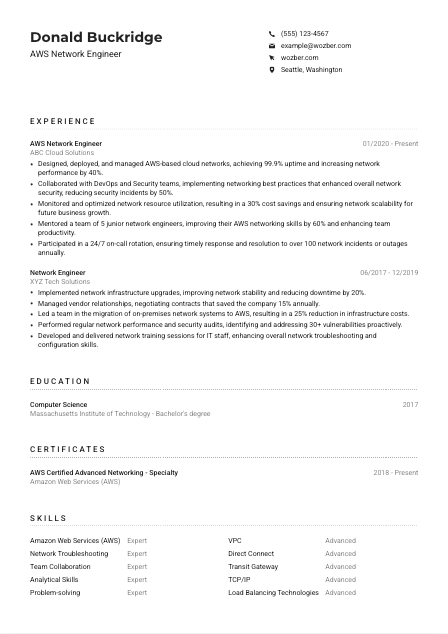
If a posting includes a location condition, address it here. In the example, Seattle, Washington is listed because the role requires the candidate to be located there or willing to relocate. That is a tailoring move for this opening, not a rule for every AWS Network Engineer CV. When location matters, remove ambiguity early.
A LinkedIn profile, portfolio, or personal site can help if it adds real technical substance, such as cloud migration work, network diagrams, infrastructure automation projects, or certification details. Skip links that do not deepen your case for AWS networking experience. Every item in this section should support the same story of cloud network ownership.
This section should confirm the basics fast: who you are, how to contact you, and whether you align with practical requirements attached to the role. That lets the rest of the CV stay focused on AWS network execution.




This is the section hiring managers read most closely for AWS network roles. They want to see what environments you designed, what network services you managed, how you handled reliability and security, and whether your work improved performance, cost, or incident response. Focus on shipped work and measurable outcomes.
Read the posting for the technical scope behind the title. Here, the important signals include AWS networking services, high availability, performance, security collaboration, capacity planning, troubleshooting, and on-call support. Use those priorities to decide which bullets deserve space and which older infrastructure tasks can be cut or condensed.
List positions in reverse chronological order, then give the most space to roles where you owned AWS cloud networking, hybrid connectivity, routing, or large-scale network operations. If part of your history is more traditional networking, frame it through migration, architecture, protocol expertise, or operational improvements that connect naturally to AWS work. The sample does this well by moving from a Network Engineer role into a dedicated AWS Network Engineer position.
Each bullet should show what you designed, deployed, optimised, or resolved. Avoid generic statements like "responsible for network support." Instead, show specific work such as building VPC connectivity, managing Transit Gateway routing, improving Direct Connect resilience, tightening security controls, or reducing outage impact through better monitoring and escalation. Those are the details that distinguish cloud network engineers from broader infrastructure candidates.
Metrics matter in network engineering because they reflect reliability and operating impact. Use numbers tied to uptime, latency improvement, cost reduction, incident volume, capacity growth, vulnerability reduction, or recovery speed. The example uses figures such as 99.9% uptime, 40% performance improvement, 30% cost savings, and 100+ incidents handled annually. Those numbers make the scope and quality of the work easier to understand.
Prioritise experience that shows AWS-native networking and the surrounding collaboration that keeps it running, including work with DevOps, security, SRE, or platform teams. If you mention older roles, connect them to transferable strengths such as routing design, hybrid architecture, audits, migrations, or operational troubleshooting. The reader should come away seeing a consistent path toward advanced AWS network responsibility, not a list of loosely related IT tasks.
A strong experience section makes it obvious that you can design, operate, and improve AWS network environments under real business conditions. When your bullets connect services, outcomes, and operational scope, the CV reads like production experience rather than platform familiarity.
Most AWS Network Engineer postings treat education as a qualifying checkpoint rather than the main selection factor, but it still matters. Present it clearly so the reader can confirm your technical foundation and move on to the sections that show applied cloud network expertise.
If the posting asks for a Bachelor's degree in Computer Science, Information Technology, or a related field, make that qualification easy to find. Use the exact degree and field wording from your record. In the example, a Bachelor's degree in Computer Science aligns directly with the requirement and supports the technical depth expected for AWS networking work.
List the institution, degree, field of study, and graduation year in a consistent structure. This section should scan in seconds. For experienced engineers, overexplaining education adds little value unless there is a highly relevant specialization tied to networking, distributed systems, or cloud infrastructure.
If your academic background directly supports the role, let that connection stand on its own. A degree in Computer Science, Network Engineering, or Information Technology helps reinforce your grounding in systems, protocols, and infrastructure concepts that show up later in your experience section.
Coursework, senior projects, or lab work belong here only if they add something useful, such as cloud architecture, network design, automation, or security projects. This is especially helpful for early-career candidates who need more technical substance beyond internships or junior roles.
Academic honors can be worth noting if they are meaningful and recent, particularly for candidates with less professional experience. For established AWS network engineers, this section should stay concise unless the distinction clearly supports your technical profile.
This section should quickly establish that you meet the degree requirement and have the technical background expected for cloud networking work. Once that baseline is clear, your experience and certifications should carry the heavier weight.
In AWS network roles, certifications often carry more weight than they do in general IT hiring because they point to current platform knowledge and specialised depth. They are especially useful when the role calls for advanced AWS networking, hybrid connectivity, routing, and cloud design decisions.
When a job posting names a certification, mirror that priority in your CV. Here, AWS Certified Advanced Networking - Specialty belongs near the top if you have it. That creates an immediate match with the posting and reinforces that your AWS networking knowledge goes beyond basic cloud familiarity.
List credentials that support cloud networking, routing, security, or network architecture. AWS networking certifications are the clearest fit, but comparable credentials in enterprise routing and switching can also add value when they strengthen your case around BGP, OSPF, design, and troubleshooting. The example pairs the AWS specialty certification with JNCIP-ENT, which gives the profile both cloud and core networking depth.
Add issue dates or active date ranges to show that your certification status is current. In cloud infrastructure hiring, recency matters because services, best practices, and exam content evolve quickly. A current certification supports the claim that your knowledge is not stuck on an older AWS networking model.
If you are renewing certifications, preparing for a higher-level credential, or maintaining multiple relevant certifications, that can reinforce your commitment to staying current with AWS services and network design patterns. Keep the wording factual. The credential should support your real work, not stand in for it.
Relevant certifications strengthen your CV when they confirm specialised AWS networking knowledge and current platform fluency. They work best beside hands-on accomplishments in design, operations, troubleshooting, and reliability.
The skills section should read like the toolkit of someone who actually runs cloud networks. For AWS Network Engineer roles, that means naming the platform services, protocols, operational strengths, and collaboration capabilities that show up repeatedly in your work, not filling the section with broad IT buzzwords.
Start with the terms the employer already uses. In this case, that includes VPC, Direct Connect, Transit Gateway, NAT Gateway, TCP/IP, DNS, BGP, OSPF, load balancing, troubleshooting, and collaboration across teams. Matching that language helps with ATS optimisation and makes your background easier to compare against the job's required environment.
Do not separate cloud skills from core networking knowledge. An AWS Network Engineer is expected to understand both. Pair platform-specific items such as VPC or Transit Gateway with the routing, DNS, peering, load balancing, and protocol knowledge that makes those services work in production. That mix is what turns a cloud user into a network engineer.
Only include skills you can support through experience, projects, or certifications. A shorter list with genuine depth is more persuasive than a long inventory of loosely familiar tools. The sample skill set works because it balances AWS services, troubleshooting, and protocol knowledge without drifting into unrelated systems or development tools.
This section should confirm that you understand AWS networking at both the service layer and the protocol layer. When the listed skills line up with your experience bullets, the CV becomes much more convincing.
Language skills are usually a supporting detail for AWS Network Engineer roles, but they still matter when the job calls out communication requirements. Network work often involves incident calls, cross-team troubleshooting, design reviews, and written documentation, so language proficiency should be presented in a practical way.
If the posting specifies a required language, include it clearly with your proficiency level. Here, English fluency is explicitly required, so it should be listed rather than assumed. That matters because the role includes collaboration, mentorship, and incident response where precise communication affects outcomes.
Order your language section by relevance. Lead with English if it is required, then add other languages you speak. This keeps the section aligned with the job rather than turning it into a general profile detail.
Additional languages can be worth listing if you work with distributed teams, global vendors, or international operations. They are not a substitute for technical depth, but they can support collaboration in multinational environments. In the example, Spanish adds breadth without distracting from the core AWS network profile.
Choose clear levels such as Native, Fluent, Professional, or Intermediate, and use them consistently. Inflating language ability can create problems quickly in technical meetings, on-call handoffs, or written documentation where precision matters.
For most AWS Network Engineer CVs, languages should stay brief unless multilingual communication is central to the role. Let this section support the profile, not overpower the technical content that drives hiring decisions.
List language proficiency in a way that supports the role's real communication demands, especially for English-heavy troubleshooting, documentation, and cross-functional coordination. Then let the technical sections do the main work.
The summary sets the lens for everything that follows. For an AWS Network Engineer, it should quickly establish years of experience, the kind of AWS network environments you handle, and the business or operational outcomes your work supports. Keep it compact, but make every line carry technical meaning.
Open with your role, years of experience, and area of depth. If your background is centered on AWS networking, say so directly. If it combines cloud and traditional network engineering, frame that blend in a way that supports the target role rather than sounding undecided.
Use the summary to mention the responsibilities that define your profile, such as designing AWS cloud networks, improving availability, managing hybrid connectivity, resolving complex incidents, or partnering with security and DevOps teams. This gives the reader a fast picture of your operating scope before they reach the detail below.
Bring in the language that matters for the target posting, especially AWS networking services, troubleshooting, scalability, performance, and mentoring if those are part of your background. The example summary works because it stays close to the role's actual needs instead of drifting into broad cloud claims.
Aim for 3 to 5 lines that feel precise rather than comprehensive. Do not repeat your full skills section or recycle generic phrases about being motivated and results-driven. A concise summary with real technical focus gives the hiring team a sharper read on whether the rest of the CV is worth deeper attention.
Your summary should establish you as an AWS network engineer with relevant depth, not just a general infrastructure professional with cloud exposure. When it names your scope and strengths clearly, the rest of the CV lands with more force.
A tailored AWS Network Engineer CV should show more than familiarity with cloud terms. It should connect AWS networking services, routing knowledge, availability targets, troubleshooting depth, and cross-team delivery in a way that feels grounded in real environments.
Use Wozber's free CV builder to tighten structure, maintain an ATS-compliant CV, and refine wording with the ATS CV scanner so the final version reflects the exact mix of AWS network design, operations, and reliability work the role calls for.
When that is clear on the page, hiring teams can quickly judge whether you are ready to own cloud network performance, resilience, and incident response from day one.




