



Use Wozber and land your dream job
Create CV
No registration required
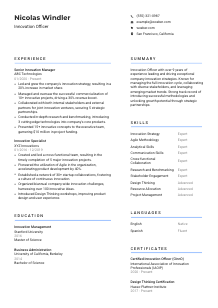
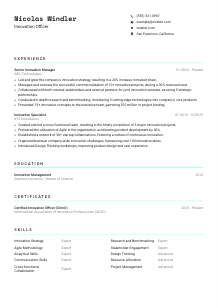
Revolutionizing businesses, but your CV feels traditional? Step into the future with this Innovation Officer CV example, created with Wozber free CV builder. Learn how to present your boundary-breaking ideas in a way that matches job requirements, setting your career trajectory on an exponential curve of success!
Innovation Officer hiring usually turns on one question fast: have you moved promising ideas through a real business system, or have you only participated in creative work around the edges. A CV for this role needs to show how you connected experimentation to business goals, built momentum across teams, and turned market insight into funded initiatives, pilots, partnerships, or commercial results.
That distinction becomes much clearer when your CV is tailored around the innovation pipeline the employer actually needs. Using Wozber's free CV builder helps you shape an ATS-compliant CV around the language of strategy, benchmarking, Agile delivery, and executive presentation, so hiring teams can quickly see where you have already led innovation work from concept to adoption.
For an Innovation Officer, the top of the CV should read like the profile of someone trusted to work across senior leadership, product or R&D teams, and external partners. Keep this section clean, professional, and aligned with any practical requirement that affects eligibility for the role.
Use your full name as the most visible element at the top of the page. Innovation roles often sit close to executive decision-making, so your header should feel polished and direct rather than styled like a personal brand experiment.
Place "Innovation Officer" beside or just below your name when that is the role you are pursuing. This immediately frames your background around innovation strategy, pipeline ownership, and commercialization instead of leaving readers to infer whether you come from product, strategy, or R&D alone.
List the phone number and email address you actively monitor. Senior and cross-functional roles often move through several interview stages, so inaccurate contact details create avoidable friction at exactly the wrong point.
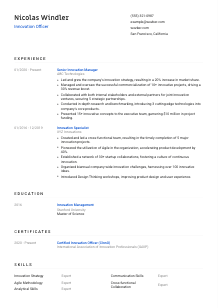
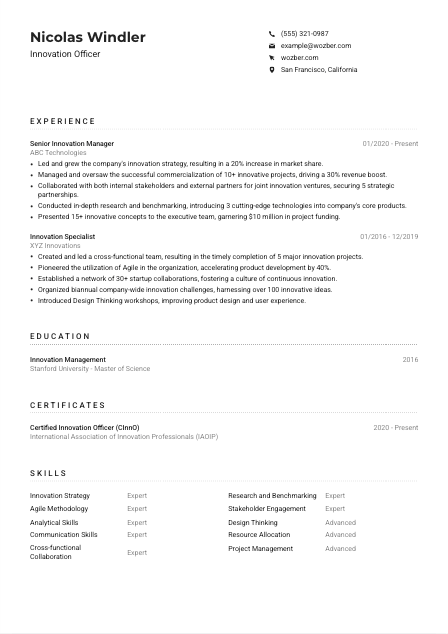
If a role specifies a location requirement, include your city and state in this section. In the example here, "San Francisco, California" directly answers the employer's stated need and removes a basic screening question before the CV even reaches your experience section.
Include a LinkedIn profile or personal website only if it extends the story on your CV. For innovation leadership, that might mean published talks, venture collaboration work, thought leadership on emerging technology, or a portfolio of programs and initiatives you helped launch.
Do not include age, marital status, photo, or other non-job-related details. Keep the header focused on information that helps an employer contact you, confirm core eligibility, and move on to your strategic and operational track record.
Your personal details should remove friction, confirm any stated logistics, and position you as a serious candidate for a strategy-facing innovation role. Then the rest of the CV can do the heavier work of proving scale, outcomes, and leadership range.




This is the section where Innovation Officer candidates usually separate themselves. Employers want to see how you led innovation work in practice, whether through pipeline management, commercialization, partnership building, trend research, or executive influence, and what changed because of it.
Start with the job description and identify the operational themes behind it. For this role, that includes innovation strategy, managing ideas through commercialization, benchmarking emerging technologies, working across functions, and presenting recommendations to senior management. Shape your experience bullets around those themes instead of listing broad strategy responsibilities with no execution detail.
List your positions in reverse chronological order so the reader reaches your most recent innovation work first. For each role, include the essential context that helps hiring teams understand level, scope, and progression.
Describe what you led, how you moved work forward, and what business effect followed. Strong Innovation Officer bullets often cover portfolio prioritization, startup partnerships, cross-functional governance, pilot launches, market research, or methodology adoption. The example does this well by showing ownership of strategy, commercialization of 10+ projects, partnership development, and executive presentations tied to funding decisions.
Use numbers that reflect how innovation is actually judged. That may include market share growth, revenue lift, number of projects commercialized, pilot-to-launch conversion, partnership count, funding secured, time-to-market improvement, or adoption of new technologies. Metrics such as a 20% market share increase or $10 million in project funding give hiring teams a much clearer view of strategic impact than statements about being creative or forward-thinking.
Prioritise work that shows you can lead beyond ideation. Innovation Officer roles usually require evidence of business alignment, stakeholder influence, and disciplined execution, so trim bullets that focus on generic project support if they do not show pipeline ownership, research depth, or commercial outcome.
By the end of your experience section, an employer should be able to trace how you spot opportunities, organise resources, move ideas through the funnel, and win support from decision-makers. That is the core story this role needs.
Education matters here because many Innovation Officer roles ask for a business, entrepreneurship, innovation management, or related academic foundation. Keep this section straightforward, then let your experience carry the deeper proof of execution and leadership.
Check whether the role calls for a specific academic background and make sure that match is easy to see. In this case, a bachelor's degree in business, entrepreneurship, innovation management, or a related field is explicitly requested, so a degree such as Business Administration should be presented clearly rather than buried.
List each credential with the information employers expect to find quickly. Simple formatting works best, especially when your CV already carries dense strategic and operational achievements elsewhere.
If your degree directly supports the role, let that alignment show naturally. In the example, a Master of Science in Innovation Management and a Bachelor of Science in Business Administration reinforce both strategic and operational credibility without needing extra explanation.
Most experienced Innovation Officer candidates do not need a long course list. Add selected coursework only if it directly strengthens your case for areas like product innovation, venture strategy, market research, or commercialization and is not already evident from your work history.
Academic distinctions can help if they connect to the role's demands. Leadership in entrepreneurship programs, research initiatives, innovation labs, or venture competitions is worth noting when it supports your broader record of leading change and developing new business opportunities.
This section should confirm that you meet the academic baseline and, where relevant, show a natural connection to innovation or business strategy. Let it support your candidacy without competing with your experience for space.
Certifications can strengthen an Innovation Officer CV when they point to frameworks and methods the role actually uses. They are especially useful for showing current fluency in structured innovation practices such as Design Thinking, Agile, or formal innovation leadership programs.
Even when a job posting does not require certifications, the right ones can sharpen your positioning. For innovation leadership roles, credentials tied to Design Thinking, Agile, innovation management, or commercialization frameworks can show that your approach is systematic, not improvised.
Only include certifications that reinforce the kind of innovation work described in your experience section. A credential like "Certified Innovation Officer" or a Design Thinking certification works because it aligns with strategy development, structured ideation, and cross-functional problem solving already expected in the role.
Innovation methods and market practices evolve quickly, so dates help show that your training is current. This is especially useful for frameworks used in active program delivery, workshops, sprint planning, or innovation pipeline governance.
If you are targeting senior innovation roles, continued learning should follow the direction of your work. That may mean adding certifications in Agile leadership, venture building, product discovery, or emerging technology strategy as your responsibilities expand.
Certifications should strengthen the methods story behind your CV. They work best when they back up real examples of how you led research, experimentation, collaboration, and commercialization in a business setting.
A useful skills section for this role should mirror the mix of strategic judgment, execution discipline, and stakeholder influence the job requires. Focus on the capabilities that support portfolio decisions, cross-functional delivery, and the translation of emerging ideas into practical business action.
Pull both direct requirements and implied capabilities from the posting. Here, that includes innovation methodologies, Design Thinking, Agile, analytical strength, trend identification, communication, and collaboration with senior management and cross-functional teams. Those are stronger anchors than generic terms like "creative" or "visionary."
Innovation Officer hiring usually spans several dimensions at once. Include strategy and research capabilities alongside execution tools and collaboration strengths, such as innovation strategy, research and benchmarking, resource allocation, stakeholder engagement, Agile methodology, and executive communication. The example list works because it covers both operating mechanics and leadership-facing skills.
Do not turn this into a keyword dump. Choose the skills that best support the story told in your experience section and match the employer's priorities. A concise list of relevant capabilities is far more convincing than a long inventory with no connection to pipeline leadership or commercial outcomes.
Your skills should confirm the operating range of an Innovation Officer: spotting opportunity, structuring experiments, guiding teams, and helping leadership make informed bets. Keep that range visible and specific.
Language skills matter most when they affect how you work with leadership, partners, customers, or international teams. For an Innovation Officer, clear communication can shape workshops, research interviews, partnership discussions, and executive presentations, so list languages with the same accuracy you would bring to any other business detail.
If the role asks for English proficiency, make sure English appears clearly in this section. Since this posting requires proficient English, it should not be left implied through the rest of the CV.
Order matters. Put the language named in the job description at the top, then follow with any additional languages that expand your ability to work across regions or partner ecosystems.
Extra languages are worth listing when they strengthen stakeholder communication, market research reach, or collaboration with external partners and startups. They are a useful plus, but only when presented honestly and with realistic proficiency.
Choose labels that are easy to understand and consistent with your actual ability. This helps employers judge whether you can operate in executive discussions, cross-functional meetings, or external-facing conversations without confusion.
Some innovation roles are heavily domestic, while others involve global benchmarking, startup ecosystems, or international technology scouting. When extra languages support that kind of work, they can add practical value beyond the core English requirement.
This section should quickly show whether you can communicate at the level the role requires. For Innovation Officer positions, that often means clear English plus any added range that helps with research, partnerships, or international collaboration.
The summary should give a hiring team a fast read on your level, focus, and track record. For an Innovation Officer, that usually means showing how long you have worked across strategy or innovation functions, what parts of the pipeline you have led, and the kind of business outcomes your work has produced.
Before writing, identify the few themes that matter most in the target role. Here those include leading innovation strategy, managing the pipeline from ideation to commercialization, spotting emerging trends, and presenting data-backed recommendations to senior management. Use those themes to decide what belongs in the opening lines.
Start with your years of experience and the area in which you operate. Phrases such as "Innovation leader with 9+ years of experience across innovation strategy, commercialization, and cross-functional program leadership" give much more direction than a broad statement about being passionate or results-driven.
Choose achievements or strengths that reflect the role's actual demands. The example summary works because it references full-cycle innovation leadership, stakeholder collaboration, and the use of market trends to unlock growth, all of which connect directly to the job description.
Aim for a short paragraph that can be read in seconds. Senior hiring teams want a quick sense of whether your background covers strategy, research, commercialization, and leadership communication before they move into the detail of your experience bullets.
A well-written summary should tell the reader what kind of innovation leader you are before they reach the rest of the page. For this role, that means making your strategic range, delivery record, and executive-facing credibility immediately clear.
You now have a clear framework for building an Innovation Officer CV that shows more than creativity. Use Wozber's free CV builder to organise your strategy, pipeline, research, and commercialization experience in an ATS-friendly CV format that reflects the language employers use for senior innovation hiring.
Before submitting, review the CV against the posting one more time with an ATS CV scanner and tighten any gaps in terminology, methods, or outcomes. The finished document should make it easy to see that you can lead innovation work from insight to investment decision to business adoption.