



Use Wozber and land your dream job
Create CV
No registration required
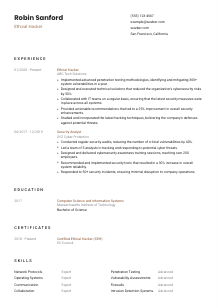
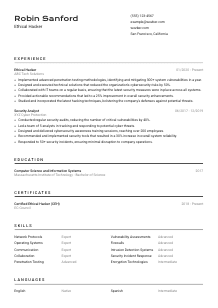
Cracking codes, but your CV seems encrypted? Unravel this Ethical Hacker CV example, created with Wozber free CV builder. Learn how to present your cyber sleuthing skills clearly to match job requirements, hacking your way to a career that's aboveboard and secure!
Ethical hacking work is judged by what you can uncover, how clearly you can explain it, and whether your recommendations actually reduce risk. A CV for this field needs to show more than security interest. It should make your penetration testing scope, vulnerability assessment work, remediation input, and collaboration with IT teams easy to follow.
Hiring teams often sort ethical hackers from broader security candidates by looking for hands-on offensive security work and direct risk reduction, not just general cybersecurity exposure. Wozber's free CV builder helps you tailor that language into an ATS-compliant CV, so penetration testing results, security tooling, and stakeholder communication are easier to read in both ATS screening and human review.
For ethical hacker roles, the header should confirm identity and logistics quickly, then get out of the way. Keep it clean, professional, and aligned with any practical filters in the posting, especially title and location when those are stated requirements.
Use your full name in a slightly larger font than the rest of the header so it anchors the page immediately. In security hiring, that top line should feel straightforward and professional, the same way your reporting and documentation would.
Place the role title under your name and match it to the job you want when it is accurate. If you are applying for an Ethical Hacker position and your background includes penetration testing or offensive security work, using "Ethical Hacker" helps frame the rest of the CV around that specialty from the first line.
List a reliable phone number and a professional email address. Ethical hackers are often expected to communicate findings, coordinate remediation, and explain technical risk to different audiences, so even basic contact details should reflect good professional judgment.
If a posting specifies a city or region, show that clearly in your header. Here, the role calls for someone based in San Francisco, California, so listing that location removes an avoidable screening question early in the process. For other roles, follow the same rule only when geography is relevant.
A LinkedIn profile, technical portfolio, or personal site can help if it reinforces your security background with certifications, projects, write-ups, or speaking work. Keep it relevant. A link is useful when it adds more context around ethical hacking work, not when it sends recruiters into unrelated content.
Your header should confirm who you are, what role you do, and whether you meet any practical filters attached to the job. That gives the hiring team a clean start before they get to your technical depth.




This section carries the most weight for an ethical hacker. Recruiters and security leaders want to see the environments you tested, the vulnerabilities you found, the fixes you influenced, and the measurable change that followed. Keep the focus on real security work, not broad IT support language.
Pull out the operational priorities from the job description and reflect them in your bullets using your own real experience. For this role, that includes penetration testing, vulnerability assessments, risk mitigation, collaboration with IT teams, and security improvement recommendations. When those same themes appear in your work history naturally, the match is immediate and credible.
List your positions in reverse chronological order and make each entry easy to scan. Include job title, company, and dates, then use bullets to show scope. For ethical hackers, scope may include web applications, internal networks, cloud assets, endpoint environments, or incident response support. That context helps hiring teams understand where you operated, not just what tools you touched.
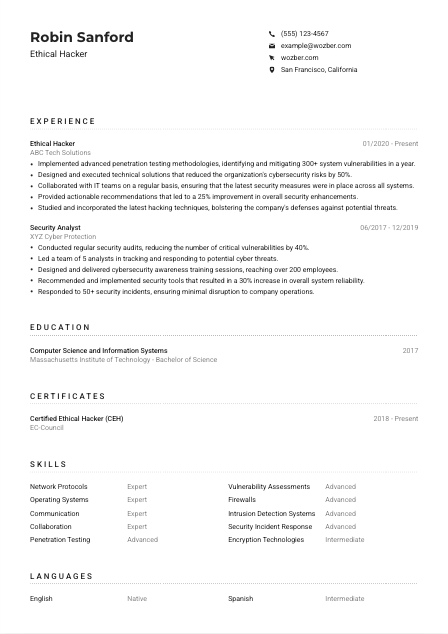
Generic statements like "responsible for security testing" do very little here. Replace them with bullets that show what you tested, what you uncovered, and what changed. The sample CV does this well with specifics such as identifying and mitigating 300+ vulnerabilities and delivering recommendations that improved overall security posture by 25%. Those are the kinds of results that make offensive security work tangible.
Numbers matter when they reflect how the work is actually measured. Include counts of vulnerabilities identified, reductions in critical findings, incident volumes handled, percentage drops in risk exposure, or improvements in system reliability after security changes. Metrics like a 50% reduction in cybersecurity risk or 40% fewer critical vulnerabilities tell a much stronger story than vague claims about improving security.
Prioritise experience that supports ethical hacking, security analysis, vulnerability management, remediation planning, or related work. Older or unrelated roles can stay brief unless they add useful context. Every bullet should strengthen your case for hands-on security testing and practical risk reduction, not dilute it with generic operational tasks.
The best experience sections make it easy to connect your offensive security work to business outcomes. When a reviewer can see the vulnerabilities you found, the teams you worked with, and the risk you helped reduce, your background reads like ethical hacking experience rather than general cybersecurity exposure.
Education matters in ethical hacking because it helps establish your grounding in systems, networks, and computing fundamentals. Keep this section clear and direct, then let experience and certifications carry the heavier proof of hands-on capability.
If the posting asks for a bachelor's degree in Computer Science, Information Systems, or a related field, make that easy to spot. In the example, the degree in Computer Science and Information Systems aligns closely with the requirement, which immediately supports the candidate's technical foundation.
List the degree, field of study, school, and graduation year or date. Security hiring does not require a creative layout here. Clean formatting helps the reviewer confirm qualifications quickly and move on to the sections where your applied technical work is shown in more depth.
When your degree directly supports the role, present it clearly without extra wording. If your education is in a related field such as information security, computer engineering, or information systems, that still works well. The point is to make the connection obvious without forcing it.
Early-career candidates can benefit from including relevant coursework, labs, capstones, or security research, especially if they relate to networking, operating systems, cryptography, secure software, or offensive security. If you already have several years of penetration testing experience, keep those details brief unless they are unusually relevant.
Honors, leadership in cybersecurity clubs, capture-the-flag participation, or a thesis tied to security architecture or vulnerability research can add useful depth. Keep these details selective. They should reinforce your technical seriousness, not turn the education section into a full second CV.
This section should confirm you have the academic base the role calls for and then stay concise. Once that foundation is clear, the hiring team can focus on your testing work, certifications, and security outcomes.
In ethical hacking, certifications often carry real hiring weight because they help validate technical range and current practice. List the credentials that support offensive security work most directly, especially when the posting names one explicitly.
When a job posting calls for CEH or an equivalent credential, lead with it. That makes technical alignment easy to confirm. In the example CV, Certified Ethical Hacker appears first, which is exactly the right move for a role that names CEH in the requirements.
Choose credentials that support the role's actual responsibilities, such as penetration testing, vulnerability assessment, exploit methodology, or security operations. A smaller list with CEH, OSCP, or another relevant certification is usually stronger than a long mixed list that drifts into unrelated areas of IT.
Include earned or active dates when they help clarify recency. In cybersecurity, current knowledge matters because attack methods, tooling, and defensive practices change quickly. A date can show that your credential is not outdated and that you stay engaged with the field.
Review your certifications regularly and update renewals, new credentials, or status changes. Ethical hackers are expected to stay current on attack surfaces, testing frameworks, and defensive countermeasures, so your certification section should reflect ongoing development rather than a one-time milestone.
Relevant certifications help reinforce what your experience already shows. They are especially useful when they directly support penetration testing work or satisfy a stated requirement in the job description.
A skills section for an ethical hacker should read like a practical operating profile. Prioritise the technical areas and collaboration strengths that show you can test systems, interpret findings, and work with others to close security gaps.
Start with the skills the role actually depends on. Here, the key themes include network protocols, operating systems, security hardware and software, penetration testing, vulnerability assessment, and communication with non-technical stakeholders. Those terms give you the baseline for tailoring, as long as they reflect your real experience.
Place the most relevant capabilities first, especially the ones that show hands-on ethical hacking depth. In the sample, penetration testing, vulnerability assessments, firewalls, intrusion detection systems, and incident response all support the target role well because they map to actual security workflows rather than generic tech familiarity.
Avoid turning this section into a keyword dump. Include technical strengths such as network protocols, operating systems, security controls, and testing disciplines, then add a few collaboration skills that matter in practice, such as communication and cross-team work. Ethical hackers often need to present findings to administrators, engineers, and non-technical stakeholders, so that balance is valuable when it is backed up elsewhere in the CV.
A well-chosen skills section should confirm the kind of systems you understand, the security work you perform, and the way you operate with other teams. If it reads like your day-to-day work, it is doing its job.
Language details matter when a role names communication requirements directly. For ethical hackers, this section is usually brief, but it can still support your application when the employer expects strong English skills or cross-border collaboration.
If the posting asks for proficient English, list it clearly. Ethical hackers write reports, explain vulnerabilities, and present remediation recommendations, so language ability supports the job in a practical way, especially when technical findings need to be understood by non-technical stakeholders.
Additional languages can help in multinational environments, distributed security teams, or organizations serving varied user bases. They are a bonus, not a substitute for technical skill, so include them when they add legitimate context rather than padding.
Use clear labels such as native, fluent, advanced, or intermediate. Security teams rely on precise communication, and that standard applies here too. Honest ratings set better expectations for interviews, reporting, and stakeholder interaction.
Some ethical hacking roles involve global teams, regional security operations, or client-facing assessments across different markets. In those cases, another language can support smoother collaboration and clearer reporting. If the role is purely local and internal, keep this section compact.
List languages because they help you work across teams, documents, or regions, not because every CV needs extra sections. In cybersecurity, communication quality matters when explaining severity, remediation timelines, and business risk. Language proficiency can contribute to that when it is relevant.
For most ethical hackers, English proficiency will be the main point here. Any additional language should add real communication value in the environment you are targeting.
Your summary should establish technical focus fast. In a few lines, show your level, your core ethical hacking strengths, and the kind of security results you have delivered, using the same language the target role uses where it fits naturally.
Review the job description before writing the summary and pull out the central themes. For this role, that means penetration testing, vulnerability assessment, mitigation planning, collaboration with IT, and communication. Those are the ideas your opening lines should revolve around if they match your background.
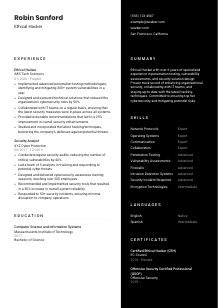
Open with your current professional identity and years of relevant experience. The example summary does this effectively with "Ethical Hacker with over 6 years of specialised experience in penetration testing, vulnerability assessments, and security solution design." That structure works because it immediately establishes scope and domain focus.
Your summary should mention two or three strengths that matter most for the target job. That may include reducing risk exposure, identifying vulnerabilities at scale, designing mitigation strategies, or working closely with infrastructure and IT teams. Keep the claims rooted in results you can support later in the CV.
Aim for concise sentences with concrete language. Avoid broad statements about passion, hard work, or being results-driven unless you tie them to actual security work. A summary should read like the opening of a technical professional profile, not a generic career objective.
When your summary clearly states your ethical hacking background, core testing strengths, and risk reduction impact, the rest of the CV has a strong frame. It should leave no doubt about the kind of security work you are prepared to do.
A tailored ethical hacker CV should make your offensive security background easy to confirm from top to bottom. That means a clear title, experience built around penetration testing and vulnerability reduction, certifications that support technical trust, and a summary that sounds like someone who has already worked through real security issues.
Use Wozber's free CV builder to tighten section structure, improve ATS optimisation, and shape your content into an ATS-friendly CV format that reflects the language of the job description. When the CV is aligned well, hiring teams can quickly see your testing depth, remediation impact, and readiness to contribute in a security-focused environment.




