



Use Wozber and land your dream job
Create CV
No registration required
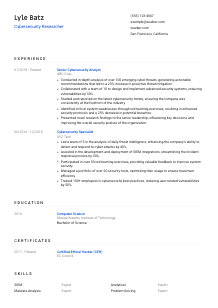
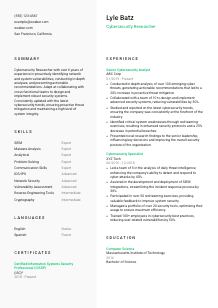
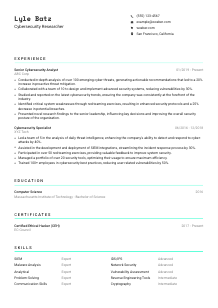
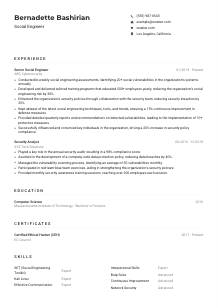
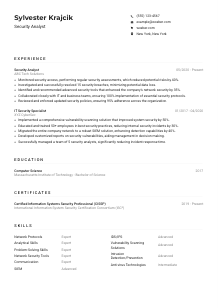
Guarding the digital realm, but your CV needs a security upgrade? Check out this Cybersecurity Researcher CV example, created with Wozber free CV builder. Learn how to detail your threat-tackling expertise to match job requirements, ensuring your cyber-defence career remains impervious to breach!
Cybersecurity research work is judged in practice by how well you turn noisy technical findings into useful decisions. Hiring teams want to see whether you can analyse emerging threats, trace vulnerabilities across systems, and translate research into recommendations that improve detection, hardening, or response. Your CV should make that line from investigation to action easy to follow.
That becomes much easier when the CV uses the same language the role is screened for. Wozber's free CV builder helps shape an ATS-compliant CV around terms such as threat intelligence, vulnerability assessment, red teaming, and security tooling, so reviewers can quickly see where your research experience maps to operational security needs.
Cybersecurity CVs usually move fast from identity to credibility. This section should be clean, professional, and complete enough that a recruiter, hiring manager, or client-facing stakeholder can immediately place you and contact you without distraction.
Use your full name as the most prominent text on the page. Keep it readable and professional. For a technical role that may involve presenting findings to leadership or clients, your CV should look as polished as the reports you would deliver on the job.
Place "Cybersecurity Researcher" directly under your name when that matches the role you are pursuing. This helps frame your background around threat analysis, vulnerability research, and security recommendations from the first glance, especially if your current title is adjacent, such as analyst or specialist.
List a current phone number and a professional email address. Accuracy matters here. If an employer wants to discuss your background in malware analysis, SIEM workflows, or red team support, there should be no friction in reaching you.
If a job specifies a location requirement, match it clearly in your personal details. In the example, listing "San Francisco, California" directly answers a stated requirement and removes doubt about eligibility or relocation timing.
Include LinkedIn, a personal site, or a research portfolio if it strengthens your application. For cybersecurity researchers, useful extras can include published advisories, conference talks, technical write-ups, GitHub projects, or responsible disclosure work, as long as the link is current and aligned with the CV.
Do not clutter this section with details that do not affect hiring decisions, such as age, marital status, or other personal identifiers. Save the space for role-relevant content and keep the CV focused on technical work, communication ability, and scope of experience.
This section should confirm who you are, how to reach you, and whether you meet any practical requirement such as location. Then the CV can move quickly into what matters most for cybersecurity research: the quality of your analysis and the impact of your findings.




For a Cybersecurity Researcher, experience has to do more than list security tasks. It should show how you investigated threats, what environments or tools you worked with, how you collaborated with engineering or operations teams, and what changed because of your work.
Start by marking the job description's core responsibilities and requirements. Here, the priority areas include emerging threat analysis, actionable recommendations, cross-functional work on security systems, red teaming, penetration testing, vulnerability assessment, and communication with senior stakeholders. Those themes should shape which bullets you keep, rewrite, or move higher.
List positions in reverse chronological order and format them consistently with title, employer, and dates. Clear structure helps reviewers quickly understand your progression from hands-on security work into deeper research, threat intelligence, or leadership responsibilities.
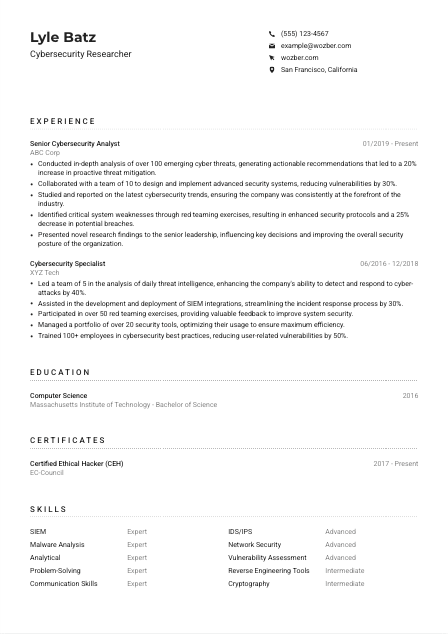
Focus each bullet on a concrete piece of cybersecurity work and the result it produced. Strong examples include analysing new threat patterns, improving detection logic, hardening systems after red team findings, or helping deploy security tools that reduced exposure. In the sample CV, bullets such as analysing more than 100 emerging threats and presenting recommendations to leadership work because they connect research activity to a real security outcome.
Quantify where numbers add operational meaning. Useful metrics for this field include threat volume analysed, reduction in vulnerabilities, improved detection or response speed, number of assessments completed, tooling coverage, user risk reduction, or breach exposure decrease. A line like "reduced vulnerabilities by 30%" or "participated in over 50 red teaming exercises" gives hiring teams a clearer sense of scale than broad claims about improving security.
If you have held several security roles, give more space to the work closest to research, threat intelligence, malware analysis, reverse engineering, vulnerability discovery, or security architecture collaboration. Support tasks can stay, but they should not overshadow the experience that shows you can investigate, interpret, and communicate complex findings. That is especially important when moving from analyst or specialist titles into a dedicated researcher position.
Your experience section should leave no doubt that you can identify meaningful threats, work with the right teams, and turn technical findings into decisions that improve security posture. That is the kind of track record this role needs.
Most Cybersecurity Researcher roles expect a solid academic grounding in computing, systems, or information security. Education will rarely carry the CV on its own for an experienced candidate, but it still matters because it confirms the technical base behind your research work.
Place the degree that directly addresses the posting's baseline requirement. For this role, a Bachelor's degree in Computer Science, Information Technology, or a related field is the stated threshold, so that credential should be easy to find.
List your degree, school, and graduation information in a simple structure. Recruiters do not need a long academic narrative here. They need to confirm that you have the expected formal training behind your work in network security, systems, and technical analysis.
If you are early in your career or applying for a highly specialised research post, include coursework that supports the role, such as operating systems, computer networks, cryptography, malware analysis, secure software, or reverse engineering. For seasoned professionals, this is usually optional unless the coursework is unusually relevant.
Projects can strengthen this section when they show technical depth, such as exploit analysis, threat modeling, traffic inspection, capture-the-flag performance, or security tooling development. Keep the description short and tie it to a capability the employer values.
With 5+ years in cybersecurity research or related work, education should support your profile rather than dominate it. Keep the section concise and let your experience, certifications, and research outcomes do most of the persuasion.
Education should confirm that you meet the role's technical entry requirement and have the academic grounding to understand complex systems and vulnerabilities. Once that is clear, the rest of the CV should focus on applied security work.
Certifications carry weight in cybersecurity when they sharpen your profile rather than pad it. They can help show hands-on security knowledge, recognized standards, and ongoing engagement with the field, especially in roles that mix research with assessment, tooling, and stakeholder communication.
Lead with certifications that support the actual responsibilities of the role. For a Cybersecurity Researcher, that usually means credentials tied to ethical hacking, security architecture, incident analysis, threat work, or offensive testing, depending on your background.
Put the certifications most likely to matter near the top. In the example, CEH and CISSP are useful because they complement research, vulnerability assessment, and broader security judgment. They are not required in every posting, but they can strengthen a profile that spans both technical depth and strategic communication.
Include the year earned and, when relevant, the current validity period. In cybersecurity, expired certifications can raise questions, while current ones suggest ongoing professional maintenance in a field where standards, tooling, and attack methods change quickly.
Review this section before each application. Remove outdated or low-value certificates if they distract from stronger credentials, and add recent training that reflects current research areas such as cloud security, threat hunting, malware analysis, or offensive security.
A focused certification list adds credibility when it aligns with the technical demands of the job. Keep it current, relevant, and clearly tied to the kind of security work you want to do next.
Cybersecurity Researcher skill sections work best when they reflect how the work is actually performed. That means balancing technical tools and methods with the analytical and communication skills needed to investigate threats and explain what they mean.
Read the job description closely and note the tools, methods, and working traits it repeats. Here, the clear priorities include SIEM, IDS/IPS, malware analysis, reverse engineering tools, vulnerability knowledge, cybersecurity frameworks, analytical thinking, problem-solving, and communication.
List the capabilities most central to the role first. Technical skills should lead, especially those tied to detection, research, and assessment workflows. In the sample CV, SIEM, malware analysis, IDS/IPS, vulnerability assessment, and reverse engineering tools align well with the posting, while analytical and communication skills support the requirement to brief leadership and collaborate across teams.
Avoid turning this into a long inventory of every security concept you have encountered. Choose the skills you can discuss in detail during interviews and that are supported by your experience bullets. A compact list of relevant tools, methods, and strengths reads better than a crowded block of generic buzzwords.
This section should quickly confirm that you have the tool familiarity, research methods, and communication strengths the work requires. If the posting emphasizes threat analysis and vulnerability discovery, those skills should be impossible to miss.
Language proficiency can matter more in cybersecurity than candidates sometimes expect. Research findings, incident context, and remediation advice often need to be written clearly and delivered to audiences ranging from engineers to executives.
If the job explicitly asks for language ability, list it clearly and near the top of the section. In this case, effective command of English is a stated requirement, so English proficiency should be easy to spot.
Additional languages can be valuable when research teams collaborate internationally, review region-specific threat reporting, or support global clients. They are a plus, though not usually a substitute for core technical qualifications.
Use clear proficiency levels so employers know whether you can write reports, present findings, or handle day-to-day collaboration in that language. Precision matters here just as much as it does in technical reporting.
If the position involves client work, international teams, or globally distributed security operations, extra language skills can add practical value. For a research role, that may also help when reviewing foreign-language sources or coordinating across regions.
List languages that add real value, but do not let this section grow larger than your technical qualifications. For most Cybersecurity Researcher roles, language skill is supporting context, while your threat research, assessment work, and tooling experience remain the core story.
Use this section to confirm required English proficiency and any additional language strengths that support collaboration or global research work. Clear communication is part of the job, especially when technical findings need to drive action.
The summary should give a hiring team a quick read on the kind of cybersecurity professional you are. For this role, that usually means your years of experience, your research or threat focus, the environments or methods you work with, and the business or security outcomes you help produce.
Start with the posting's core themes before you write a single sentence. Here, the summary should reflect cybersecurity research depth, threat analysis, knowledge of vulnerabilities, familiarity with security tools, and the ability to communicate recommendations clearly.
Your first line should identify you in direct professional terms. A formula like "Cybersecurity Researcher with 6+ years of experience in threat intelligence and vulnerability analysis" gives immediate context and sets the right expectation for the rest of the CV.
Use the next lines to highlight the most relevant strengths, such as emerging threat analysis, red teaming support, malware analysis, SIEM or IDS/IPS work, collaboration with engineering teams, or presenting findings to leadership. The sample summary does this well by tying years of experience to proactive threat mitigation and cross-functional security design.
Aim for 3 to 5 lines with enough detail to sound specific, but not so much that it reads like a second experience section. Strong summaries avoid vague phrases and instead name the kind of systems, threats, tools, or outcomes that define your work.
A well-written summary should quickly tell the reader whether you bring the research depth, security judgment, and communication range the role calls for. By the time they reach your experience section, that picture should already be in place.
You now have a clear structure for presenting yourself as a Cybersecurity Researcher with relevant threat analysis, assessment experience, tooling knowledge, and communication range. Build each section so the hiring team can see not only what you know, but what changed because of your work.
Wozber's free CV builder and ATS CV scanner can help you turn that experience into a well-structured, ATS-friendly CV format that mirrors the language of the role without forcing keywords. Use Wozber to refine wording, surface missing requirements, and strengthen ATS optimisation, then submit a CV that makes your research judgment and operational value easy to recognize.