



Use Wozber and land your dream job
Create CV
No registration required
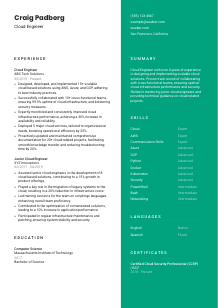
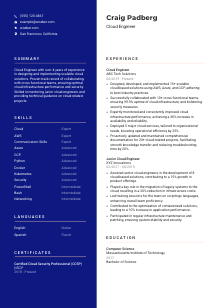
Building atop the cloud but your CV feels foggy? Navigate this Cloud Engineer CV example, created with Wozber free CV builder. Learn how to articulate your cloud expertise to match the job's dynamic demands, gearing your career higher and far from any data storms!
Cloud engineering CVs are strongest when they show how you build and run reliable infrastructure, not just that you know cloud terms. Hiring teams want to see platform depth, automation, uptime-minded operations, security awareness, and the ability to work across engineering, product, and support when production systems are on the line.
A targeted CV changes what stands out first: whether your background maps cleanly to the cloud stack, scripting work, and operational scope in the role. Wozber's free CV builder helps you shape that experience into an ATS-friendly CV format, so the hiring team can quickly see your platform coverage, containerization work, and hands-on record supporting scalable cloud environments.
This section does basic but important work. For a Cloud Engineer, it should confirm who you are, where you are based when location matters, and how to reach you without clutter getting in the way of the technical story that follows.
Use your full name as the top line of the CV and make it slightly more prominent than the rest of the text. Keep the styling clean and readable. In technical hiring, polished formatting helps, but clarity matters more than visual flair.
Place "Cloud Engineer" directly under your name when that is the role you are pursuing. This immediately aligns your profile with the opening and helps frame the rest of the CV around cloud architecture, infrastructure operations, automation, and reliability work.
Your contact information should be easy to scan and ready for follow-up from recruiters, hiring managers, or technical interview panels.
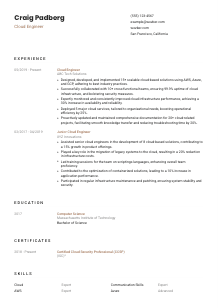
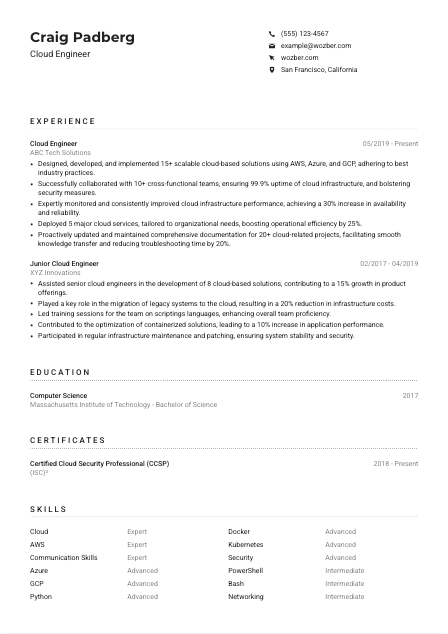
Some Cloud Engineer roles are flexible, and some are tied to a site, region, or timezone because of collaboration, security, or on-call expectations. Here, listing "San Francisco, California" directly addresses the stated location requirement and removes uncertainty about availability.
If you include LinkedIn, GitHub, or a personal site, make sure it supports your CV with consistent titles, dates, and technical substance. For cloud roles, this can be useful if you have architecture write-ups, automation projects, Kubernetes labs, or infrastructure-as-code examples worth sharing.
Keep your details crisp, accurate, and aligned with the posting. Then let the rest of the CV do the heavier work of proving cloud platform depth, operational judgment, and delivery experience.




This is the section most likely to decide whether you move forward. For Cloud Engineer hiring, experience needs to show platform ownership, environment scale, reliability outcomes, scripting, security practices, and the kinds of cloud services you have actually built, deployed, monitored, or improved.
Read the description like an implementation checklist. Note the cloud platforms named, the scripting languages, the container tools, and the operational expectations such as scalability, availability, security, troubleshooting, and documentation. Those priorities should shape which bullets you keep, rewrite, or move higher.
Use reverse chronological order and include job title, company, and dates for each role. For infrastructure and cloud positions, a clear timeline helps hiring teams understand your progression from support or junior engineering work into broader ownership of deployments, monitoring, platform administration, and cross-team delivery.
Focus each bullet on work that maps to the role's real responsibilities. Good Cloud Engineer bullets describe what you designed, deployed, automated, migrated, secured, or stabilized. The example CV does this well with lines about implementing cloud-based solutions across AWS, Azure, and GCP and deploying services tailored to business needs, which directly mirrors the job's scope.
Use numbers that make sense for cloud operations and delivery: uptime, cost reduction, deployment count, service availability, incident reduction, migration volume, environment scale, or performance gains. Metrics like 99.9% uptime, a 30% increase in availability, or a 20% reduction in troubleshooting time tell a much clearer story than vague claims about impact.
Prioritise experience that supports cloud administration, scripting, containerization, monitoring, reliability, and collaboration with other technical teams. Older or less relevant work can stay brief unless it adds something useful, such as migration experience, automation work, or production support under real operational pressure.
Your experience section should make it easy to see the platforms you worked in, the systems you supported, and the results you produced. That is what turns a list of past jobs into a credible Cloud Engineer profile.
Cloud Engineer hiring often starts with practical experience, but education still matters because it confirms your technical foundation. A clearly presented degree in computer science, information technology, or a related field supports your background in systems, networking, software, and infrastructure thinking.
When a posting asks for a bachelor's degree in Computer Science, Information Technology, or a related field, make sure that qualification is easy to find. In the example, "Bachelor of Science" in "Computer Science" lines up directly with the requirement and should stay visible near the top of the section.
List degree, field of study, school, and graduation year in a consistent order. Technical CVs benefit from structure that is easy to parse, both for people and for ATS systems reading standard education fields.
If your degree title closely matches the posting, use the full formal wording. "Bachelor of Science in Computer Science" is stronger than an abbreviated or casual version because it directly reflects what the employer asked for.
This is most useful early in your career or when the academic work connects directly to cloud engineering, such as distributed systems, operating systems, networking, cybersecurity, DevOps tooling, or infrastructure automation. Skip it if your professional experience already carries the application.
Capstone projects, research, engineering clubs, or technical awards can add value if they reinforce cloud-relevant strengths. For example, a project involving containerized deployment, system performance, or secure architecture is worth more here than general campus involvement.
This section does not need to be long. It needs to confirm that your academic background supports the systems, networking, scripting, and engineering concepts behind cloud work.
Certifications can strengthen a Cloud Engineer CV when they reinforce the work you already do. They are especially useful for showing depth in cloud security, platform administration, architecture, or operations where employers value current technical standards and continuous learning.
Choose certifications tied to the platform or specialization you want to be hired for. Even when a posting does not require one, a credential like CCSP can add weight by showing security knowledge that matters in cloud design, access control, and infrastructure protection.
Do not crowd this section with every course completion badge you have earned. Prioritise certifications that strengthen your case as a Cloud Engineer, such as cloud platform, Kubernetes, security, networking, or automation credentials.
Cloud and security certifications often have renewal cycles, version relevance, or active status. Including the earned date or validity range helps show that the credential is current enough to matter in a fast-moving infrastructure environment.
Cloud tooling changes quickly, and the most useful certificate list changes with it. Update this section as your work shifts toward architecture, reliability engineering, platform specialization, security, or multi-cloud administration.
A well-chosen certification section tells employers that you keep your knowledge current in areas that affect real cloud delivery, from security posture to platform operations.
This section should read like a practical inventory of the tools and capabilities you can use on the job. For Cloud Engineer roles, that usually means cloud platforms, scripting, containers, security, networking, and the collaboration skills needed to work across teams during deployment and incident response.
Start with the technologies and capabilities the employer actually named. In this posting, that includes AWS, Azure or GCP, Python, PowerShell or Bash, Docker, Kubernetes, communication skills, and cloud infrastructure performance and security. Those are the core skills to match first.
Lead with the capabilities most central to the work. Cloud platform administration, scripting, containerization, and reliability-focused infrastructure work should appear before broader or softer skills. In the example, AWS, Azure, GCP, Python, Docker, Kubernetes, and Security belong near the top because they map directly to the role.
Organise the section so the stack is obvious at a glance. Categories such as "Cloud Platforms," "Scripting," "Containers and Orchestration," "Security," and "Networking" make your profile easier to read than a single undifferentiated list, especially for hiring managers comparing several engineers with similar titles.
Your skills section should confirm the environment you can step into and support. Keep it aligned with the posting and grounded in tools you have actually used in production or meaningful project work.
Language fluency matters more in cloud roles than many candidates assume. Cloud Engineers spend a lot of time explaining incidents, documenting changes, coordinating deployments, and working with developers, security teams, and stakeholders who need clear technical communication.
If the role specifies English proficiency, list English clearly and use an honest proficiency label. This posting asks for proficient English speaking skills, so that requirement should be addressed directly rather than left implied.
Order matters. Lead with the language the job requires so reviewers do not have to search for it. "English - Native" or another accurate level works well when that language is essential for day-to-day collaboration and documentation.
Additional languages are worth including when they reflect real communication ability. They can be useful in global engineering teams, vendor coordination, or support environments that span regions, even if they are not mandatory for the role.
Stick to plain, understandable labels such as Native, Fluent, Advanced, Intermediate, or Basic. Avoid vague wording. Technical teams need to know whether you can write documentation, run meetings, or handle live issue discussions in that language.
For a Cloud Engineer, communication is not decorative. It affects architecture discussions, runbooks, incident updates, and cross-functional handoffs. If another language has practical value in your target environment, listing it can support that broader collaboration picture.
In cloud engineering, language skills support documentation, coordination, and incident handling. Present them clearly, especially when the posting names one explicitly.
Your summary should quickly establish the level and shape of your cloud experience. In a few lines, it needs to tell the reader which environments you have worked in, what kinds of infrastructure problems you solve, and where your background aligns with the platform, automation, and reliability needs of the role.
Before writing, identify the recurring needs in the job description. Here, the main themes are cloud platform administration, scalable solution design, scripting, containerization, infrastructure performance, security, and collaboration across teams. Those themes should anchor your opening lines.
State your title or specialization and your level of experience in a direct way. The example summary starts with "Cloud Engineer with over 4 years of experience in designing and implementing scalable cloud solutions," which works because it immediately sets role, tenure, and technical focus.
Choose strengths that reflect the posting rather than trying to cover everything. For this kind of role, that may include multi-cloud administration, containerized environments, scripting for automation, uptime and performance improvement, or cross-functional delivery with security and application teams.
Aim for a short paragraph with real technical meaning. Skip generic traits and focus on what you actually do well. A concise summary that references scalable cloud solutions, infrastructure reliability, and technical guidance will do more than a long paragraph full of broad claims.
When the summary is tailored well, the reader understands your cloud background before they reach the first job entry. That makes the rest of the CV easier to read through the lens that matters for the role.
A Cloud Engineer CV should make your platform knowledge, automation ability, container experience, reliability work, and cross-team collaboration easy to identify within seconds. When each section is tailored to the role, the hiring team can connect your background to the real work of building, securing, and maintaining cloud infrastructure.
Use Wozber's free CV builder to tighten that alignment, strengthen ATS optimisation, and present your experience in an ATS-compliant CV that reflects the cloud environments and operational outcomes you can actually deliver. The finished CV should make one thing clear: you can step into the role and contribute to stable, scalable cloud systems.