



Use Wozber and land your dream job
Create CV
No registration required
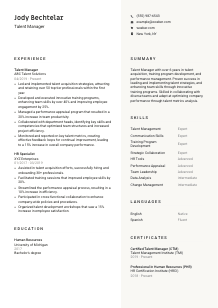
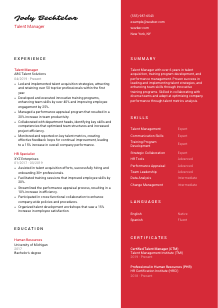
Unearthing stars, but your CV seems low-key? Tune in to this Talent Manager CV example, created with Wozber free CV builder. Learn how to bring your scouting skills and artist insights in tune with job needs, conducting a career story that always hits the high notes!
Talent Managers work where hiring plans, employee development, and performance conversations meet business results. A CV for this role needs to show more than general HR exposure. It should make your judgment visible through outcomes such as hiring quality, stronger engagement, manager support, training adoption, and the way you use talent data to improve decisions.
When those details are tailored to the target role, screening becomes much clearer, especially in an ATS-compliant CV built with Wozber's free CV builder. Matching the language of the posting, from talent acquisition strategy to performance appraisal and talent metrics, helps the system and the hiring team quickly see whether you have handled the same kind of workforce planning and development work they need.
For a Talent Manager, the header does quiet but important work. It should confirm who you are, how to reach you, and whether you meet practical requirements without distracting from your HR and talent credentials.
Your name should be the most visible text at the top of the page. Keep it easy to read and professional. In people-facing roles like talent management, a clean header supports the impression that you communicate clearly and organise information well.
Place "Talent Manager" beneath your name when that is the role you are pursuing. This helps align your CV with the posting right away and keeps your positioning consistent across ATS filters, recruiter review, and LinkedIn or portfolio links.
Add a dependable phone number and a professional email address. Talent Managers often coordinate with candidates, hiring managers, and leadership, so even small details like a clean email format reinforce professionalism and sound judgment.
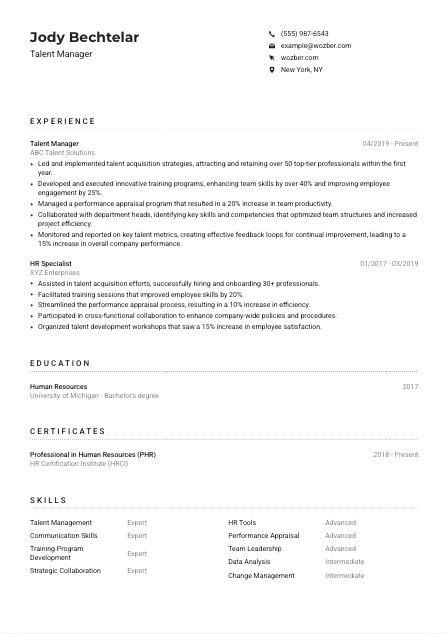
If a job requires candidates to be based in a specific city, say so directly in your personal details. Here, listing "New York, NY" addresses a stated requirement and avoids unnecessary questions about relocation or availability for on-site collaboration.
Include LinkedIn or another professional profile if it is current and supports your CV. For talent-focused roles, an updated profile can reinforce your experience in recruiting, employee development, employer branding, or HR systems, provided the details match your CV exactly.
This section should answer basic hiring questions in seconds and let the reader move straight to your talent strategy, development, and performance management experience.




This is the section most likely to determine whether you move forward. Talent Manager CVs need to show how you influenced hiring outcomes, employee capability, manager effectiveness, and the metrics behind those programs, not just that you supported HR processes.
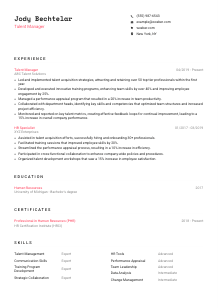
Read the posting line by line and pull out the core work streams: talent acquisition, training and development, performance appraisal, cross-functional partnership, and reporting on talent metrics. Then make sure your bullets show direct ownership or meaningful contribution in those same areas. The sample CV does this well by opening with leadership in talent acquisition strategy rather than a generic HR duty.
List your roles in reverse chronological order and make the bullets outcome-focused. Start with what you led, built, or improved, then show the result. For a Talent Manager, that might mean workforce growth, faster hiring, stronger engagement, improved productivity, or better manager adoption of appraisal processes.
Metrics matter here because this role is expected to track and report talent performance. Include figures tied to hiring volume, retention, engagement, training impact, process efficiency, or productivity. In the example, hiring more than 50 professionals, improving skills by 40%, and increasing productivity by 20% makes the impact easy to understand.
General administrative HR tasks can weaken your positioning if they take space away from stronger material. Keep bullets that show strategic partnership with department heads, program design, coaching around performance discussions, or data-driven improvement loops. Save broader HR support work for earlier roles or compress it into fewer lines.
If the job description uses phrases like "talent acquisition strategies," "training and development programs," or "key talent metrics," work those exact terms into your bullets where they truthfully match your experience. This helps with ATS optimisation and makes your background easier to connect to the role without sounding forced.
A hiring team should be able to scan this section and see that you have already handled the mix of recruiting, development, performance support, and talent reporting the role requires.
Education usually is not the deciding factor for an experienced Talent Manager, but it still needs to confirm that you meet the baseline. Keep it concise and relevant, especially when the posting specifies a degree in Human Resources, Business Administration, or a related field.
If the employer asks for a bachelor's degree in HR, business, or a related discipline, make that easy to spot. The example CV lists a Bachelor's degree in Human Resources, which directly supports the requirement and needs no extra explanation.
Use a straightforward structure: degree, field of study, school, and graduation year or date range. Clean formatting helps both ATS parsing and human review, especially when recruiters are moving quickly through a high volume of CVs.
A directly related field such as Human Resources strengthens your positioning because it supports your foundation in workforce planning, employee relations, development, and organizational practices. If your degree is adjacent rather than exact, keep the wording clear and rely on experience to do the heavier lifting.
Most mid-career Talent Managers do not need coursework or campus achievements unless those details connect to recruiting, leadership development, organizational behaviour, or analytics. Include them if they sharpen your fit, especially early in your career. Otherwise, keep the section lean.
If you have completed workshops, HR systems training, leadership development programs, or people analytics coursework beyond your degree, those details may fit here or in certifications. They are particularly useful when the target role emphasizes current HR tools or evolving talent practices.
Education should confirm that you meet the formal requirement and support the rest of the story, which for this role is driven mainly by results in hiring, development, and performance management.
Certifications carry weight in talent management because they show commitment to current HR standards and structured professional development. They are especially helpful when a posting names preferred credentials such as PHR or CTM.
List certifications that connect directly to the role's priorities. For this posting, PHR and talent management credentials are an obvious match because they support expertise in HR practice, employee development, and performance processes. The example CV wisely includes both PHR and CTM.
A shorter list of respected, role-relevant certifications is stronger than a long catalogue of loosely related courses. Prioritise credentials that support hiring strategy, workforce development, coaching, HR compliance, or talent analytics.
Dates help show recency and ongoing relevance. In a field shaped by changing HR technology, labour expectations, and development practices, current credentials suggest that your knowledge has kept pace with the work.
Update certifications as you renew them or complete new ones. If you have older credentials that no longer strengthen your case, replace them with training that better reflects the kind of Talent Manager role you are targeting now.
Relevant credentials can tip the balance when candidates have similar experience, particularly in roles that combine recruiting, employee development, and performance guidance.
A Talent Manager skills section should look like the toolkit behind your results. It needs to reflect the actual work of building talent pipelines, developing employees, advising managers, and using HR systems and metrics to guide decisions.
Start with the skills the posting makes explicit, then add closely related strengths you can support in your experience section. Here that would include talent acquisition, talent management, HR software proficiency, communication, training and development, performance appraisal, and reporting on talent metrics.
This role sits between strategy and execution. Alongside interpersonal communication and collaboration, include hard skills tied to HR tools, data analysis, training design, process improvement, or change management. The sample CV handles this balance well by combining communication, HR tools, performance appraisal, and data analysis.
Avoid stuffing this section with every HR-related term you know. Choose skills that support the target position and that recur across your recent work. A focused list is easier for recruiters to scan and easier for an ATS CV scanner to map to the job requirements.
Every skill you list should feel backed by a bullet elsewhere on the page, whether that is a hiring initiative, a training program, a performance review process, or a measurable talent outcome.
Language ability matters in talent management because the job depends on clear communication with candidates, employees, managers, and leadership. That does not mean every role needs multiple languages, but it does mean the section should be accurate and relevant.
If the posting explicitly requires strong English communication, list English clearly and use an honest proficiency level. In this case, the requirement is direct, so your CV should remove any doubt that you can handle interviews, manager coaching, written communication, and policy discussions in English.
Put the most important language first, then any others that could support the workforce or business context. For organizations with diverse teams or candidate pools, an additional language can strengthen your value, but it should not distract from the core requirement.
Use simple labels such as Native, Fluent, Advanced, or Intermediate. That gives hiring teams a realistic sense of how you can operate in conversations, presentations, documentation, or employee-facing programs.
Do not overstate fluency. Talent Managers often handle sensitive conversations around hiring, performance, and development, so accuracy matters more than sounding impressive.
If you have language skills that help with multilingual recruiting, employee training, or cross-cultural collaboration, they are worth listing. In the example, Spanish adds value because it suggests broader communication range in a diverse workforce setting, even though English remains the stated requirement.
Language skills should clarify how you communicate in the workplace and whether you can support the employee and candidate populations the organisation serves.
The summary needs to tell the reader, quickly, what kind of Talent Manager you are. Focus on years of experience, your main areas of ownership, and a few outcomes that reflect how you improve hiring, development, and performance systems.
Before writing, identify the two or three priorities the role emphasizes most. In this case, they are leading talent acquisition strategy, running development programs, supporting performance management, and reporting on talent outcomes. Your summary should reflect that mix rather than trying to cover every part of HR.
Start with your title and experience level, such as "Talent Manager with 6+ years of experience." That gives immediate context and helps the reader place you at the right seniority level for a role asking for at least 5 years in talent acquisition, talent management, or HR.
Use details that sound native to the work. Mention leading hiring strategies, developing training programs, improving engagement, guiding performance processes, or using HR tools and metrics to shape decisions. The example summary works because it combines acquisition, training, performance management, and metrics in a compact way.
Aim for a short paragraph of three to five lines. Skip broad claims about being results-driven or passionate unless they are attached to something specific, like hiring outcomes, development program impact, or better organizational performance.
A clear summary should tell the hiring team, from the first few lines, that you can lead the talent programs they care about and measure whether those programs are working.
Your Talent Manager CV should now show the parts of the job that matter most: attracting strong hires, building development programs, guiding performance conversations, partnering with leaders, and tracking talent metrics that improve the business.
Use Wozber to shape that experience into an ATS-friendly CV format, align your wording with the posting through targeted ATS optimisation, and present a hiring team with a CV that makes your talent leadership easy to recognize.