



Use Wozber and land your dream job
Create CV
No registration required
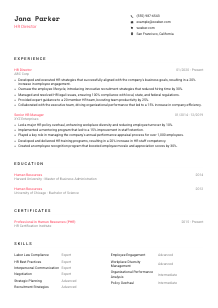
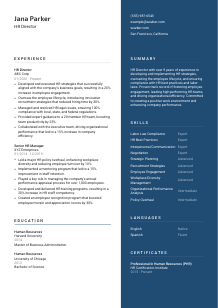
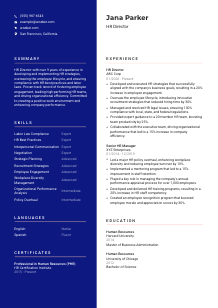
Orchestrating HR strategies, but your CV feels off-key? Sync up with this HR Director CV example, created with Wozber free CV builder. Learn how to align your top-level HR leadership with job expectations, conducting your career chorus with confidence and flair!
HR Director hiring usually turns on one question fast: have you led people policies, employee programs, and compliance decisions at a level that affects business performance. A CV for this role needs to show boardroom credibility and operational control at the same time, from workforce planning and retention to labour law risk and team leadership.
That becomes much easier to read when the CV mirrors the employer's language around strategy, employee lifecycle ownership, and regulatory compliance. Wozber's free CV builder helps you shape an ATS-compliant CV around those priorities so hiring teams can quickly connect your experience to the scale, judgment, and leadership the role requires.
For an HR Director, the contact section should feel polished and dependable. This is basic information, but it still sends a message about professionalism, attention to detail, and whether you meet practical requirements such as location and communication readiness.
Use your full name in a clear, slightly larger font so it is easy to spot at the top of the page. HR leaders are expected to present information cleanly and confidently, and that standard starts here.
Place "HR Director" directly under your name when that is the role you are pursuing. This keeps your positioning clear from the first line and helps connect your background to senior HR leadership rather than generalist or manager-level work.
Include a current phone number and a professional email address, then double-check both. For a role built on communication, negotiation, and stakeholder management, small errors in contact information can undercut credibility before anyone reaches your experience section.
If the job calls for a specific city or state, include it plainly. Here, listing "San Francisco, California" answers a stated requirement right away and avoids unnecessary questions about relocation or local availability. Keep that kind of tailoring for roles where geography is part of the hiring decision.
A LinkedIn profile can strengthen this section, especially for senior HR candidates with visible leadership history, certifications, recommendations, or speaking and policy work. Make sure the title, dates, and scope on your profile match the CV exactly.
Keep this section accurate, clean, and tailored to any practical filters in the posting. For HR leadership roles, even the basics should reflect precision and executive-level professionalism.




This is where an HR Director CV earns attention. Hiring teams want to see how you shaped HR strategy, handled compliance risk, improved employee outcomes, and led teams or programs with measurable organizational impact.
Start by marking the responsibilities and requirements that define the role. For this opening, that includes HR strategy, full employee lifecycle oversight, legal compliance, team leadership, and partnership with senior management. Those themes should appear clearly across your recent experience, not just in a skills list.
List your roles from most recent to oldest, including title, employer, and dates. For senior HR candidates, chronology matters because it shows progression into broader scope, larger teams, and more strategic responsibility, such as moving from Senior HR Manager into an HR Director seat.
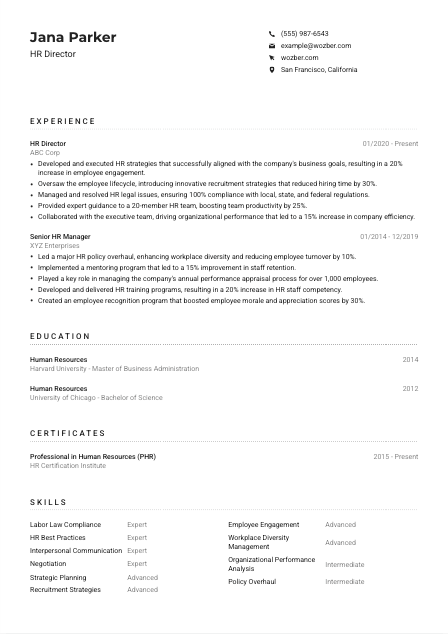
Each role should show what you owned and what changed because of your work. Strong HR Director bullets often cover workforce initiatives, policy design, employee engagement, compliance management, organizational development, or leadership of HR staff. The sample CV does this well with points on strategy execution, employee lifecycle oversight, and executive collaboration rather than vague people-focused language.
Quantified results make your leadership easier to judge. In this field, useful metrics include engagement scores, turnover reduction, time-to-fill, retention, policy adoption, training impact, compliance rates, or productivity gains within the HR function. A bullet like reducing hiring time by 30% or raising employee engagement by 20% tells far more than saying you "improved recruiting" or "supported culture."
Prioritise experience that shows strategic influence, legal and policy judgment, employee lifecycle leadership, and partnership with executives. Early-career tasks or generic administrative details can dilute the case you are making. Every bullet should reinforce that you can lead an HR function, not just contribute to one.
Your experience section should leave no doubt about scale, leadership, and business impact. If a hiring team can quickly see strategy ownership, compliance control, and measurable workforce results, you are presenting yourself at the right level.
Education matters in HR leadership because it helps establish your foundation in people management, business operations, and organizational decision-making. For director-level roles, keep this section straightforward and aligned with what the employer asked for.
Check which credentials are explicitly requested before you format this section. Here, a bachelor's degree in Human Resources, Business Administration, or a related field is required, and a master's degree is preferred. If you have both, list them clearly so the qualification match is immediate.
For each degree, include the institution, degree name, field of study, and graduation year. That is usually enough for an HR Director CV. Clean formatting helps reviewers process your qualifications quickly, especially when they are checking for baseline education early in the review.
Degrees in Human Resources, Business Administration, organizational development, or related disciplines are especially relevant because they connect directly to workforce strategy and business partnership. In the example, the combination of a bachelor's in Human Resources and an MBA in Human Resources supports both operational knowledge and executive-level perspective.
Most senior candidates do not need a course list, but it can help if your degree title is broad or if you want to highlight labour relations, employment law, compensation, organizational behaviour, or change management. Include it only when it adds useful context.
Honors, leadership roles, or major research projects can stay if they are genuinely relevant and still support your current senior profile. For experienced HR leaders, this section should stay concise and let your leadership record carry more weight.
A concise education section should confirm that you meet the formal requirements and support the business-facing side of your HR background. At this level, relevance and clarity matter more than detail.
HR certifications carry real weight because they point to current knowledge of employment law, compliance standards, and professional practice. For director roles, they also reinforce that you lead from an informed, up-to-date understanding of the field.
Check the posting for mandatory credentials and place those first. In this case, PHR or SHRM-CP is required, so that certification should be impossible to miss. When a certification is named in the job description, it is often part of both ATS filtering and hiring manager review.
List credentials tied to compliance, strategic HR management, labour relations, or senior people leadership before less relevant training. Broad professional recognition matters more here than short course certificates unless the role has a specialised focus.
Add the year earned and, if applicable, the active renewal period. This helps show that your credentials are current, which matters in a function shaped by changing labour regulations, reporting requirements, and policy expectations.
If you have advanced or follow-on certifications, they can strengthen your profile by showing progression. The example lists both PHR and SPHR, which works well for a senior candidate because it supports a history of deeper professional commitment and growing scope.
Well-chosen certifications strengthen your credibility in compliance, policy, and HR leadership. Keep the list focused on credentials that matter to the job and current enough to support executive-level trust.
The skills section should read like the operating toolkit of an HR Director. That means a mix of strategic, compliance, leadership, and people-facing capabilities that reflects how senior HR work actually gets done.
Review the posting for named skills, then infer the ones required to deliver the work. Here, labour law knowledge, regulatory compliance, negotiation, communication, consensus building, and strategic HR planning all belong because they are directly tied to the responsibilities described.
Director-level CVs should lean toward strategic planning, employee relations leadership, policy development, organizational effectiveness, talent strategy, compliance oversight, and executive partnership. Include recruiting or engagement skills when they reflect leadership of those functions, not only hands-on execution.
Group or order skills so the most relevant ones appear first. A skills list like the sample works because it places compliance, HR best practices, communication, negotiation, and strategic planning near the top, giving a quick read on both technical HR knowledge and leadership capability.
Your skills should support the story told in your experience section. When they align with the posting and reflect director-level responsibility, they help frame you as a strategic HR leader rather than a broad but generic people professional.
Language ability is not the main decision point for most HR Director roles, but it can matter when the posting requires fluency or when the workforce is multilingual. Present it clearly and keep it relevant to how communication happens in the organisation.
If the job description names a language requirement, list it first with an honest proficiency level. Here, English fluency is mandatory, so it should appear clearly rather than being left for a reviewer to assume.
Put the language most important to the role at the top, then follow with additional languages that could help in employee relations, training, investigations, or cross-functional communication. This is especially useful in organizations serving diverse employee populations.
Extra languages can add value for HR leaders working across distributed teams or multicultural workplaces. For example, Spanish may be useful in employee communication or field operations depending on the workforce mix, even if it is not a stated requirement.
Choose clear levels such as Native, Fluent, Intermediate, or Basic, and do not overstate your ability. In HR, language skill often affects trust-sensitive work like conflict resolution, policy explanation, and employee support, so accuracy matters.
Only expand this section if language ability has practical value in the role. If the business operates across regions, supports a multilingual employee base, or requires sensitive communication across cultures, your language profile becomes more than a nice extra.
List languages when they meet a requirement or strengthen your ability to lead and communicate across the workforce. For HR roles, relevance and honesty matter more than volume.
Your summary should quickly establish seniority, HR scope, and the kind of outcomes you have led. For an HR Director, this is where you connect years of experience with strategic influence, compliance depth, and people leadership in a few compact lines.
Start with a concise statement of your HR seniority, such as 8+ or 10+ years in progressive HR roles, including leadership experience. That immediately addresses one of the first screening points for director-level hiring.
Use the summary to reflect the employer's most important themes, such as HR strategy, full employee lifecycle leadership, labour law compliance, team development, and partnership with senior management. The example summary works because it covers strategy, compliance, engagement, and team leadership in language that matches the role closely.
Aim for three to five lines with concrete language rather than broad claims about being passionate or results-driven. A concise summary with terms like employee engagement, regulatory compliance, workforce strategy, or organizational efficiency gives the reader a faster and more accurate picture of your value.
When this section is tailored well, it frames the rest of the CV before the first bullet is read. It should immediately place you in the conversation for strategic HR leadership, compliance oversight, and business partnership.
An effective HR Director CV makes three things easy to see fast: the scale of your leadership, the quality of your compliance judgment, and the business impact of your people strategy. When each section supports those points, the document reads like a leader's record, not a collection of HR tasks.
Use Wozber to organise that story in an ATS-friendly CV format, refine the language with its AI CV builder, and strengthen ATS optimisation around the requirements that matter most. The result should make your readiness for an HR Director role clear from the first screen.




