



Use Wozber and land your dream job
Create CV
No registration required
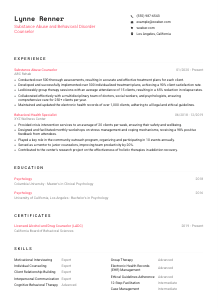
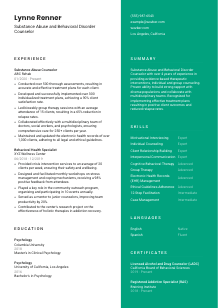
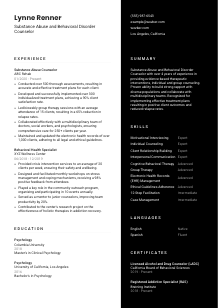
Guiding recoveries, but your CV feels stuck in denial? Browse this Substance Abuse and Behavioral Disorder Counselor CV example, created with Wozber free CV builder. Learn how to align your interventions with job expectations, making your career story as transformative as the lives you touch!
Substance abuse and behavioral disorder counseling work is judged in practice by the quality of your clinical decisions and the trust you build with clients who may be in crisis, early recovery, or relapse. Your CV should make that visible quickly through direct treatment experience, evidence-based counseling methods, care planning, and the kind of outcomes that matter in treatment settings, such as engagement, relapse reduction, continuity of care, and accurate documentation.
A targeted CV changes how your background is read, especially when hiring teams need to separate broad behavioral health experience from hands-on addiction treatment work. Wozber's free CV builder helps you shape an ATS-compliant CV around the language of the posting, so clinical tools like Motivational Interviewing, CBT, group facilitation, licensure, and level-of-care assessment are easy to find and easy to connect to your actual client work.
This section does more than identify you. For counseling roles, it should immediately establish that you are reachable, professionally presented, and aligned with any nonclinical requirements the employer listed, such as location or licensure-linked context.
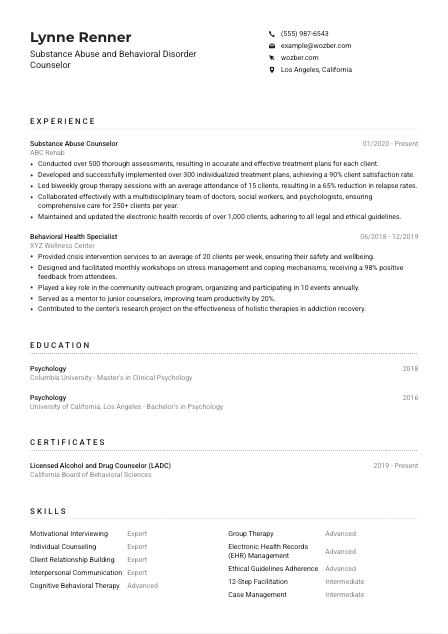
Place your full name at the top, followed by the exact professional title you want to be considered for. Using "Substance Abuse and Behavioral Disorder Counselor" helps position your background in addiction treatment and behavioral health from the first line, rather than leaving the reader to infer it from later sections.
List one phone number and one professional email address that you check regularly. In healthcare and community treatment settings, interview scheduling often moves quickly, so accuracy matters. Keep the email simple and professional, ideally based on your name rather than a casual handle.
If an employer specifies a city or state, reflect that clearly in your personal details. Here, Los Angeles, California is part of the stated requirement, so including it removes a basic screening question right away. Only mention location to confirm alignment, not to fill space.
Include LinkedIn or another professional profile when it reinforces your counseling background with consistent job titles, education, licenses, or treatment specialties. If the profile is sparse or outdated, leave it off until it reflects the same clinical story as your CV.
You do not need extra personal data such as birth date, marital status, or a full street address. For counseling positions, concise professional identifiers work best. Save room for the parts of the CV that show assessment volume, treatment planning, group work, and interdisciplinary care.
Your personal details should answer the practical basics in seconds: who you are, what counseling role you do, how to reach you, and whether you meet any stated location requirement.




For this profession, experience carries the most weight when it shows direct client care, treatment planning, counseling methods, documentation standards, and collaboration across a care team. Hiring teams want to see the kind of caseload, setting, and outcomes you have handled, not a generic list of duties.
Prioritise positions where you conducted assessments, delivered individual or group counseling, developed treatment plans, supported relapse prevention, or worked in a behavioral health or recovery setting. If your background includes adjacent roles in mental health, crisis services, or case management, connect them clearly to substance use treatment whenever that link is real.
For every role, include your job title, employer, and dates in reverse chronological order. Then use bullets to show the setting and substance of your work. In this field, that often means client volume, treatment modality, documentation systems, multidisciplinary coordination, and whether you worked in outpatient, residential, community, or crisis environments.
Strong bullets pair a clinical responsibility with a result. Instead of writing that you "provided counseling," show what that counseling produced. The example CV does this well with bullets like conducting 500+ assessments and implementing 300+ treatment plans with a 90% client satisfaction rate. Metrics like relapse reduction, attendance, completion, referral follow-through, or caseload coverage make your work easier to understand.
Numbers are especially persuasive when they reflect how counseling work is actually tracked. Useful measures include number of assessments completed, active caseload size, group attendance, documentation accuracy, crisis response volume, plan compliance, or client outcome trends. A bullet such as a 65% reduction in relapse rates stands out because it ties therapeutic work to a treatment outcome, not just activity.
Keep older or less relevant work brief unless it supports the role directly. If you include broader behavioral health experience, frame it around transferable counseling strengths such as crisis intervention, psychoeducation, case coordination, workshop facilitation, or mentoring junior staff. Every bullet should move your profile closer to addiction counseling practice, not away from it.
Your experience section should show that you can assess clients, plan treatment, run counseling interventions, document care properly, and contribute to better outcomes in a real clinical setting.
Education matters in counseling roles because it establishes your clinical foundation and confirms that you meet baseline qualification requirements. The key is to present your degrees in a way that makes the training relevant to addiction treatment, behavioral health, and therapeutic practice.
When the role calls for a master's degree in Psychology, Social Work, or a related field, lead with the graduate credential that satisfies that requirement. If your degree includes a clinical, counseling, or substance abuse treatment focus, make that clear in the degree or field line.
List the degree, school, field of study, and graduation year in a consistent format. This helps the reviewer confirm your academic background without searching. In healthcare hiring, straightforward presentation works better than decorative detail.
If your education directly supports the role, say so plainly. A degree such as a Master's in Clinical Psychology aligns well because it signals formal training in assessment, intervention, and therapeutic frameworks. When applicable, related concentrations in addiction studies, counseling, or social work practice add useful context.
You do not need to list classes by default, but relevant study can help if it supports the role's clinical methods. Coursework in Motivational Interviewing, Cognitive Behavioral Therapy, psychopathology, addiction counseling, trauma, or group therapy can strengthen an early-career CV or clarify a specialised track.
Research projects, clinical placements, thesis work, or honors are worth mentioning when they relate to behavioral health or recovery work. For example, a research contribution on treatment effectiveness or a practicum in a rehabilitation setting gives the education section more practical weight.
Your education should quickly establish that you meet the degree requirement and that your training supports the clinical work described elsewhere on the CV.
Licensure and addiction-specific credentials are central in this field. They are often reviewed early because they affect eligibility, supervision requirements, and how quickly a counselor can step into client care.
Start with the license or certification that directly matches the posting. For this type of role, that may be a state-recognized credential such as LADC, CADC, or RAS. If the employer asks for valid licensure, make sure the credential name is impossible to miss.
List the certifications that matter most to addiction treatment before broader professional development items. A current substance abuse counseling license carries more hiring weight here than a general workshop certificate because it directly affects your ability to practice.
Include the issuing body and the dates, especially when the credential is current. The example CV handles this clearly with "2019 - Present" and "2018 - Present," which signals active standing. If renewal is pending or supervision status matters, reflect that accurately.
Additional certifications can strengthen your profile when they relate to treatment delivery, co-occurring disorders, trauma-informed care, crisis intervention, or specific modalities used in recovery settings. Focus on credentials that deepen your clinical range rather than padding the section.
A hiring manager should be able to confirm your practice eligibility, current standing, and commitment to staying current in addiction counseling standards.
The skills section works best when it reads like the toolkit you use in treatment, documentation, and care coordination. In this profession, that means balancing therapeutic methods, client-facing strengths, and operational skills required in a regulated clinical environment.
Start with the clinical and interpersonal skills the employer named. Here, that includes evidence-based modalities such as Motivational Interviewing, Cognitive Behavioral Therapy, and 12-Step Facilitation, along with rapport-building and communication. Mirror the employer's wording where it matches your actual experience so both ATS screening and human review line up.
Do not separate technical counseling skills from relational ones. Substance use treatment depends on both. A useful list may combine MI, CBT, group therapy, relapse prevention, assessment, case management, and EHR documentation with strengths like de-escalation, trust building, and work with diverse populations.
Put the most job-relevant skills first. If the position centers on treatment planning and counseling delivery, those should come before generic traits. The sample CV does this well by leading with Motivational Interviewing, individual counseling, rapport building, and CBT before listing supporting skills like EHR management and ethical guideline adherence.
Your skills list should sound like the daily practice of an addiction counselor, not a generic mix of buzzwords. It should tell the reader how you work with clients and how you operate inside a treatment team.
Language ability can matter a great deal in counseling because trust, informed consent, psychoeducation, and relapse prevention all depend on clear communication. When you serve multilingual communities, language skills can directly affect access and continuity of care.
If the posting names a required language, list it first with an honest proficiency level. In this case, strong English communication is essential, so English should appear clearly and prominently.
Order them based on how useful they are in the client population or treatment setting you are targeting. This makes the section more than a side note. It becomes part of how you support rapport, assessment accuracy, and group participation.
Even when a second language is not listed as required, it can strengthen your application in community health, outpatient treatment, and urban behavioral health settings. The example's Spanish fluency is a good illustration of added value when working with diverse populations.
Stick to standard terms such as Native, Fluent, Intermediate, or Basic. Avoid vague wording. Clear labels help employers understand whether you can conduct counseling sessions, explain treatment plans, or handle only everyday conversation.
If you know the employer serves a specific community, highlight any language ability that supports therapeutic rapport and care access for that population. Only do this when the skill is real enough to use responsibly in practice.
Language skills should reinforce your ability to communicate clearly with clients and families, especially where cultural and linguistic access are part of effective treatment.
The summary should give a hiring team a quick clinical snapshot of who you are. For counseling roles, that means naming your treatment focus, your experience level, and the kinds of outcomes or strengths that make you effective with clients and care teams.
Open with your professional identity and the area you work in. Make it clear whether your background is in substance abuse treatment, behavioral health, co-occurring disorders, or a combination. This helps the reader place your experience immediately.
Include your years of relevant experience and two or three strengths that match the role closely, such as assessment, individualized treatment planning, group facilitation, relapse prevention, or evidence-based counseling methods. Keep these tied to actual practice, not broad personality claims.
Use the summary to mention high-value results or distinctions, such as strong rapport with diverse populations, improved client outcomes, multidisciplinary collaboration, or measurable relapse reduction. The example summary works because it combines evidence-based interventions with client relationship building and positive treatment results.
Aim for a short paragraph that can be read quickly before the reviewer moves into your experience. Three to five lines is usually enough. Focus on the parts of your background that best match the caseload, treatment model, and clinical expectations of the job.
Your summary should quickly tell the employer that you have relevant treatment experience, recognized counseling methods, and the professional judgment to support clients through recovery-focused care.
A well-tailored Substance Abuse and Behavioral Disorder Counselor CV should make your clinical experience, active credentials, therapeutic methods, and treatment outcomes easy to recognize. When those details are clearly organised, hiring teams can quickly see whether you are ready for assessments, care planning, group work, documentation, and multidisciplinary coordination.
Use Wozber to build and refine an ATS-friendly CV format that reflects the language of the role without losing the reality of your practice. The finished CV should make one thing clear right away: you can support recovery work with sound counseling judgment and dependable clinical follow-through.




