



Use Wozber and land your dream job
Create CV
No registration required
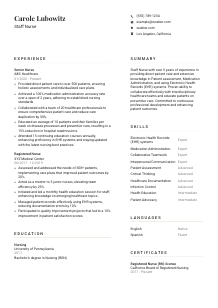
Dishing out care, but your CV feels under the weather? Lay out your nursing expertise with this Staff Nurse CV example, created with Wozber free CV builder. Get it bedside-ready to show you're the right prescription for the job requirements, leading your nursing career to prime health!
Staff Nurse hiring moves quickly because the work carries immediate clinical responsibility. A CV has to show more than compassion or general bedside experience. It needs to make your patient assessments, medication administration, care planning, charting habits, and team coordination visible enough for a hiring manager to picture you on the unit.
When those details are tailored to the posting, your background reads less like broad nursing experience and more like a direct match for the floor, patient population, and documentation environment. Wozber's free CV builder helps you build an ATS-compliant CV around the job's language so direct care experience, EHR proficiency, and active licensure are easy to identify early.
For Staff Nurse roles, the personal details section should remove any friction before the clinical review even starts. Hiring teams need to know who you are, how to reach you, and whether you meet basic practical requirements such as location and professional identity. Keep this section clean, current, and immediately useful.
Place your full name at the top in a readable size so it anchors the CV clearly. In healthcare hiring, reviewers often scan fast before moving into licensure, experience, and care settings, so your header should feel orderly and professional from the first glance.
Add "Staff Nurse" directly under your name when that is the position you are targeting. Matching the posted title helps frame the rest of the CV around bedside nursing rather than education, management, or advanced practice tracks.
Include a working phone number and a professional email address that you check regularly. Interview scheduling in hospital and clinic settings can move fast, and missed calls or an outdated email can slow down your application more than any wording issue.
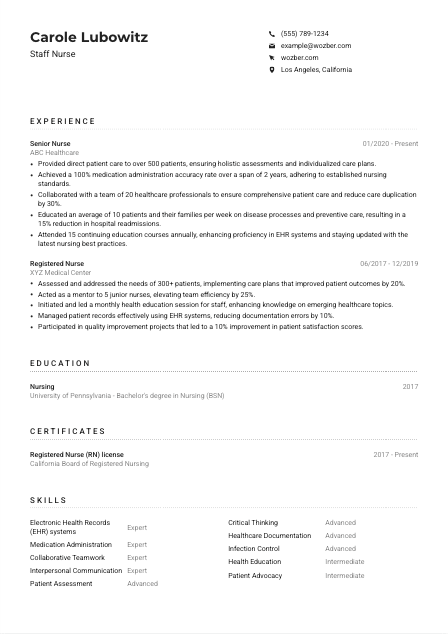
If an employer specifies a location requirement, show your city and state in the header. Here, Los Angeles, California matters because the posting asks candidates to be based there. Including it answers a logistical question upfront without taking space from your clinical qualifications.
Do not add age, marital status, photo, or other non-job-related details. Staff Nurse hiring decisions should stay focused on licensure, patient care experience, communication, and clinical judgment, not personal background.
A precise personal details section keeps attention on your nursing qualifications from the start. Once these basics are handled, the CV can move quickly into the clinical experience and credentials that matter most for Staff Nurse hiring.




This section carries the most weight on a Staff Nurse CV because it shows how you practice, document, and contribute under real patient care conditions. Hiring managers look for clear signs of clinical scope, safe execution, and collaboration with physicians, charge nurses, and other care team members. Your bullets should show what you handled and what improved because of your work.
Read the job description closely and identify the care activities it emphasizes. For a Staff Nurse role, that often includes patient assessment, care planning, medication administration, interdisciplinary collaboration, patient education, and EHR use. Build your experience bullets around those functions instead of relying on generic nursing duties.
Start with your most recent position and include your title, employer, and dates in a consistent structure. Healthcare recruiters often review dozens of nursing CVs at once, so a straightforward timeline helps them quickly understand your level, continuity of practice, and progression from roles such as Registered Nurse to Senior Nurse.
Bedside nursing work is full of repeatable responsibilities, but your CV should show how well you performed them. Replace vague lines like "provided patient care" with specifics about patient volume, care planning, discharge teaching, quality improvement, or coordination across disciplines. The example CV does this well by tying direct care to more than 500 patients and connecting family education to a 15% drop in readmissions.
Metrics make clinical work easier to understand when they are grounded in nursing outcomes. Patient load, medication accuracy, documentation error reduction, satisfaction scores, readmission changes, or team efficiency all work well. The sample's 100% medication administration accuracy rate and 10% documentation error reduction are strong because they reflect safety and charting discipline, not inflated claims.
Keep this section centered on care delivery, coordination, documentation, safety, and patient communication. Extra achievements outside nursing only belong if they reinforce the role, such as mentoring junior nurses or contributing to unit education. Every bullet should help a reviewer understand how you function in a clinical setting.
A focused experience section gives employers a usable picture of your nursing practice, from assessments and medications to education and charting. That is the level of detail that helps a Staff Nurse CV move forward.
Education matters in nursing because it confirms your clinical foundation and helps employers quickly check whether you meet baseline requirements for practice. For experienced nurses, this section can stay compact, but it still needs to clearly show the degree that supports your licensure and patient care work.
If the posting asks for a BSN or equivalent experience, use the full degree wording that best matches your record. A Bachelor of Science in Nursing should appear clearly, since it is one of the first qualifications a healthcare employer may confirm before moving deeper into your application.
List your degree, field, school, and graduation year in an easy-to-scan order. This is not the place for long descriptions unless you are early in your nursing career. Most Staff Nurse reviewers simply want fast confirmation of your nursing education and training path.
Make sure the nursing degree itself stands out more than surrounding details. In the example, "Bachelor's degree in Nursing (BSN)" is stated plainly, which works well because it mirrors the educational language used in the posting without overexplaining it.
If you are a newer nurse, relevant rotations, senior practicum experience, simulation training, or coursework in adult health, pharmacology, pediatrics, or community health can help fill out this section. If you already have several years of bedside experience, those details usually matter less than your recent patient care record.
Honors, leadership in a nursing association, or a capstone tied to patient care improvement can add value, especially early in your career. Include them when they show discipline, initiative, or clinical engagement, not just because they are available to list.
Your education section should quickly answer a basic hiring question: do you have the nursing preparation this role calls for? When the degree is easy to find, employers can move on to the parts of the CV that show how you practice.
Licensure and certifications carry special weight in nursing because they affect both legal eligibility and unit-level readiness. This section should make it easy to confirm that you are cleared to practice and current with any credentials relevant to the setting you want to join.
For a Staff Nurse application, your current and unrestricted Registered Nurse license is the priority credential. Put it where it is easy to see, including the issuing body and active dates if relevant. That immediately addresses one of the role's core requirements.
After licensure, include certifications that match the unit or employer's patient population. ACLS, BLS, PALS, wound care, or specialty certifications can strengthen your application when they relate directly to the role. Avoid filling the section with minor training items that do not change your bedside scope.
Dates matter here because healthcare employers need to know whether a credential is current. The sample CV handles this well by showing the California RN license as active from 2017 to present, which communicates continuity and compliance at a glance.
Ongoing education is part of nursing practice, especially as protocols, documentation systems, and care standards change. If you regularly complete continuing education in areas such as infection control, medication safety, or EHR documentation, mention that selectively to reinforce current practice habits.
A well-structured certificates section tells an employer that you are licensed, current, and serious about maintaining practice standards. For Staff Nurse roles, that clarity matters as much as any summary statement.
A Staff Nurse skills section should reflect how care is actually delivered. That means blending clinical execution, documentation tools, and patient-facing communication rather than listing soft skills in isolation. Choose skills that help an employer picture how you assess, intervene, document, and collaborate during a shift.
Start with the specific capabilities the employer names, then add closely related nursing skills you genuinely use. Here, that includes EHR proficiency, communication, interpersonal effectiveness, and critical thinking, along with the clinical work behind them such as assessment, medication administration, and care planning.
Place the strongest role-matching skills first. For many Staff Nurse roles, that means items like Patient Assessment, Medication Administration, Healthcare Documentation, Infection Control, and interdisciplinary teamwork before more general traits. The example CV follows this logic by highlighting EHR systems, medication administration, and collaborative teamwork near the top.
A shorter, targeted skills section usually works better than a long inventory. If you have many competencies, group them mentally around clinical care, technical systems, and communication so the final list stays balanced. The aim is to show usable nursing capability, not every term you have encountered on the job.
When this section is tailored well, it supports the experience section instead of repeating it. Employers should be able to scan your skills and immediately see the clinical tools, documentation strengths, and patient communication abilities the role depends on.
Language skills can be especially valuable in nursing because they affect patient education, trust, and care coordination. While English proficiency is often non-negotiable, additional languages can strengthen your application in facilities serving diverse communities and can support safer, clearer patient interaction.
If the job calls for proficient English, list English first and state your level clearly. In nursing, this matters for charting, handoff communication, patient teaching, and coordination with physicians and allied health professionals.
Include additional languages when you can use them meaningfully in a clinical setting. In a market like Los Angeles, Spanish can be especially useful for patient education and family communication, which is why the example's fluent Spanish is a relevant addition rather than filler.
Use honest labels such as Native, Fluent, Advanced, or Intermediate. Overstating language ability can create real problems in healthcare settings where misunderstandings affect consent, discharge instructions, and patient safety.
Additional languages are most valuable when they help you explain treatment plans, answer patient questions, or reduce reliance on ad hoc interpretation. Include them when they improve your effectiveness as a nurse, not just to make the CV look broader.
Strong language skills often signal cultural awareness and stronger rapport with patients and families. In nursing, that can support clearer education, calmer interactions, and better adherence to care instructions, especially in diverse clinical environments.
If your language section is relevant and credible, it adds another practical layer to your nursing profile. It shows that you can communicate care clearly across a wider range of patient interactions.
The summary sits at the top of your CV, so it should quickly establish your level as a nurse, the kind of clinical work you do well, and the qualifications most relevant to the job. Avoid broad statements about passion or dedication unless they are backed by concrete nursing experience, tools, or results.
Before writing the summary, note the few requirements the employer is likely to care about first. For a Staff Nurse position, that usually means clinical experience, active RN licensure, direct patient care, medication administration, interdisciplinary teamwork, and comfort with EHR documentation.
Name your role and years of practice right away. A line such as "Staff Nurse with 5+ years of experience in direct patient care" works because it gives immediate context and aligns with the employer's minimum experience threshold without wasting space.
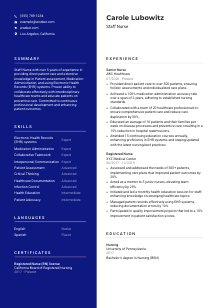
Choose details that match the job and are supported elsewhere in the CV. EHR proficiency, patient assessment, education of patients and families, reduced readmissions, or strong medication safety are all useful options. The sample summary succeeds because it combines care delivery, EHR use, team collaboration, and patient education in a compact way.
Aim for a short paragraph of about 3 to 5 lines. In healthcare hiring, a summary works best when it gives a fast clinical snapshot that leads smoothly into your experience section rather than repeating your entire CV in miniature.
Your summary should read like the opening chart note on your professional profile: concise, relevant, and grounded in real practice. Once it does that, the rest of the CV has a clear direction.
Your Staff Nurse CV should now show the essentials clearly: active licensure, solid nursing education, direct patient care experience, safe medication practice, effective charting, and collaboration with the wider care team.
Use Wozber's free CV builder, ATS-friendly CV templates, and ATS optimisation tools to tighten the language, align it with the posting, and present everything in an ATS-friendly CV format that keeps your nursing qualifications easy to read.
When the CV is tailored this way, employers can quickly see that you are prepared to step into patient care and contribute from day one.




