




Use Wozber and land your dream job
Create CV
No registration required
Measuring meds, but your CV feels like a prescription mix-up? Refill your confidence with this Pharmacy Technician CV example, created with Wozber free CV builder. It shows how to combine your pharmaceutical skills with job specifics, so your career can dispense success without a dose of confusion!
Pharmacy technician work leaves little room for vague claims. Employers want to see that you can process prescriptions accurately, support safe dispensing, manage inventory without lapses, and handle patient questions calmly in a fast-moving pharmacy environment. Your CV should make those day-to-day standards visible from the start.
Screening usually narrows quickly when a CV does not surface the essentials early, especially certification, recent pharmacy experience, and familiarity with prescription workflows. Wozber's free CV builder helps you shape that information into an ATS-compliant CV, so the first read makes it clear whether you can step into medication processing, stock control, and patient-facing support with confidence.
This section is brief, but it still carries practical weight. In pharmacy hiring, missing contact details, an unclear title, or a location mismatch can slow down an otherwise qualified application before anyone reviews your dispensing or inventory experience.
Use your full name in a clean, readable format at the top of the page. Keep it slightly more prominent than the rest of the header so employers can immediately connect your application, certification, and work history without hunting for basic information.
Place "Pharmacy Technician" directly under your name if that is the role you are pursuing. Matching the posted title helps frame the rest of the CV around prescription processing, medication handling, and pharmacy operations instead of leaving your focus open to interpretation.
Include a reliable phone number and a professional email address. Pharmacy settings depend on timely communication for interviews, onboarding documents, and certification follow-up, so accuracy here matters as much as accuracy in the rest of the CV.
If a posting specifies a location requirement, address it clearly in your header. In the example, listing Los Angeles, California immediately answers a stated requirement and removes questions about availability or relocation timing.
Include a LinkedIn profile or professional page only if it supports your candidacy with consistent job titles, certifications, or additional pharmacy experience. Skip any link that is outdated or unrelated to pharmacy operations, patient service, or healthcare work.
Treat Personal Details as operational information, not decoration. When this section is clean and complete, hiring teams can move straight to what matters most in pharmacy hiring: your certification, accuracy, and recent hands-on experience.




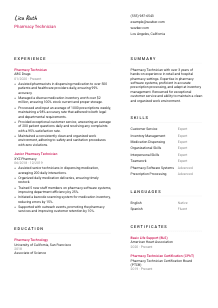
For pharmacy technician roles, the experience section usually does the heaviest lifting. Employers want to see whether you have worked with prescription volume, medication inventory, pharmacy systems, and patient-facing service in a setting where accuracy and compliance matter every shift.
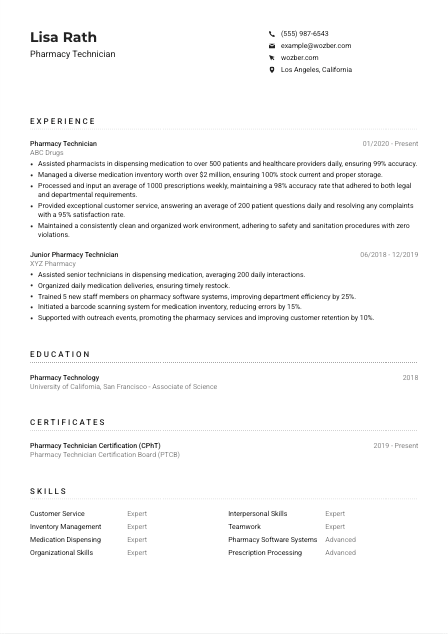
Pull the core responsibilities from the job description and make sure your bullets show comparable work. If the employer emphasizes dispensing support, electronic prescription entry, inventory control, and customer service, your experience should speak directly to those workflows. The sample CV does this well by covering medication dispensing, prescription input, inventory oversight, and patient questions across separate bullets.
List your positions in reverse chronological order with employer name, title, and dates. For pharmacy hiring, that timeline helps reviewers quickly see whether your experience comes from retail, hospital, or another medication-use setting, and whether you have the recent practice needed to handle current pharmacy systems and procedures.
Do not stop at "filled prescriptions" or "helped customers." Write bullets that show scope, standards, and outcomes. "Processed 1,000 prescriptions weekly with 98% accuracy" says far more than a generic duty statement because it shows volume and precision in one line.
Quantify details that naturally matter in this field, such as daily patient volume, weekly prescription count, inventory value, satisfaction scores, training impact, or error reduction. In the example, figures like 500 patients served daily and a $2 million inventory make the candidate's workload and trust level much easier to judge.
Keep the section centered on medication handling, prescription data entry, pharmacy software, inventory practices, compliance, sanitation, and patient support. If you include side projects or unrelated duties, make sure they still reinforce pharmacy performance, such as process improvement, staff training, or service quality.
A pharmacy technician CV stands out when the experience section shows accurate prescription work, dependable inventory handling, and strong patient service under real volume. Give employers enough detail to picture you working safely and efficiently on the bench.
Education is usually reviewed quickly in pharmacy technician applications, but it still needs to be precise. Employers are checking for baseline qualification first, then for any training that directly supports prescription processing, medication safety, and pharmacy operations.
If the posting asks for a high school diploma or equivalent, make sure your education section clearly meets that standard. If you also completed higher education or technical training, list the most relevant credential in a way that still keeps the baseline requirement easy to confirm.
List the school, degree or credential, field of study, and graduation year or date. Straightforward formatting helps employers review your qualifications quickly, especially when they are comparing many applicants with similar years of pharmacy experience.
If you completed a pharmacy technician or pharmacy technology program, make that easy to spot. In the example, an Associate of Science in Pharmacy Technology immediately supports the role because it connects the candidate's education to dispensing procedures, medication terminology, and pharmacy workflow.
Relevant coursework can help if you are early in your career or if the program content directly supports the role. Topics such as pharmacology basics, pharmacy law, dosage calculations, sterile technique, or medication safety are worth mentioning when they add context beyond the degree title.
Continuing education, healthcare training, or employer-sponsored coursework can be useful when it reinforces safe patient care or current pharmacy knowledge. Prioritise training that connects to compliance, medication handling, or service in clinical and retail settings.
Your education section should quickly confirm that you meet the entry requirements and, where relevant, show specialised pharmacy training. That clarity helps the hiring team move on to the parts of the CV that show how you perform in practice.
Certification is often one of the first checkpoints for pharmacy technician applications. If the job calls for an active credential, employers want to see it clearly listed, current, and easy to verify alongside your experience.
Start with any certification named in the posting. Here, an active Pharmacy Technician Certification, or CPhT, is a firm requirement, so it should appear prominently rather than being buried after optional credentials.
Choose certificates that support pharmacy practice, patient safety, or healthcare readiness. A focused list is stronger than a long one. In this case, CPhT is central, while something like BLS can still add value because it shows broader healthcare preparedness.
List the issuing body and the date earned, and make the active timeframe clear when relevant. For regulated healthcare roles, dates show that your credential is current and reduce follow-up questions about renewal status.
Keep this section current as you renew licenses, complete CE requirements, or add pharmacy-related credentials. In a field shaped by regulation, software changes, and safety standards, current certification signals that you stay aligned with practice requirements.
When your credentials are relevant, current, and easy to read, they strengthen the entire application. For many pharmacy technician openings, that clarity can be the difference between moving forward and being screened out too early.
A pharmacy technician skills section works best when it reflects real pharmacy tasks, systems, and service demands. Employers are looking for a concise view of what you can handle, from prescription entry to inventory control to patient interaction at the counter or by phone.
Review the posting for specific language and build your list from it. If the employer mentions pharmacy software systems, electronic prescriptions, inventory management, and customer service, those should appear naturally in your skills section when they reflect your actual background.
Prioritise skills that connect to daily technician work, such as prescription processing, medication dispensing support, pharmacy software use, stock rotation, insurance coordination, customer service, or compliance with legal procedures. The closer the match, the easier it is for employers and ATS tools to place you in the right candidate pool.
Do not overload this section with every transferable skill you have ever used. A tighter list of pharmacy-relevant capabilities is more useful than a broad inventory of generic traits. The example CV keeps this grounded by combining operational skills like inventory management and prescription processing with service-facing strengths such as customer service and teamwork.
The best skills lists sound like the work itself. When your terms match the pharmacy environment accurately, employers can connect your CV to the role faster and with fewer assumptions.
Language ability can matter more in pharmacy than applicants sometimes expect. Clear communication affects patient questions, medication pickup conversations, and basic understanding of pharmacy instructions, especially in communities where more than one language is commonly spoken.
If the posting requires English proficiency or the ability to read complex English text, list English clearly with an accurate proficiency level. That requirement often relates to reading prescriptions, labels, policy documents, and system prompts without error.
Additional languages can strengthen your application when they improve communication with patients, caregivers, or healthcare staff. In many community pharmacies, bilingual ability is especially useful for explaining routine processes and handling service interactions more smoothly.
Be precise about what you can actually do in each language. If you can hold patient-facing conversations in Spanish but are less confident with formal written communication, choose a level that reflects that realistically.
List languages that improve your ability to serve the population around you or support the type of pharmacy setting you are targeting. In a busy urban pharmacy, multilingual communication can directly support customer service, intake efficiency, and patient comfort.
Language skills matter most when they help you work more effectively with patients and colleagues. The example CV's English and Spanish combination is useful because it strengthens communication capacity in a patient-facing healthcare setting, not because extra languages are automatically required everywhere.
Used well, this section adds more than a personal detail. It can show that you are equipped to communicate clearly in the environments where pharmacy technicians often work and serve.
Your summary should quickly position you within pharmacy practice, not recycle generic strengths. In a few lines, it needs to establish your experience level, the setting you have worked in, and the parts of pharmacy operations you handle well.
Before writing the summary, identify the two or three responsibilities that define the opening. For a pharmacy technician, that often means prescription accuracy, dispensing support, inventory control, pharmacy software use, and patient service. Build the summary around the parts of that work you have done most consistently.
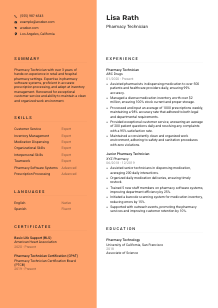
Lead with your title and a clear measure of experience, such as "Pharmacy Technician with 3+ years in retail pharmacy" or similar wording that fits your background. The example summary does this effectively by stating both the profession and experience across retail and hospital settings.
Follow with a few high-value strengths tied to pharmacy performance, such as accurate prescription processing, medication inventory management, pharmacy systems proficiency, or patient-facing service. Choose details that align with the target job rather than trying to summarise your entire background.
Aim for a short paragraph that can be read in seconds. A good summary gives enough detail to frame the rest of the CV without repeating full bullet points. Save the larger metrics, such as prescription volume or satisfaction scores, for the experience section where they can be supported properly.
When this section is written well, the reader immediately understands your pharmacy setting, your level of responsibility, and the strengths you bring to dispensing and patient support. That is the right tone to set for the rest of the CV.
A pharmacy technician CV should make a few things unmistakable: you meet the baseline requirements, you understand prescription and inventory workflows, and you can work accurately in a patient-facing setting. When each section supports those points, the document reads like someone ready to contribute on day one.
Wozber's free CV builder, ATS CV scanner, and ATS-friendly CV format make that tailoring process faster and more precise by helping you align your wording with the posting and surface missing requirements early. The finished CV should make your certification, pharmacy experience, and operational reliability easy to judge.




