



Use Wozber and land your dream job
Create CV
No registration required
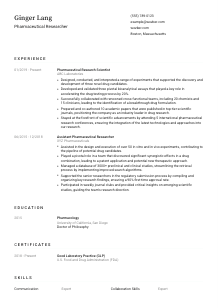
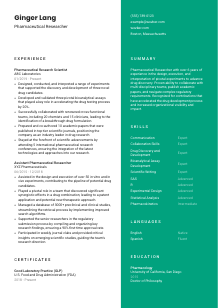
Working on drug discoveries, but your CV lacks the right prescription? Check out this Pharmaceutical Researcher CV example, created with Wozber free CV builder. It shows how to distill your scientific investigations to match job specifics, ensuring your career path is as breakthrough-filled as your lab experiments!
Pharmaceutical research work is judged in results that can withstand scrutiny. Hiring teams want to see whether you can design sound studies, interpret preclinical or clinical data correctly, and move a program forward through assay development, reporting, and cross-functional collaboration. Your CV should make that scientific judgment visible quickly, not bury it under broad claims or generic lab language.
The first screen often hinges on whether your background clearly matches the research scope, methods, and documentation demands in the posting. Wozber's free CV builder helps shape that match into an ATS-compliant CV by aligning your wording with the role's terminology, so reviewers can immediately see experience with experiments, data analysis, statistical software, and research writing that supports drug development.
In pharmaceutical research, small details carry weight. The personal details section should read like the header of a well-prepared manuscript: accurate, professional, and easy to scan. Keep it clean, then use it to confirm practical requirements the employer has stated upfront.
Your name should be the clearest line on the page. Use a slightly larger font and clean formatting so it stands out immediately, much like author attribution on a published paper or conference abstract. In research hiring, clarity beats decoration every time.
Place your working title directly below your name and match it to the role when it is accurate for your background. Using "Pharmaceutical Researcher" or a close equivalent such as "Pharmaceutical Research Scientist" helps connect your profile to the position before the reader reaches your experience section.
List only the details needed to reach you quickly and without confusion. Include:
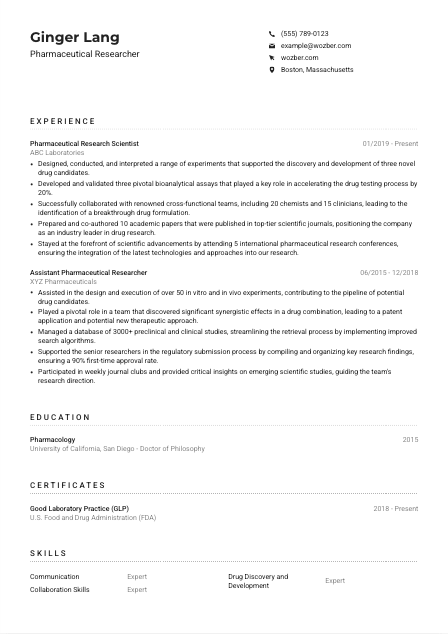
Some research employers screen for location early, especially when lab access, onsite collaboration, or relocation timing matters. Here, listing "Boston, Massachusetts" addresses a stated requirement directly. If a posting includes a location condition and you already meet it, make that easy to confirm.
A LinkedIn profile, publication list, ORCID, or professional webpage can help if it reinforces your research identity with publications, presentations, patents, or project scope. Make sure the details match your CV, especially job titles, dates, and research focus.
Do not include age, marital status, gender, or other details that have no bearing on your ability to run studies, analyse findings, or contribute to regulated research work. Save the space for information that supports hiring decisions.
Your header should answer the basics in seconds: who you are, what role you do, how to contact you, and whether you meet any stated location requirement. In a research hiring process, that kind of precision sets the right tone.




This section carries most of the weight for a Pharmaceutical Researcher CV. Employers are looking for evidence that you can plan experiments, generate reliable data, interpret findings in context, and contribute to decisions that affect a development program. Focus on research work that connects methods to outcomes.
Start by identifying the main work in the posting, then reflect that language where it matches your experience. For this role, that means study design, experiment execution, preclinical and clinical data interpretation, assay validation, statistical analysis, and scientific writing. Your bullets should show where you have already done that work rather than speaking in broad terms about laboratory support.
List your most recent role first and keep each entry easy to scan. Every position should include:
Each bullet should show what you designed, developed, interpreted, improved, or authored. Good Pharmaceutical Researcher bullets often mention experiment type, assay work, data set scope, collaboration with chemists or clinicians, and resulting scientific or operational progress. The sample CV does this well by tying experiments to three novel drug candidates and linking assay development to faster testing.
Use numbers where they reflect the way research work is measured. Useful metrics include number of studies run, assays validated, candidates supported, publications produced, teams coordinated with, approval rates, cycle-time improvement, or data volume managed. "Accelerated the drug testing process by 20%" is stronger than saying you improved efficiency because it gives the reader a real operating result.
Prioritise bullets that show drug discovery support, pharmacokinetics, bioanalytical methods, data interpretation, regulatory contribution, and cross-functional teamwork. If earlier roles included less relevant lab work, trim those bullets and preserve space for experience that speaks to development-stage research. The point is not to list everything you have done, but to foreground the work that resembles the target role most closely.
After this section, a reviewer should understand the scale of your research work, the methods you have handled, and the outcomes you influenced. Make it easy to see that your experience extends beyond bench activity into analysis, collaboration, and scientific contribution.
For pharmaceutical research roles, education is a major qualification screen, especially when the position requires doctoral training. Present your academic background in a way that confirms subject-matter depth quickly, then use supporting detail only where it adds real relevance to your research profile.
When a posting calls for a PhD in Pharmacology, Pharmaceutical Sciences, or a related field, your education section should make that visible at first glance. Lead with the highest relevant degree and use the exact field name where possible. In the example, the PhD in Pharmacology immediately addresses the requirement.
List your academic entries in a consistent structure so the reader can process them quickly. Include:
If the role leans heavily on pharmacokinetics, bioanalysis, toxicology, translational science, or another specialty, relevant coursework or concentration details can support your application, especially earlier in your career. For experienced researchers, the degree itself often does the main job unless a specialised area is central to the posting.
Doctoral and master's research can be worth naming when it connects to drug discovery, assay development, biomarker work, PK analysis, or clinically relevant data interpretation. Publications, dissertation topics, and funded projects are especially useful if they mirror the scientific direction of the role.
If you already have several years of industry research experience, you do not need to turn this section into a full academic history. Keep the focus on the credentials that qualify you for the role and let your experience section carry most of the proof of execution.
Your education section should remove any doubt about academic eligibility for the role. Once that requirement is clear, the rest of the CV can focus on how you have applied that training in real research settings.
Certifications matter most when they reinforce how you work in regulated or technically demanding environments. They are especially helpful in pharmaceutical research when they show current knowledge of compliance expectations, lab standards, or specialised methods that support reliable study execution.
Some research roles do not name a certification outright, but the responsibilities often imply what matters. If the job involves regulated studies, assay validation, or submission support, certifications tied to GLP, GCP, GMP, or related compliance frameworks can strengthen your profile even when they are not mandatory.
List credentials that support core pharmaceutical research tasks. Good Laboratory Practice is a strong example because it relates directly to study conduct, documentation discipline, and data integrity. In a role involving preclinical work, assay validation, and regulatory collaboration, that relevance is clear.
Include the year earned and, if relevant, the active date range or renewal status. That helps employers see whether your training is current, which matters more in regulated environments than simply naming a certificate without context.
Recent workshops, method training, software upskilling, or regulatory courses can belong here if they sharpen your suitability for the role. Focus on learning that supports current research practice, such as updated statistical workflows, assay techniques, or evolving regulatory guidance.
Certifications should reinforce the quality and compliance side of your research profile. Use them to show that your technical work is backed by current standards, not just experience alone.
A useful skills section for this field is tightly curated. It should reflect how pharmaceutical research is actually done, from experimental design and statistical analysis to assay work, scientific writing, and collaboration with clinical or regulatory partners. Keep it specific enough that a reviewer can picture you contributing to the team's workflow.
Read the role carefully and note both the scientific tools and the working style it calls for. Here, that includes analysing preclinical and clinical data, using SAS or R, supporting drug discovery and development, and collaborating effectively across functions. These should appear in your skills section only if they reflect real capability you can back up elsewhere in the CV.
Put the highest-value skills first. For a Pharmaceutical Researcher, that often means drug discovery, experimental design, bioanalytical assay development, statistical analysis, pharmacokinetics, scientific writing, and the specific software you use. The example CV also balances technical depth with collaboration and communication, which matters in team-based development environments.
Do not overload this section with every lab technique or broad soft skill you have ever used. A shorter list of relevant strengths reads better in ATS systems and to human reviewers than a long catalogue of mixed-value terms. Choose skills that match the posting and that your experience bullets can substantiate.
This section should give a fast read on your technical range and where you can contribute from day one. When the right skills appear in the right order, the rest of your CV becomes easier to trust.
Language skills matter in pharmaceutical research when they affect writing quality, cross-functional communication, and collaboration across international teams. For many roles, English is essential because study reports, publications, protocols, and regulatory documents all depend on precise written communication.
If the posting asks for strong English literacy, make English impossible to miss in this section. Research employers need to know you can write clearly, interpret technical literature, and contribute to documents such as papers, reports, and submission materials.
Use labels such as "Native," "Fluent," or "Professional" so the reader can understand your level immediately. Avoid vague descriptions. Clear language ratings are especially useful in globally distributed research organizations.
Additional languages are not usually a core requirement for Pharmaceutical Researcher roles, but they can still help if your work involves multinational studies, global teams, external partners, or international conference activity. They should support the profile, not distract from the scientific qualifications.
If you can present, write, or negotiate in a language, say so accurately. If your ability is conversational or intermediate, label it that way. Overstating language ability can become a problem quickly in research settings where precision matters.
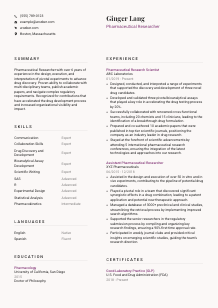
Use this section to support a broader story of communication, especially if your experience includes global literature reviews, cross-border project teams, or international scientific exchange. In the example, Spanish adds breadth, but English remains the key requirement because of the writing-heavy nature of the role.
For this kind of role, language proficiency should confirm that you can communicate science clearly and work smoothly with the people around the program. Keep English prominent, then add other languages only when they add genuine value.
Your summary should function like the opening paragraph of a strong abstract. In a few lines, it should establish your level, your scientific focus, and the kind of outcomes you have already delivered in pharmaceutical research. Keep it specific enough to feel credible and broad enough to support more than one application.
Start with the responsibilities and qualifications that matter most in the posting, then reflect those priorities in compact language. For this role, that includes pharmaceutical research experience, experiment design, data interpretation, statistical fluency, cross-functional collaboration, and scientific writing. A summary that centers these points will feel immediately relevant.
Your first sentence should name who you are and how much experience you bring. A line like "Pharmaceutical Researcher with 6+ years of experience in drug discovery and development" works because it places you quickly within the field and seniority range the employer is considering.
Choose details that signal how you work and what you influence. That could include developing validated assays, supporting novel drug candidates, publishing peer-reviewed papers, interpreting preclinical and clinical data, or contributing to regulatory documents. The sample summary works because it combines years of experience with tangible development impact and publication strength.
Aim for 3 to 5 sentences with no wasted lines. This section should be dense with relevant information, not overloaded with adjectives. If every sentence points to a real capability or outcome, the summary will do its job well.
By the end of the summary, the reader should already understand your research level, your technical focus, and the kind of contribution you bring to a development program. That context makes the rest of the CV easier to read in your favor.
You now have a framework for presenting your pharmaceutical research background with the level of precision the field expects. Use Wozber's free CV builder to organise your experience, education, and skills into a clear ATS-friendly CV template that reflects real research work, not generic lab phrasing.
Before you apply, run the CV through Wozber's ATS CV scanner to check terminology, missing requirements, and section-level alignment with the target posting. That final pass helps your ATS-friendly CV format show what hiring teams need to judge quickly: whether you can contribute sound science, reliable analysis, and well-documented progress in pharmaceutical research.




