



Use Wozber and land your dream job
Create CV
No registration required
Caring for tiny superheroes, but your CV feels stuck in the incubator? Breeze through this Neonatal Nurse CV example, created with Wozber free CV builder. Learn how to shine a spotlight on your compassionate care to match job needs, illuminating your career for a bright and healthy future!
Neonatal nursing is reviewed through a high-accountability lens. Hiring teams want to see how you care for medically fragile newborns, carry out treatments safely, work alongside neonatologists and respiratory therapists, and support families through stressful decisions and discharge planning. Your CV should make that clinical judgment and day-to-day NICU contribution visible from the start.
A tailored CV changes how quickly your background reads as NICU-ready instead of broadly pediatric. Using Wozber's free CV builder and an ATS-friendly CV format, you can align your wording with neonatal care terms, surface the right credentials, and make it easier for a hospital team to recognize experience with newborn assessment, family education, and coordinated neonatal care.
Healthcare hiring moves quickly, and the top of your CV should answer practical questions without delay. For a Neonatal Nurse, that means showing a clear professional identity, reliable contact details, and, when relevant, whether you already match the location requirement for the unit.
Your name should be the clearest text on the page, set in a clean professional font. In hospital hiring, recruiters often scan dozens of RN CVs in one sitting, so a readable header helps them find and return to your application quickly.
Place "Neonatal Nurse" directly under your name when that matches your target role. This keeps your CV aligned with the posting and immediately separates you from candidates whose background is more general pediatric, postpartum, or med-surg.
List a phone number you answer, a professional email address, and nothing that creates friction. Clinical hiring can move fast when a unit has staffing needs, so one typo in your number or email can cost you an interview.
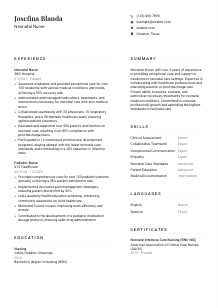
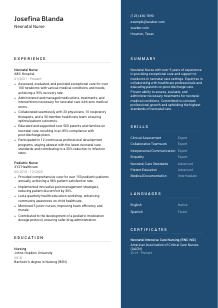
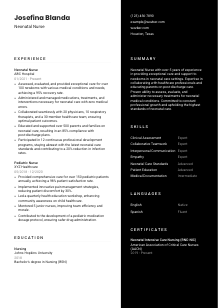
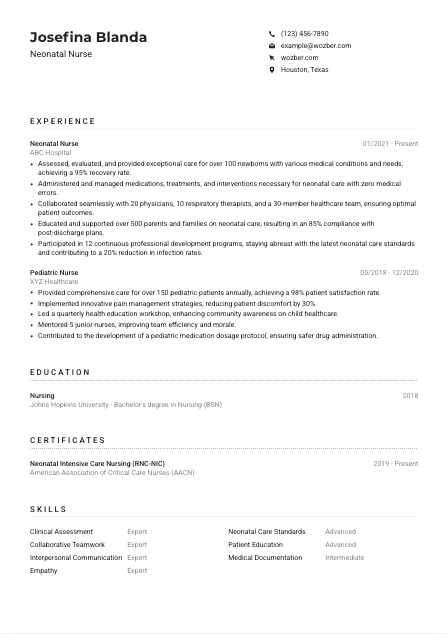
If the employer asks for someone based in Houston or willing to relocate, state your city and state in the header. Josefina's example does this well by listing Houston, Texas, which removes an immediate concern for a role tied to on-site patient care. If you are relocating, make that clear without overexplaining.
A LinkedIn profile or professional website can help if it supports your nursing background with consistent job titles, certifications, or professional activity. Keep it polished and aligned with your CV, especially if it reinforces neonatal or critical care experience.
This section does not need personality flourishes. It needs to confirm who you are, how to reach you, and whether you already meet the basic logistics for a neonatal nursing opening.




The experience section carries the most weight on a Neonatal Nurse CV. Hospitals want to understand your patient population, your clinical responsibilities, the team environment you worked in, and the outcomes or quality markers tied to your care.
Read the job description with a clinician's eye. If it emphasizes newborn assessment, medication administration, multidisciplinary collaboration, parent education, and ongoing training, those themes should appear in your bullets using language you can honestly support from practice.
List positions in reverse chronological order and give the most space to neonatal or NICU-related work. In the example, the current Neonatal Nurse role leads the section, while earlier pediatric nursing experience stays useful as support rather than taking over the story.
Focus each bullet on work that matters in neonatal settings: assessing newborns with complex needs, carrying out interventions, coordinating with physicians, educating families, or contributing to infection control and discharge readiness. The example bullet about caring for more than 100 newborns and achieving a 95% recovery rate works because it ties direct patient care to a measurable outcome.
Quantify scope and results where they are credible and natural. Patient volume, medication accuracy, family education reach, compliance with post-discharge plans, infection reduction, and team size all give hiring managers a better read on your practice environment. Metrics like zero medication errors or improved compliance are especially useful when they reflect safety and continuity of care.
Keep older or less relevant roles brief unless they build directly toward neonatal care. If you include pediatric or general nursing work, emphasize transferable elements such as medication administration, patient education, protocol adherence, or mentoring, rather than unrelated floor tasks.
A hiring manager should be able to see, within a few bullets, that you can handle neonatal assessment, safe intervention, team-based care, and family communication. That is the experience story a NICU opening needs.
Education matters in neonatal nursing because it confirms your formal training and baseline eligibility. For most openings, this section is straightforward, but it still needs to reflect the degree requirements clearly and without clutter.
If the job asks for a Bachelor of Science in Nursing, make sure your education section states that plainly. The example does this well with "Bachelor's degree in Nursing (BSN)," which mirrors the posting and removes doubt about qualification.
List your degree, field, school, and graduation year in a consistent order. Hiring teams do not need a paragraph here. They need to confirm your nursing education quickly while reviewing licensure, experience, and certifications.
When a degree is a stated requirement, do not bury it under extra academic detail. Your BSN should be easy to find because it is part of the basic screening criteria for many hospital nursing roles, especially in specialised care settings.
If you are early in your career, relevant honors, neonatal coursework, pediatric clinical rotations, or simulation-based training can add context. If you already have several years of NICU experience, your education section can stay lean.
Ongoing education matters in a field shaped by changing care standards, safety protocols, and evidence-based neonatal practice. If you have completed workshops or training tied to neonatal resuscitation, developmental care, infection prevention, or family-centered care, they can strengthen this section or support your certifications area.
Your education section should confirm that you meet the academic requirement and give hiring teams a clean starting point for the rest of your clinical profile.
Certifications matter more in neonatal nursing than in many general RN roles because they show sustained commitment to a specialised patient population. They can also help distinguish you from applicants whose experience is adjacent but not deeply neonatal.
When a posting says RNC-NIC is preferred, put that certification where it is easy to see if you hold it. In the example, listing Neonatal Intensive Care Nursing certification immediately strengthens the case for specialised NICU readiness.
Lead with credentials tied directly to neonatal or critical care practice. General certifications can still appear, but they should not distract from the credentials that support your ability to care for high-risk newborns.
Name the issuing body and show when the certification was earned or renewed. That gives hospitals a quick way to understand whether your specialised knowledge is current, which matters in roles guided by strict protocols and evolving standards.
Neonatal care requires current knowledge of treatment standards, safety practices, and continuing education expectations. If your certifications are active and recently renewed, that quietly reinforces that you stay current in a high-stakes clinical environment.
Relevant certifications tell a hospital that your neonatal knowledge is formalized, current, and serious. For NICU-focused hiring, that extra layer of specialization often matters.
The skills section should reflect how neonatal nurses actually operate on the unit. Skip vague filler and focus on the clinical, interpersonal, and documentation strengths that support safe newborn care and coordinated family communication.
Review the posting for repeated capabilities such as assessment, communication, collaboration, and neonatal care standards. Then match those to the work you have actually done in NICU or newborn care settings, rather than pasting in broad nursing keywords.
A Neonatal Nurse CV should usually include both technical and interpersonal abilities. Skills like clinical assessment, medication administration, neonatal care standards, patient education, medical documentation, collaborative teamwork, and family communication reflect the real demands of the role. The example strikes this balance well.
Order your skills so the first few lines reflect what the unit is hiring for. If the posting emphasizes multidisciplinary care and family education, those should not be buried under generic entries. Prioritization helps both ATS matching and human review.
This section should sound like the day-to-day work of a neonatal nurse. When the skills are right, they reinforce the experience section instead of repeating generic nursing language.
Language skills can be especially valuable in neonatal settings because parents need clear explanations during emotionally intense moments. This section is worth keeping when it supports patient-family communication in the communities you serve.
If the role specifically requires strong English skills, list English clearly with an honest proficiency level. That covers a stated requirement and confirms your ability to document care, communicate with the care team, and educate families.
After English, include additional languages that may improve communication with parents and caregivers. In a diverse metro area, Spanish can be a meaningful asset because it helps with education, reassurance, and post-discharge instructions when interpreter access is limited or families feel more comfortable in their preferred language.
Use labels such as "Native," "Fluent," or "Conversational" only if they accurately describe your ability. In healthcare, overstating language ability can create real communication risk, so accuracy matters more than impressiveness.
Multiple languages are especially relevant when your role includes explaining care plans, answering parent questions, and preparing families for discharge. That communication component is part of neonatal nursing, not an extra detail on the side.
You do not need to turn language ability into a global narrative. Keep it focused on practical value in clinical care, family trust, and clearer teaching during high-stress neonatal situations.
When language skills are presented honestly and tied to patient-family communication, they strengthen your profile in a way that feels directly relevant to neonatal care.
Your summary should quickly position you as a neonatal nurse, not leave the reader to infer that from later sections. In a few lines, it should show your level of experience, your care focus, and the kind of clinical environment you are prepared to support.
Open with your title and years of relevant experience. The example does this effectively by leading with "Neonatal Nurse with over 5 years of experience," which gives immediate context before moving into care responsibilities and strengths.
Use the next line to name core neonatal responsibilities you perform well, such as assessing newborns with medical complications, administering treatments, coordinating with multidisciplinary teams, or educating families on post-discharge care. This makes the summary feel grounded in actual unit work.
If the employer emphasizes collaboration, family education, or neonatal care standards, echo those priorities in your own words. Keep it specific to your practice rather than writing a broad mission statement.
Aim for 3 to 5 lines with concrete wording. Avoid soft claims that are not supported elsewhere in the CV. A concise summary built around years of experience, neonatal scope, and a few high-value strengths will read better than a paragraph full of generic dedication.
A well-written summary helps the reader place you quickly: experienced with newborn care, comfortable in multidisciplinary settings, and prepared to support both fragile infants and their families. That is the frame you want before they reach your experience bullets.
You now have a clear framework for presenting your neonatal nursing background in a way hospitals can review quickly and confidently. When each section points back to newborn assessment, safe treatment delivery, family education, and coordinated team care, your CV reads as role-ready instead of broadly nursing-focused.
Wozber's free CV builder can help you turn that experience into an ATS-compliant CV, refine wording with AI support, and organise everything in an ATS-friendly CV template. The final result should make one thing easy to judge: you are prepared to step into neonatal care and contribute from day one.