



Use Wozber and land your dream job
Create CV
No registration required
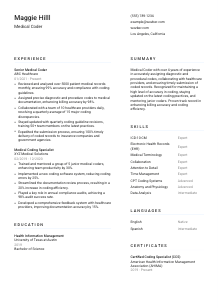
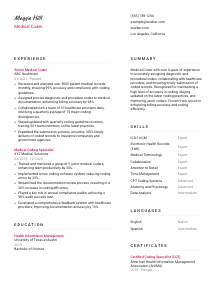
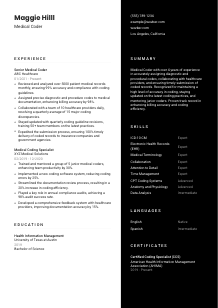
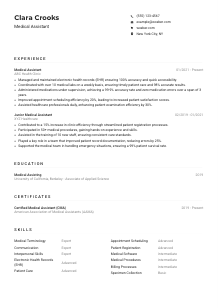
Cracking complex codes, but your CV seems scrambled? Check out this Medical Coder CV example, created with Wozber free CV builder. It shows how to translate your coding genius to match job specifics, keeping your career prognosis as healthy as can be!
Medical coding work sits at the point where clinical documentation, reimbursement, and compliance meet. Hiring teams want to see that you can read a chart carefully, translate it into correct ICD-10-CM and CPT codes, and catch documentation gaps before they create billing issues, denials, or audit risk. Your CV should make that operational precision visible from the first few lines.
CV tailoring changes how quickly your coding background makes sense in a screening pass. When your wording mirrors the posting's terminology, uses role-specific metrics, and stays clean in an ATS-friendly CV format, Wozber's free CV builder helps surface the coding systems, EHR work, and accuracy standards that matter most for Medical Coder hiring. That makes it easier to recognize whether you can code confidently, work within guidelines, and keep submissions moving on time.
The header section should read like the front end of accurate coding work. Clean, exact, and easy to verify. For a Medical Coder, even basic details set the tone, because this role depends on precision in every field, from patient records to code assignment.
Use your full name in a slightly larger font than the rest of the CV. Keep it simple and professional. A cluttered header can make the document feel careless, which is the opposite of the accuracy expected in coding and compliance work.
Place "Medical Coder" directly under your name if that is the role you are applying for. If your recent title is more specific, such as "Medical Coding Specialist" or "Senior Medical Coder," you can still align it to the target role when the experience supports it. This helps the employer connect your background to the vacancy immediately.
Your phone number and email need to be current, professional, and typo-free. In a role where one incorrect character can affect reimbursement or compliance, sloppy contact information creates the wrong impression.
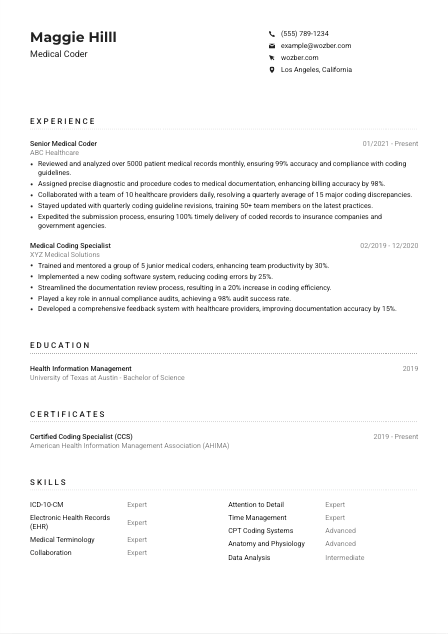
If an employer specifies a city or state, include it in your header when you meet that requirement. Here, listing "Los Angeles, California" helps address the posting's location filter right away. For other applications, use the level of location detail that matches the employer's instructions.
A LinkedIn profile or professional portfolio link can support your application if it is updated and consistent with your CV. For medical coding, that usually means matching titles, dates, certifications, and healthcare experience rather than building a broad online presence for its own sake.
Your personal details should confirm that you handle information carefully. If the header is clean, complete, and aligned with the posting, the rest of the CV starts from a position of trust.




Experience is where Medical Coder CVs either become credible or stay generic. Employers want to see the volume of records you handled, the coding systems you used, the accuracy you maintained, and how your work affected billing, denials, audits, or turnaround time.
Read the posting closely and build bullets around the actual work being hired for. For this role, that includes reviewing patient records, assigning ICD-10-CM and CPT codes, resolving discrepancies with providers, staying current on guidelines, and submitting coded records on time. If your experience covers those areas, name them directly instead of relying on broad statements about healthcare administration.
List your recent coding positions first, with job title, employer name, and dates. A straightforward timeline helps the reviewer track your coding progression, whether that means moving from a coding specialist role into senior coding work, taking on mentoring responsibilities, or expanding into audit and compliance support.
Each role should show what you handled and what improved because of your work. Good bullets mention record volume, coding accuracy, claim timeliness, discrepancy resolution, training, audit performance, or workflow gains. The sample CV does this well with details like reviewing more than 5000 records monthly and maintaining 99% accuracy, which tells a hiring manager far more than "responsible for coding charts."
Medical coding is a metric-heavy function, so numbers belong here when they are real. Use percentages, monthly volumes, turnaround improvements, denial reduction, billing accuracy, audit scores, or team productivity gains. Metrics such as a 25% drop in coding errors or 100% on-time submission give your CV operational weight.
Keep this section centered on coding, documentation review, compliance, reimbursement support, provider communication, and EHR or coding software use. Unrelated duties dilute the picture. Every bullet should strengthen the case that you can code accurately, work within guidelines, and contribute to clean claim submission.
The best experience sections show more than time on the job. They show accurate coding decisions, productive collaboration with providers, and steady results in billing and compliance environments.
Education matters in medical coding because it gives context for your technical base. Even when employers focus more on recent coding experience and certification, your degree can still reinforce your knowledge of medical terminology, anatomy, physiology, and health information workflows.
List your highest or most relevant degree first, including school, degree name, field of study, and graduation year. A degree in Health Information Management fits naturally for coding roles because it connects directly to documentation standards, records handling, and reimbursement processes.
Present education in a compact, consistent structure. Hiring teams reviewing coding CVs are often moving quickly between credentials, certifications, and experience, so they should not have to work to find your academic details.
If your degree is directly related to the work, spell that out clearly. "Bachelor of Science in Health Information Management" is stronger than listing only a general degree title because it immediately connects your academic training to coding, records, and healthcare data accuracy.
If your degree title is broad or you are earlier in your career, relevant coursework can help bridge the gap. Subjects like anatomy, physiology, medical terminology, healthcare reimbursement, or clinical documentation are worth mentioning when they support your coding profile.
Honors, scholarships, or relevant student involvement can stay if they add meaningful context, especially for newer coders. Once you have several years of coding experience, keep the section tighter unless an achievement directly supports your healthcare or health information background.
Your education section does not need to be long. It needs to confirm that your coding experience sits on a solid understanding of healthcare documentation and clinical terminology.
Certifications carry real weight in medical coding because they point to recognized standards of knowledge and ongoing professional upkeep. When a posting mentions CPC or CCS, the employer is telling you exactly which credentials will strengthen the application most.
List credentials such as CPC and CCS prominently when you hold them, especially if the posting names them as preferred or required. In this example, including both certifications directly supports the employer's stated preference and shows breadth across common coding credentials.
Prioritise certifications that connect to coding, compliance, health information, or reimbursement work. A short, targeted certification section is stronger than a long list of loosely related training that does not affect coding quality or claim processing.
Add the issue date, renewal period, or "present" status where appropriate. Coding rules, payer requirements, and reimbursement guidance change over time, so current credentials help show that your knowledge has stayed active.
If you are maintaining credentials, completing continuing education, or adding specialised coding knowledge, keep the section updated. Employers value coders who stay current with guideline revisions, documentation changes, and coding compliance expectations.
For Medical Coder roles, certifications are often one of the fastest credibility checks on the page. Make them visible, accurate, and current.
The skills section should read like the tools and judgment you use in real coding workflows. It is where you make the technical side of the role easy to scan, from code sets and EHR systems to documentation review and accuracy under deadline.
Start with the exact capabilities the employer asks for. Here, that includes ICD-10-CM, CPT coding systems, coding software, EHR systems, medical terminology, anatomy, physiology, accuracy, and written and verbal English. Those terms should appear naturally if they reflect your actual background.
Build the list around both technical and practical strengths. Good Medical Coder skill sections often combine code set expertise, EHR proficiency, reimbursement awareness, provider communication, time management, and attention to detail. The sample CV balances these well by pairing ICD-10-CM and EHR knowledge with collaboration and detail orientation.
Do not overload this section with every skill you have ever used. Choose the capabilities that matter most for coding productivity, clean documentation review, and compliant submissions. A shorter, sharper list is also easier for ATS parsing and for human reviewers scanning for match.
A focused skills section should quickly show that you know the code sets, systems, and working discipline the job depends on. Keep it specific enough that the employer can picture you in the workflow.
Language skills matter in medical coding when they affect documentation review, provider communication, and written clarity. English proficiency is often essential because coding guidance, chart documentation, payer communication, and discrepancy follow-up all depend on precise language.
Read the posting carefully before deciding how much emphasis to give this section. In this case, strong verbal and written English is listed as essential, so English should be clearly shown rather than left implied.
If the role calls for English, list it first with an honest proficiency level. That helps the employer connect your profile to the communication demands of chart review, provider clarification, and accurate written handling of coding issues.
Additional languages can be helpful in healthcare settings with diverse patient populations or multilingual staff communication. For example, Spanish can be a practical asset in some medical offices or hospital systems, but it should remain secondary to coding expertise unless the employer specifically requests it.
Use clear labels such as Native, Fluent, Advanced, Intermediate, or Basic. Overstating language ability can create problems later, especially in roles where terminology, written communication, and clarification requests must be handled accurately.
Do not treat languages as decoration. Include them when they support communication, documentation review, or team interaction in the environment you are targeting. If they do not add value for the role, this section can stay brief.
For Medical Coder roles, language proficiency should support accuracy and communication. Keep it factual, relevant, and easy to understand.
A Medical Coder summary should quickly establish coding experience, code set expertise, and the kind of accuracy or workflow results you deliver. It is the place to frame your background before the reader gets into the full record of your work.
Review the posting and identify the few points that deserve immediate mention. For this employer, that means hands-on coding experience, ICD-10-CM and CPT knowledge, comfort with EHR and coding software, strong accuracy, and timely submission work. Your summary should reflect the overlap between those needs and your background.
Lead with your title and years of experience, then narrow into your specialty. A line such as "Medical Coder with 4+ years of experience in diagnostic and procedural coding" tells the reader what you do and how long you have done it without wasting space.
Choose specifics that connect to actual coding performance. That might be high coding accuracy, provider collaboration to resolve documentation gaps, audit support, reimbursement improvement, or faster coded-record submission. The example summary works because it references accuracy, provider collaboration, and coding efficiency rather than leaning on generic claims.
Aim for a short paragraph that sounds natural while still carrying the terminology an employer or ATS will scan for. Mention the coding systems, workflow strengths, and outcomes you can genuinely support, then leave the detail for the experience section.
A well-written summary should make your coding background clear within a few seconds. By the time a hiring manager moves into your experience section, they should already understand your scope, your standards, and the kind of results you deliver.
A Medical Coder CV works when it shows disciplined chart review, accurate code assignment, current knowledge of coding guidelines, and reliable follow-through on submission timelines. Those are the details that help an employer picture you handling records, resolving documentation issues, and supporting clean reimbursement workflows.
Use Wozber's free CV builder to organise your content into an ATS-compliant CV, then strengthen the wording with role-specific terminology, measurable outcomes, and an ATS-friendly CV template that keeps the document easy to scan. If you want another layer of tailoring, Wozber's ATS CV scanner can help you align your CV to the posting's coding systems, certification preferences, and documentation language. The finished CV should make one thing clear right away: you can code accurately and support compliant, timely claims processing.




