



Use Wozber and land your dream job
Create CV
No registration required
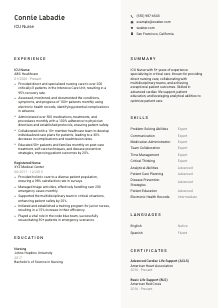
Navigating critical care, but your CV seems comatose? Check out this ICU Nurse CV example, created with Wozber free CV builder. Learn how to present your life-saving skills to match job signals, ensuring your career pulse remains strong in the high-pressure healthcare arena!
ICU hiring moves quickly because the work itself does. A CV for this specialty needs to make high-acuity nursing visible fast, especially your judgment at the bedside, comfort with rapid clinical change, and ability to document and act accurately when a patient's condition turns. Generic nursing language tends to flatten that distinction.
When the CV mirrors the language of the unit, hiring teams can separate general inpatient experience from true critical care practice much faster, and that matters in both ATS screening and human review. Wozber's free CV builder helps you organise that language into an ATS-compliant CV that clearly shows ICU scope, certifications, and the kind of patient care experience the team needs to see first.
The top of your CV should answer basic screening questions immediately. For an ICU Nurse, that usually means clear identity, current contact information, and any location detail that affects shift coverage, licensure, or hiring logistics.
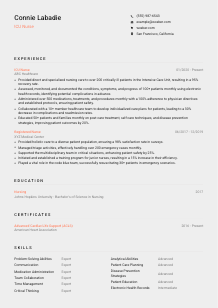
List your name prominently, then use the exact role title you are pursuing, such as "ICU Nurse." That keeps your positioning clear from the first line and helps align your CV with the posting language in ATS searches.
Include one reliable phone number and a professional email address. If a nurse manager or recruiter wants to move quickly after reviewing your critical care background, they should not have to work around an outdated number or casual email handle.
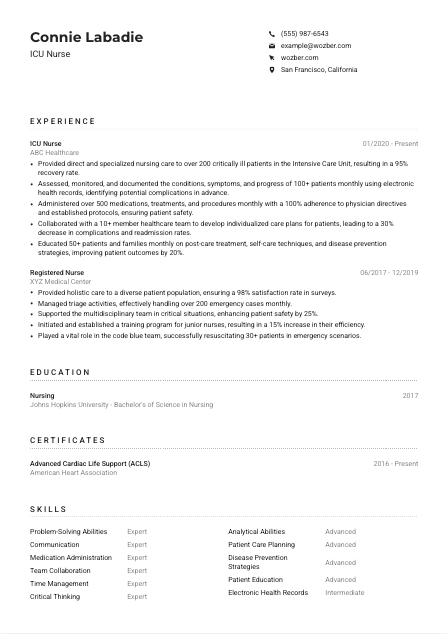
If the employer specifies a city or state, include yours in this section. In the example, listing San Francisco, California directly supports a stated requirement and removes an immediate question about local availability.
A LinkedIn profile, portfolio, or professional page can help if it reinforces your nursing background, education, certifications, or leadership activity. Keep it current and consistent with your CV, especially around titles, employment dates, and credentials.
Do not include age, marital status, gender, or other non-job-related details. Keep this section focused on the information that supports licensure, communication, and hiring logistics for a clinical role.
This section should make you easy to contact and easy to place. If the opening lines already show "ICU Nurse," a usable contact path, and any relevant location detail, the hiring team can move straight to your clinical background.




For ICU positions, experience is where your CV proves you can manage unstable patients, follow protocols without losing clinical judgment, and work effectively with physicians, respiratory therapists, and the rest of the care team. This section should read like actual unit work, not a generic nursing job list.
Start by identifying the care activities and responsibilities emphasized in the job description, then shape your bullets around matching work. Here, direct care for critically ill patients, monitoring and documentation, medication administration, multidisciplinary collaboration, and family education all appear in the posting and should show up in your experience if they reflect your background.
Use reverse chronological order and make the setting easy to understand. Include your job title, employer, and dates, then make your latest ICU or critical care role do most of the work. Earlier nursing positions still matter, but your recent high-acuity experience should carry the strongest detail.
Focus each bullet on work that matters in an ICU environment: managing critically ill patients, recognizing deterioration, documenting in the EHR, carrying out physician orders, participating in rounds, or educating families after intensive treatment. The example bullet about assessing and documenting 100+ patients monthly works because it combines monitoring volume with a clear clinical result, identifying complications early.
Quantify what you can without forcing it. Patient volume, medication volume, adherence to protocols, reduction in complications, readmission impact, satisfaction scores, or code participation can all add credibility. "Administered over 500 medications, treatments, and procedures monthly with 100% adherence to physician directives" is effective because it ties volume to safe execution, which is highly relevant in intensive care.
Every line should strengthen your case for ICU work. Prioritise ventilator-adjacent care, rapid assessment, escalation, care planning, interdisciplinary coordination, and patient or family communication under pressure. If a bullet does not help explain your readiness for critical care, trim it or rewrite it with clearer clinical context.
A hiring team should be able to scan this section and understand your patient acuity, your responsibilities, and the outcomes you influence. Wozber's free CV builder and ATS CV scanner can help you align those bullets with the posting so your critical care experience is easier to surface in both ATS and nurse manager review.
Education is usually a quick screen in nursing, but it still matters. For ICU roles, the degree line confirms that you meet baseline qualifications and gives context for licensure and clinical preparation.
If the posting asks for a BSN or equivalent, show that qualification clearly in your Education section. In this example, "Bachelor's of Science in Nursing" directly supports the stated requirement and should not be buried below less relevant details.
List the degree, field of study, school, and graduation year in a consistent format. Recruiters and clinical hiring teams often scan this section quickly, so a clean layout helps them confirm your academic background without slowing down.
Use the formal name of your degree as awarded, especially when it closely aligns with the posting language. Precision helps with ATS matching and avoids confusion around equivalent qualifications.
If you are earlier in your career, relevant clinical placements, honors, leadership in nursing organizations, or coursework tied to acute care can add value. If you already have solid ICU experience, keep this section lean and let your practice history carry more weight.
Continuing education, specialty training, or structured learning related to critical care, hemodynamic monitoring, patient safety, or advanced nursing practice can reinforce your commitment to staying current. These details are especially useful when they connect to the work of the unit you are targeting.
This section does not need to do more than it should. It should clearly show that you meet the nursing degree requirement and support the rest of your CV's story about safe, qualified ICU practice.
In critical care hiring, certifications are often reviewed early because they connect directly to patient safety and emergency response. If the posting names required credentials, those should be visible and current.
When ACLS and BLS are listed in the job description, place them first. Those certifications are central to ICU readiness and should be easy to confirm without the reviewer searching through unrelated credentials.
Include certifications that strengthen your profile for intensive care nursing, not every course you have ever completed. The point is to show readiness for critical care workflows, emergency response, and safe patient management.
Include the organisation and the date range or expiration information where applicable. In the example, listing ACLS and BLS with issuers and current validity makes compliance easy to verify and shows that the credentials are maintained.
Nursing certifications expire, renew, and expand over time. Keep this section current so you do not undersell your qualifications or create avoidable questions during screening for a time-sensitive clinical hire.
For an ICU application, certifications should confirm current emergency preparedness and professional discipline at a glance. If ACLS, BLS, and other relevant credentials are clearly listed, you have removed one more barrier to interview consideration.
Skills matter most when they reflect how you actually work in a critical care unit. A useful ICU skills section combines clinical capabilities, judgment under pressure, and communication that supports coordinated care.
Use the posting to identify the skills that deserve priority. In this case, analytical thinking, problem-solving, communication, team collaboration, documentation, medication administration, and patient education all map naturally to ICU work and should be reflected if they are part of your practice.
Include hard skills such as medication administration, electronic health records, patient care planning, and critical assessment, alongside communication and collaboration skills that matter during handoffs, rounds, and family updates. The example does this well by pairing clinical abilities with teamwork and patient education.
Avoid turning this section into a long inventory of generic strengths. A focused, ATS-friendly CV format works better when skills are specific to intensive care nursing and match the language used in the posting. That helps both automated screening and human readers connect your capabilities to the unit's day-to-day work.
A well-chosen skills section should reinforce what your experience already shows: that you can think clearly, communicate well, and deliver safe care in a high-acuity environment.
Language skills are especially relevant in healthcare because communication affects education, consent, discharge understanding, and family support. For ICU roles, list only languages you can use credibly in clinical or professional settings.
If the employer asks for strong English speaking and writing skills, list English first with an honest proficiency level. That matters in charting, handoff communication, patient education, and multidisciplinary coordination.
Additional languages can be valuable when they help you communicate with patients and families in diverse care settings. They are especially useful in hospitals serving multilingual populations, where trust and understanding often depend on clear bedside communication.
Use clear levels such as Native, Fluent, Intermediate, or Basic. Overstating language ability can create problems quickly in a clinical environment where accuracy matters.
Some locations make additional language skills more relevant. In the example, fluent Spanish is a practical asset in San Francisco, but the broader rule is to highlight languages that genuinely support patient interaction in the community you serve.
List languages because they improve care, education, and family communication, not simply because they look impressive. In nursing, language skills are most valuable when they help reduce misunderstanding and strengthen patient support.
This section can add meaningful value when it shows how you communicate across patient populations. Keep it accurate, relevant, and tied to the realities of care delivery.
Your summary should quickly establish the level of nursing work you do. For ICU applications, that means years of critical care experience, the kind of patients or workflows you manage, and a few strengths that match the unit's priorities.
Open with your title and years of relevant experience, such as "ICU Nurse with 5+ years of experience in critical care." That immediately answers two core questions: what kind of nurse you are and whether you meet the experience threshold.
Follow with strengths that reflect actual ICU practice, such as direct care for critically ill patients, collaboration during multidisciplinary rounds, strong clinical judgment, or calm execution in high-pressure situations. Keep the language grounded in how care is delivered, not in broad personality claims.
Mention two or three capabilities that align closely with the posting, such as ACLS, patient and family education, EHR documentation, or care planning. The example summary works because it ties critical care experience to collaboration and patient outcomes without turning into a full bullet list.
Aim for 3 to 5 sentences. That is enough space to establish your specialty, scope, and strengths while leaving room for the experience section to supply the detail. A concise summary with ICU-specific language is usually stronger than a longer paragraph filled with generic nursing phrasing.
A good summary gives the reader an immediate sense of your ICU background and your value on the unit. Once that framing is clear, the rest of the CV can prove it with clinical detail and measurable results.
A well-tailored ICU Nurse CV makes the essentials easy to confirm: critical care experience, current certifications, strong documentation and communication habits, and the ability to deliver safe care in high-pressure conditions.
Use Wozber's free CV builder to sharpen that alignment, apply ATS optimisation thoughtfully, and present your background in an ATS-friendly CV format that helps hiring teams quickly recognize your ICU readiness.