



Use Wozber and land your dream job
Create CV
No registration required
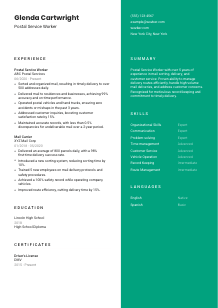
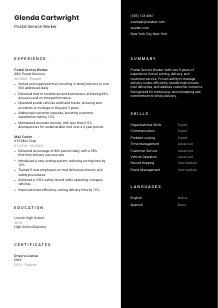
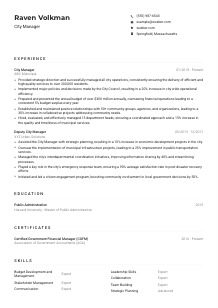
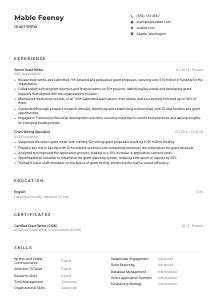
Delivering mail, but your CV feels lost in transit? Stamp your skills on this Postal Service Worker CV example, created with Wozber free CV builder. Learn how to present your delivery expertise to match job requirements, sending your career right to the desired destination!
Postal work runs on consistency. Hiring teams look for people who can sort accurately, stay on route, handle customer questions professionally, and keep deliveries moving even when volume is high or conditions are stressful. A CV for this field needs to show dependable daily execution, safe vehicle handling, and the kind of organisation that keeps mail, records, and schedules under control.
When those details are tailored to the posting, your background reads more clearly in both human review and ATS screening. Wozber's free CV builder helps you match your wording to route delivery, customer service, record keeping, and other role-specific terms in an ATS-friendly CV format, so the employer can quickly see whether you can manage the route, the workload, and the service standard the job requires.
Postal employers start with practical basics. Can they contact you easily, are you applying to the right role, and do you meet any location requirement listed in the posting. This section should answer those points cleanly and without clutter.
Place your full name at the top in a clear, readable format. Keep it slightly larger than the rest of the text so it stands out quickly when a hiring manager scans the page.
Add the role title directly under your name. If the posting says "Postal Service Worker," use that phrasing so your CV immediately aligns with the position you want and the terminology used in screening.
List a working phone number and a professional email address you check regularly. Postal hiring often moves quickly once a candidate is shortlisted, so accuracy matters here as much as it does in delivery records.
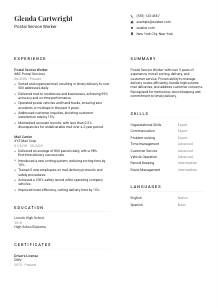
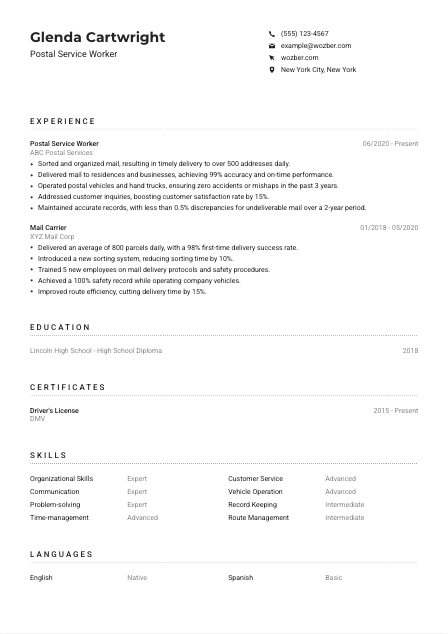
If an employer specifies a location requirement, show it in your personal details. In the example, listing "New York City, New York" directly supports the posting's local requirement and removes a basic eligibility question early.
Include a website or LinkedIn profile if it supports your application and matches the information on your CV. For a Postal Service Worker, this is optional, but it should be current and professional if you use it.
This section should confirm the practical details fast. Clear contact information, the right job title, and any stated location requirement help the employer move on to the parts that show how you work.




Experience carries the most weight in a Postal Service Worker CV because it shows how you handle volume, timing, customer interaction, and safety in real working conditions. Focus on the tasks and results that map directly to delivery operations.
Read the job description closely and underline the repeated work themes. For this role, that includes sorting and organising mail, delivering on an assigned route, operating vehicles and hand trucks safely, helping customers, and maintaining accurate records. Those are the experiences your bullets should reflect first.
Start with your most recent position and include your job title, employer, and dates. This makes it easy to follow your delivery or customer service progression and quickly confirm that you meet the requested 2+ years of relevant experience.
Each bullet should describe a task and the result it produced. Instead of saying you were responsible for mail sorting, show the scale or outcome. The example does this well with "Sorted and organised mail, resulting in timely delivery to over 500 addresses daily," which ties routine work to delivery performance.
Postal and delivery work is measured through volume, accuracy, timeliness, safety, and service. Metrics such as addresses served, parcels delivered, first-time delivery rate, discrepancy rate, or accident-free driving help hiring teams picture your reliability. The sample's 99% on-time accuracy and less than 0.5% record discrepancies are strong examples of role-native measurement.
Choose accomplishments that support the target role, especially delivery, route efficiency, customer service, safe driving, and record keeping. Even if you have broader work history, the most valuable bullets are the ones that show you can manage route-based work under pressure and keep service standards steady.
A hiring team should be able to see your route discipline, safety record, customer handling, and delivery accuracy from this section alone. If your bullets show how you performed the job day after day, the fit becomes much easier to judge.
Education is usually straightforward for postal roles, but it still matters because many postings set a minimum credential. Present it clearly so the employer can confirm you meet that baseline without searching for it.
If the posting asks for a high school diploma or equivalent, make sure that credential is listed clearly. In the example, the High School Diploma directly satisfies the stated requirement.
List the degree or diploma, the school name, and the graduation year. This section does not need extra styling or explanation unless you are early in your career and education is one of your main qualifying points.
When a posting names a specific education level, mirror that language naturally in your entry. A clear "High School Diploma" listing helps confirm that you meet the foundational requirement without adding unnecessary detail.
You usually do not need coursework for this kind of role, but it can help if it supports customer service, logistics, driving responsibility, or workplace safety. Keep it brief and only include it if it strengthens your case.
Honors, leadership roles, or school activities can be worth including if they point to dependability, service, teamwork, or discipline. For experienced candidates, these details are secondary to delivery and customer-facing experience.
For most Postal Service Worker applications, this section is about meeting the stated requirement and moving on. Clear formatting and the right credential are enough.
Certificates can strengthen a postal CV when they confirm legal eligibility, safe operation, or job-relevant training. For many Postal Service Worker openings, the most important item is not an extra credential but proof that you can legally and safely drive.
Start with any certificate or license specifically named in the posting. Here, a valid driver's license with a safe driving record is central, so listing your current license directly supports your eligibility for route work and vehicle operation.
Prioritise credentials tied to delivery work, safety, transportation, customer service, or compliance. A shorter, relevant list is more useful than a long list of unrelated training.
Dates help employers see whether a license or certificate is current. This matters most for active credentials, recent training, or any requirement linked to legal operation or updated procedures.
Driving, safety, and operational requirements can shift across employers and routes. Keep your listed credentials current so your CV reflects your present ability to take on the work without administrative gaps.
For this kind of role, the right credential can answer a hiring question immediately. If you drive, handle deliveries, or work under regulated procedures, make that qualification easy to spot.
The skills section should mirror how the job is actually done. Postal employers want to see organisation, route discipline, customer interaction, time management, and safe handling of vehicles or equipment, not a generic list of traits.
Pull skills from the posting and from common postal tasks. Sorting accuracy, time management, customer service, record keeping, communication, vehicle operation, and handling pressure all belong here because they connect directly to daily route and delivery performance.
Use the employer's wording where it reflects your real experience. If the job emphasizes organizational and time-management skills, include those terms naturally. The sample skills list does this well by naming "Time-management," "Customer Service," and "Vehicle Operation," all of which connect directly to the role.
Order your skills so the top entries support the job's main responsibilities. For a Postal Service Worker, organisation, communication, customer service, safe vehicle operation, and record keeping should usually appear before broader or less essential abilities.
This section works best when it reads like the real job. If your top skills support sorting, delivery, service, safety, and accuracy, the match will feel immediate.
Postal work depends on clear communication. You may need to answer resident questions, explain delivery issues, document exceptions, or coordinate with supervisors, so language ability should be presented in a practical and honest way.
Always start with the language requirement in the job description. In this posting, strong English communication is essential, so your CV should clearly show your English proficiency.
List English at the top of this section and give your proficiency level plainly. That makes it easy for the employer to confirm you can communicate with customers, follow route instructions, and handle delivery records accurately.
Additional languages can be useful, especially in dense urban service areas where carriers interact with a wide range of residents and businesses. They are usually a bonus rather than a requirement, but they can support customer service range.
Use clear levels such as native, fluent, intermediate, or basic. In the example, listing Spanish at a basic level is useful because it is honest and sets the right expectation.
For a Postal Service Worker, language ability supports more than conversation. It affects customer interactions, complaint handling, delivery explanations, and written documentation, so list only languages you can use credibly in a work setting.
A clear language section helps the employer understand how you will interact with customers and handle day-to-day communication. Accuracy matters here as much as it does in the rest of the CV.
The summary should give a quick, grounded picture of the kind of Postal Service Worker you are. Focus on experience level, delivery strengths, customer service, and the operational habits that matter in the job, not broad personality claims.
Look at the role requirements before writing your summary. For this job, the priorities are delivery experience, customer service, organisation, time management, safe driving, and strong communication. Those are the themes worth carrying into your opening lines.
Lead with a direct professional label and your experience level. A line like "Postal Service Worker with over 5 years of experience" works because it immediately tells the employer both your field and your level of exposure.
Include capabilities that map closely to daily responsibilities, such as route efficiency, high-volume mail handling, customer issue resolution, or accurate record keeping. The example summary does this by pointing to mail sorting, delivery, customer service, and route management instead of vague strengths.
Aim for a short paragraph that can be read in seconds. Three to five lines is enough to frame your background, especially if each sentence mentions something concrete like delivery operations, customer communication, or accuracy under pressure.
By the end of the summary, the reader should know your experience level, the kind of delivery work you handle well, and the service standard you bring. That sets up the rest of the CV effectively.
A well-tailored Postal Service Worker CV should make four things clear right away: you can handle route-based delivery work, communicate well with customers, maintain accurate records, and operate safely under pressure. If those points are obvious across your summary, experience, skills, and credentials, you are presenting the right hiring picture.
Use Wozber's free CV builder to organise that experience in an ATS-compliant CV, refine your wording with role-specific language, and check alignment with an ATS CV scanner before you apply. The finished CV should make it easy to judge whether you can keep mail moving accurately, safely, and on schedule.