



Use Wozber and land your dream job
Create CV
No registration required
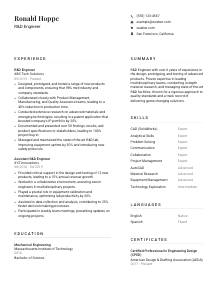
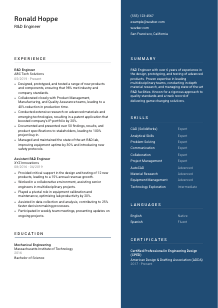
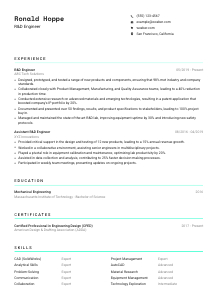
Inventing the future, but your CV feels stuck in the past? Check out this R&D Engineer CV example, created with Wozber free CV builder. It shows how to showcase your boundary-breaking innovations and scientific acumen to match job expectations, propelling your career as forward as your breakthroughs!
R&D engineering work is judged in the real world by what survives design review, prototype testing, manufacturing handoff, and standards checks. Your CV needs to make that process visible. Hiring teams want to see how you move from concept to validated product, how you solve technical problems with data, and how your work affects quality, speed, cost, or lab performance.
A tailored CV changes how quickly that story comes through, especially when product development hiring involves ATS screening before an engineer or manager reviews your file. Wozber's free CV builder helps you align your wording with the job description, keep an ATS-friendly CV format, and surface the engineering details that matter first, such as prototyping scope, CAD work, test results, and cross-functional delivery.
For an R&D Engineer, the personal details section should be clean, practical, and easy to scan. This is not the place for extra personality cues. It is where you confirm professional identity, location when relevant, and reliable ways to reach you for technical interviews, design reviews, or follow-up conversations.
Use your full name as the header anchor of the CV and make it slightly more prominent than the body text. In engineering hiring, this section should read like a well-labeled document header, not a design exercise. Keep it simple and professional so the focus stays on your product development and technical work.
Place "R&D Engineer" under your name when that matches the role you are pursuing. This helps position you immediately for research, prototyping, testing, and product development work. If your background is more specialised, such as mechanical product development or electromechanical design, you can reflect that only when it matches the opening.
List a phone number you actually answer and a professional email address. For engineering roles, that basic precision matters. Sloppy contact information suggests the same kind of carelessness hiring managers do not want around specifications, test data, or documentation.
Some R&D roles depend on lab access, prototype builds, or close collaboration with manufacturing, so location can matter early. In the example posting, San Francisco, California, is a stated requirement, so listing that city and state removes an avoidable question. Only treat location this way when the employer clearly asks for it.
If you have a LinkedIn profile, engineering portfolio, patent page, GitHub, or project site that strengthens your case, include it. Make sure the content supports the same story as your CV. For R&D hiring, a portfolio is most useful when it shows design iterations, CAD models, testing work, technical presentations, or product outcomes rather than generic profile filler.
Do not include age, marital status, photo, or other details unrelated to engineering performance. Product development teams are hiring for technical judgment, collaboration, documentation quality, and execution in the lab or design environment. Keep the section focused on information that supports that review.
This section should feel as organised as a specification sheet. When your identity, contact details, and relevant location are easy to confirm, reviewers can move quickly to the parts of the CV that show how you design, test, and deliver products.




Experience carries the most weight on an R&D Engineer CV because it shows how you turn engineering work into tested, documented outcomes. Hiring managers look for proof of design ownership, prototyping, validation, research depth, and cross-functional execution, especially when products have to move from concept into production.
Pull apart the job description before you rewrite your bullets. Look for the actual work being emphasized, such as CAD design, prototype testing, materials research, manufacturing collaboration, documentation, or lab management. Then match your experience to those priorities instead of leading with broad engineering statements.
List positions in reverse chronological order and make the basics effortless to scan. Include title, company, and dates first so reviewers can quickly understand your level, progression, and time spent in product development environments. In R&D hiring, a clear timeline helps teams judge whether you have enough hands-on exposure to full development cycles.
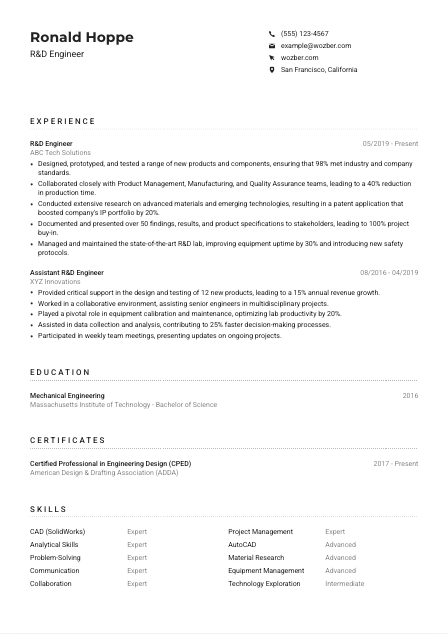
Your bullets should show what you designed, how you tested it, who you worked with, and what changed because of your work. Strong R&D bullets often include prototype development, validation against standards, material or component research, documentation, and production readiness. The example CV does this well by tying product design and testing work to concrete results instead of repeating job duties.
Use numbers where they reflect real engineering performance. This can include compliance rates, reduction in production time, uptime improvements, number of prototypes, patent activity, test pass rates, or speed of decision-making. For instance, the sample CV shows a 40% reduction in production time and 30% better equipment uptime, which gives hiring teams a much clearer view of impact than "supported manufacturing" or "managed lab equipment."
Prioritise experience that speaks to design iteration, experimental work, technical analysis, documentation, and collaboration with product, quality, or manufacturing teams. Older or less relevant experience can stay brief unless it adds something useful, such as industry context or transferable testing experience. Every bullet should help explain why you can contribute in a development lab and carry work toward production.
A strong experience section should make it easy to picture you in the lab, at the CAD workstation, and in cross-functional reviews. When your bullets show technical scope and measurable product outcomes, your experience reads like applied engineering, not a list of tasks.
Education matters on an R&D Engineer CV because it establishes your engineering foundation before the reader gets into project work. For many openings, especially those involving mechanical design, electrical systems, or industrial product development, the degree field is one of the first qualification checks.
Start with the credential the employer asked for. If the role calls for a bachelor's degree in engineering, make sure that information is immediate and unmistakable. In this posting, a mechanical, electrical, or related engineering degree is preferred, so a Bachelor of Science in Mechanical Engineering fits naturally near the top of the section.
List field of study, degree, school, and graduation date in a clean order. Engineering hiring does not require decorative formatting here. What matters is that reviewers can quickly confirm your academic discipline and how it relates to the product or systems work involved.
If your degree aligns closely with the opening, do not bury it. Mechanical and electrical backgrounds are especially relevant for many R&D environments involving CAD, components, prototyping, and testing. The sample CV gets this right by listing Mechanical Engineering clearly rather than assuming the employer will infer it from experience alone.
Early-career candidates can include capstone projects, lab research, senior design work, or coursework tied to product design, materials, manufacturing, controls, or testing. If you already have several years of direct R&D experience, keep this section concise unless a project or thesis directly strengthens your fit for the role.
Honors, engineering society memberships, competition teams, or thesis work can be worth adding when they reinforce technical credibility. Choose items that connect to design work, experimentation, or applied engineering practice. Skip achievements that do not add anything meaningful to your case for product development work.
This section should confirm that you have the engineering base required for design, testing, and analytical work. Once that is clear, the rest of the CV can focus on how you have applied that training in real development settings.
Certifications are useful on an R&D Engineer CV when they reinforce design capability, tools knowledge, safety awareness, or specialised technical depth. They are usually secondary to hands-on product development experience, but the right credential can strengthen your case, especially in design-heavy or standards-driven environments.
Review the posting for any required or preferred credentials, then keep only the certifications that support the engineering scope of the role. If no certification is specified, choose ones connected to design, testing, quality, manufacturing, or relevant tools. The CPED credential in the example works because it complements engineering design responsibilities.
A short, targeted list is stronger than a long catalogue. Focus on certifications that support CAD-based design work, technical documentation, laboratory practice, product quality, or regulated development standards. Recruiters and engineering managers will care more about relevance than volume.
Include the issue date or active period if the timing helps establish currency. This matters most for certifications tied to evolving software, standards, or regulated processes. A current or ongoing credential can support the impression that your technical knowledge is being kept up to date.
R&D work changes with new tools, materials, and standards, so your certifications should reflect your current direction. Update this section when you add training in areas like advanced CAD workflows, design validation, quality systems, or lab safety. That is especially useful if you are moving toward a more specialised product domain.
Certifications should strengthen the technical profile already established by your projects and results. When they are relevant and current, they add another layer of credibility to your design and development background.
A skills section for R&D engineering should do more than list broad strengths. It needs to reflect the actual tools, technical methods, and collaboration habits used in product development, from CAD and testing to analysis, documentation, and cross-functional coordination.
Start with the capabilities the employer actually named and then add closely related skills you genuinely use. For this role, CAD proficiency, analytical problem-solving, collaboration, project management, and English communication are all explicit. Related skills such as materials research, prototyping, testing, equipment management, and standards knowledge can strengthen the section when they match your background.
Put the skills closest to day-to-day R&D work near the top. Software like SolidWorks or AutoCAD should usually appear before generic traits, and technical strengths such as prototyping, test planning, or material evaluation often deserve more space than vague descriptors. The sample CV does this effectively by naming CAD tools and material research alongside collaboration and project management.
Keep the section structured and easy to read. Grouping technical tools, engineering methods, and collaboration skills can help, especially when the role spans design work and cross-functional execution. This also supports ATS optimisation because the terms are easy to parse and naturally aligned with the language used in the job description.
By the time someone reaches this section, they should recognize the same capabilities they would expect in design reviews, prototype builds, testing plans, and manufacturing handoffs. A focused skill list reinforces that you can operate in the full R&D workflow.
Language ability matters in R&D when engineers need to document findings, present results, write specifications, and coordinate with cross-functional teams. For many product development roles, strong English is essential because it shapes how clearly you communicate design intent, test outcomes, and technical recommendations.
Check the job description for required languages before deciding what to list. In this case, English proficiency is explicitly required, so it should appear clearly on the CV. That matters in engineering roles where reports, presentations, standards documentation, and stakeholder communication are central to the job.
Lead with the language the role depends on and show your proficiency level plainly. If English is the working language for design reviews, reports, and coordination with manufacturing or product teams, it belongs at the top of this section.
Extra languages are worth listing when they support collaboration across suppliers, manufacturing sites, customers, or global engineering teams. For example, Spanish may be useful in some industrial or cross-border environments, even when it is not a hiring requirement. Keep the focus on languages you can use in a professional setting.
Stick to familiar terms such as Native, Fluent, Intermediate, or Basic. Avoid inflated descriptions. In technical environments, accuracy matters, and hiring teams may expect you to present findings, discuss design issues, or write documentation at the level you claim.
If the role involves stakeholder presentations, vendor coordination, or work across multidisciplinary teams, your language section can quietly reinforce communication strength. This is especially relevant in R&D settings where engineers need to explain tradeoffs, test conclusions, and product specifications clearly, not just perform technical analysis in isolation.
Language skills should support the way R&D work gets done: through reports, design discussions, presentations, and collaboration across functions. When listed accurately, they strengthen the communication side of your engineering profile.
The summary should quickly tell the reader what kind of R&D Engineer you are and what level of product development work you have handled. It works best when it combines experience level, technical focus, and one or two outcomes that reflect how you contribute in design and testing environments.
Review the posting before you write a single line. If the employer needs someone who can design, prototype, test, research materials, collaborate with manufacturing, and maintain documentation, those themes should shape your opening language. Avoid generic engineering introductions that could describe almost any technical role.
Start with a concise professional description that includes your title and years of relevant experience. Mention your main R&D focus, such as product design, prototyping, testing, electromechanical development, or industrial research. The sample summary does this well by establishing 6+ years of experience in design, prototyping, and testing right away.
Use one or two specifics that show how you operate, such as improving production readiness, leading multidisciplinary work, contributing to patents, strengthening standards compliance, or managing lab operations. Pair technical strengths with outcomes. That makes the summary sound grounded in engineering execution rather than personal branding language.
Aim for three to five lines with no wasted space. A hiring manager should be able to read the summary and immediately understand your development scope, tools or methods, and the kind of results you tend to deliver. If every line points toward product development performance, the section is doing its job.
Your summary should prepare the reader to see you as someone who can contribute to design, testing, documentation, and cross-functional product delivery. When it is tailored well, the rest of the CV feels consistent from the first line onward.
You now have the framework for an R&D Engineer CV that reflects actual product development work, from CAD and prototyping to testing, documentation, and manufacturing collaboration. Wozber can help you turn that experience into an ATS-compliant CV using an ATS-friendly CV template that keeps technical content clear and easy to scan.
Before applying, run the CV through Wozber's ATS CV scanner to compare your language against the job description, surface missing requirements, and strengthen ATS optimisation without forcing keywords unnaturally. The finished CV should make one thing easy to judge: that you can take engineering ideas through validation and into production.