



Use Wozber and land your dream job
Create CV
No registration required
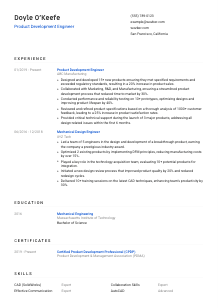
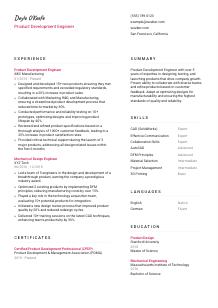
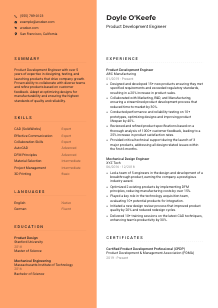
Designing cutting-edge products, but your CV feels like an outdated prototype? Check out this Product Development Engineer CV example, created with Wozber free CV builder. Learn how to blend your engineering ingenuity with job specifications, ensuring your career evolves as dynamically as your innovations!
Product development engineering sits at the point where concept work meets manufacturing reality. Hiring teams want to see how you move a product from design intent to prototype, testing, refinement, and launch without losing sight of cost, reliability, regulatory requirements, or manufacturability.
When that progression is tailored clearly, the CV is easier to rank in an ATS and easier to read as real product ownership instead of generic mechanical design work. Wozber's free CV builder helps organise that story in an ATS-friendly CV format, so your CAD work, DFM decisions, testing results, and cross-functional collaboration are visible early.
For a Product Development Engineer, the header should do one practical job well: confirm who you are, what role you are targeting, and whether you meet any basic logistics the employer listed. Keep it clean, accurate, and easy to scan so the reader can move quickly to your design and development experience.
Use your full name as the most prominent line in the header. A simple, readable presentation works best. This role depends on technical clarity, and that standard should start with the way your CV is laid out.
Use the exact title "Product Development Engineer" when that is the role you are pursuing. It immediately connects your CV to the posting and helps separate your profile from adjacent titles such as Mechanical Design Engineer or Manufacturing Engineer.
List one phone number and one professional email address that you check regularly. Product development hiring often moves through recruiter screens, engineering interviews, and cross-functional meetings, so your contact details need to support quick follow-up.
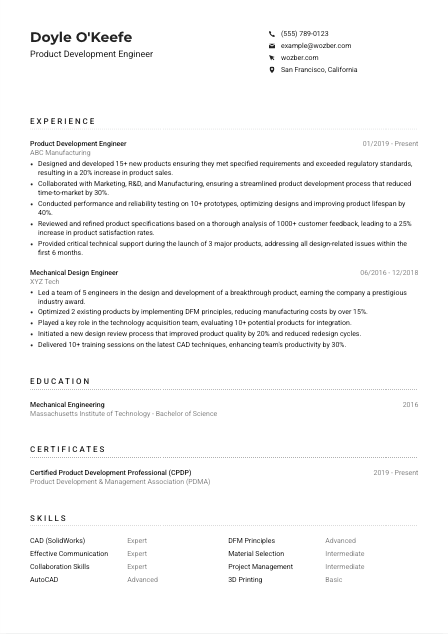
If a job specifies a city or relocation requirement, include your location so that question is answered upfront. In the example, listing San Francisco, California directly supports a stated requirement. For other openings, tailor this line only when geography affects eligibility or on-site collaboration.
A current LinkedIn profile can reinforce your CV when it reflects the same titles, employers, project scope, and technical tools. If you also maintain a portfolio or project page with CAD renders, prototype photos, or product launch work, include it only if the content is polished and relevant.
Do not include age, marital status, headshot, or other personal details that have no bearing on product design, testing, manufacturing collaboration, or launch support. Keep the header focused on information the employer can actually use.
A well-built header removes friction. It confirms your target role, makes you easy to contact, and answers practical requirements such as location without taking attention away from your engineering work.




This section carries the most weight because product development is judged through shipped work, testing discipline, design decisions, and collaboration across functions. Hiring managers are looking for proof that you can turn requirements into manufacturable products and improve them with real data.
Before rewriting bullets, mark the recurring themes in the job description. For this kind of role, that usually includes new product design, prototype testing, DFM, materials decisions, regulatory or specification compliance, customer feedback, and support through launch. Those are the experiences your bullets should surface first.
Start with your most recent position and work backward. For each role, include title, employer, and dates so the reader can quickly track your growth from design support into broader product ownership or cross-functional responsibility.
Describe what changed because of your work. Strong bullets show the product problem, the engineering action, and the result. In the example, "Designed and developed 15+ new products" works because it is tied to regulatory standards and a 20% sales increase. That reads as product development impact, not a generic duty list.
Use numbers where they reflect normal engineering performance. Time-to-market reduction, prototype count, product lifespan improvement, cost reduction, redesign cycle reduction, launch support scope, and customer satisfaction changes all make sense here. Metrics like a 30% faster development process or 40% longer product lifespan give hiring teams a clearer sense of scale and execution quality.
Focus on experience tied to concept development, CAD modeling, prototyping, validation testing, design iteration, and manufacturing handoff. If you have broader engineering experience, keep the details that connect to product specs, DFM decisions, materials selection, or post-launch issue resolution. Cut bullets that do not strengthen your case for owning product development work.
Your experience section should make it easy to follow how you design, test, refine, and launch products. When the bullets show measurable outcomes and real collaboration with manufacturing, R&D, or marketing, your background reads as practical product development rather than general engineering support.
Education matters in product development because it anchors your understanding of mechanics, materials, design process, and engineering problem-solving. Present it clearly, with the degree information most relevant to the role easy to find in a quick scan.
Check the education line in the job description and mirror it where you truthfully can. Here, a Bachelor's degree in Mechanical Engineering, Product Design, or a related field is the baseline. If your degree matches directly, make sure that alignment is unmistakable.
List each education entry with degree, field, school, and graduation year if you choose to include it. Straightforward formatting helps the reader confirm your academic background without digging through extra detail.
If you hold multiple degrees, lead with the one most tied to product development work. In the example, Mechanical Engineering and Product Design both reinforce a CV centered on product design, prototyping, and manufacturability.
If you are earlier in your career, selected coursework can help connect your education to the role. Subjects like materials science, CAD, mechanics, tolerance analysis, design for manufacturability, or product development methods are worth listing when professional experience is still growing.
Honors, capstone projects, research, or additional study can help when they relate directly to product development. Use them if they support your work with prototypes, testing, product design, or manufacturing processes, not simply to make the section longer.
This section should confirm that you have the technical grounding the role calls for. Once the degree match is clear, the rest of the CV can focus on how you applied that foundation in real product development work.
Certifications are rarely the first filter for Product Development Engineers, but they can add useful depth when they reinforce your design process, product strategy, or specialised tools. Include them when they sharpen your professional profile rather than simply fill space.
Some product development roles do not require certifications at all, so relevance matters more than volume. Review the posting first, then decide whether a credential helps support your expertise in development workflows, CAD tools, testing, or product management.
Choose certifications tied to product development responsibilities. A credential like CPDP is useful because it aligns with product planning and development practice. Other strong options might relate to CAD platforms, quality systems, or project delivery if they connect to the work you actually do.
List the issue date or renewal period when it helps establish current standing. This is especially useful for credentials that remain active, require continuing education, or show recent specialization relevant to manufacturing and product development.
Product development changes with materials, tooling methods, validation standards, and software workflows. Adding recent certifications can show that you stay current in the parts of the field that affect design decisions and product launch execution.
A certification section works best when each entry reinforces your ability to contribute to product design, testing, or launch. Keep it selective and tied to the engineering work the employer needs done.
A Product Development Engineer needs more than a list of software names. The skills section should show the mix of technical tools, engineering judgment, and cross-functional collaboration that drives a product from concept into production.
Start with the terms the employer already uses. For this role, that includes CAD software such as SolidWorks or AutoCAD, materials science, DFM principles, communication, and collaboration across teams. Those are the terms most worth reflecting if they match your background.
Lead with the skills most central to product development work. CAD proficiency, DFM, materials selection, prototype testing, and cross-functional communication generally deserve higher placement than broader supporting skills. The example does this well by giving visible space to SolidWorks, AutoCAD, DFM principles, and communication.
Group and trim your skills so the section reads like a clear engineering profile, not a catch-all inventory. Aim for a balanced mix of technical tools, manufacturing-aware design knowledge, and collaboration skills that matter in design reviews, specification updates, and product launch support.
When this section is ordered well, a hiring manager should quickly understand how you design products, work with other teams, and solve manufacturability or testing issues. Relevance matters more than volume.
Language ability matters here because product development depends on clear communication across design reviews, test reporting, specification changes, and launch support. If the posting names a required language, treat that as a real qualification rather than a minor extra.
Check whether the employer explicitly asks for language proficiency. In this case, strong English matters because the role involves collaboration with Marketing, R&D, and Manufacturing, along with written communication around specifications, testing, and support.
Put English at the top of this section when it is required and label your proficiency honestly. For roles involving cross-functional coordination and technical documentation, that placement answers an important screening question quickly.
Additional languages can be worth listing when they support international manufacturing, supplier communication, or work with global teams. In the example, German adds useful range, but it remains secondary to the required English proficiency.
Choose familiar levels so the reader can interpret your ability without guessing. Keep the labels simple and credible.
If language is a secondary factor, keep this section concise. If the work involves global product teams, supplier coordination, or international customers, additional languages can carry more weight and deserve inclusion.
For Product Development Engineers, language skills matter most when they help you communicate specifications, testing results, and design decisions clearly. Lead with the required language, then add others that genuinely support the scope of the role.
The summary should quickly establish the kind of products and engineering work you handle best. In a few lines, show your level of experience, your technical focus, and the business or product outcomes that follow from your work.
Read the job description for the themes that should shape your opening lines. For this role, that means product design and development, testing, DFM, cross-functional work, and post-launch support. Your summary should reflect the same priorities in natural language.
Start with your title and level of experience, such as "Product Development Engineer with 5+ years of experience." That gives immediate context and helps position you correctly against candidates from adjacent engineering tracks.
Choose strengths that map directly to the job. Good examples include designing manufacturable products, running prototype and reliability testing, refining specifications from customer feedback, or collaborating with manufacturing and R&D to reduce time-to-market.
Aim for three to five sentences with concrete language. The example summary works because it ties design, testing, launch work, DFM, and quality outcomes together without drifting into generic claims. Keep yours concise enough to scan quickly, but specific enough to sound like a product development engineer rather than a generalist.
A good summary gives the reader a fast, accurate picture of your development work before they reach the details below. It should make your engineering focus, level of experience, and product impact clear from the start.
Once each section is tailored, your CV should show a consistent thread from design work to prototype validation, specification refinement, and launch support. Wozber's free CV builder can help structure that story so your CAD tools, DFM knowledge, and measurable product outcomes are easy to surface.
Before you apply, run the CV through an ATS CV scanner and check whether the language reflects the posting naturally, especially around CAD software, manufacturability, materials, testing, and cross-functional work. An ATS-compliant CV is most useful when it also makes your product development judgment easy to recognize.




