



Use Wozber and land your dream job
Create CV
No registration required
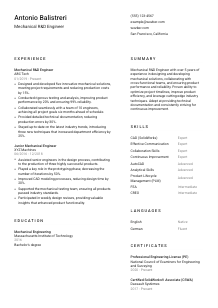
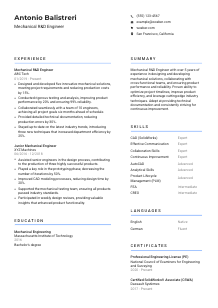
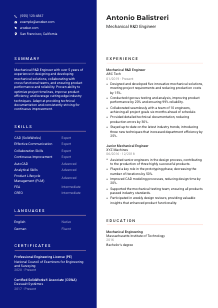
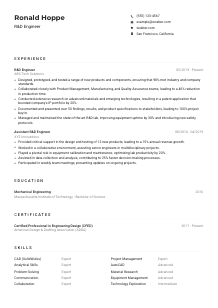
Engineering the future, but your CV feels stuck in the design phase? Check out this Mechanical R&D Engineer CV example, created with Wozber free CV builder. It shows how to highlight your innovative breakthroughs in line with job expectations, launching your career trajectory just as smoothly as your prototypes!
Mechanical R&D work is judged by what you can move from concept into a reliable, buildable product. Hiring teams look for engineers who can design parts and assemblies, test performance, solve failure points, and document decisions well enough that manufacturing and cross-functional partners can act on them. Your CV should make that engineering workflow visible, not just list tools or responsibilities.
A tailored CV changes how quickly your design depth is understood, especially when similar candidates all mention CAD, testing, and collaboration. Wozber's free CV builder helps you align your wording with the posting and keep an ATS-compliant CV easy to scan, so strengths like FEA-backed analysis, prototype validation, and product lifecycle support are clear from the first read. That clarity matters when a team needs to see whether you can contribute to real development work quickly.
For a Mechanical R&D Engineer, the header should do one practical job well: identify you clearly and remove any friction around contact, title match, and basic eligibility. Keep it clean, accurate, and aligned with the role you are targeting.
Use your full name at the top in a larger, readable font. Mechanical engineering CVs often carry dense project and technical content, so your header should stay simple and highly legible.
Place "Mechanical R&D Engineer" directly under your name when that is the position you are pursuing. This immediately frames the rest of the CV around product development, testing, and design work instead of broader mechanical engineering experience.
List a phone number and email address that you actively monitor. These basics still matter because interviews for R&D roles often move quickly once a team finds someone with the right mix of CAD, analysis, and development experience.
If a job specifies a city or state, reflect that clearly in your header. In the example, San Francisco, California is listed because the employer asked for local availability, which removes an avoidable screening question early.
A personal website, LinkedIn profile, or portfolio link can help if it shows product work, CAD models, patents, publications, or engineering project outcomes. Only include links that support your R&D profile with material a hiring manager would actually review.
Do not use header space for age, marital status, or other personal information unrelated to engineering performance. Save the room for information that supports contactability, location fit, or professional identity.
This section should answer three questions immediately: who you are, what engineering role you are targeting, and whether you meet any location-related requirement. Once that is clear, the reader can focus on your design work, testing results, and development history.




This is the section where Mechanical R&D candidates separate themselves. Hiring managers want to see more than task lists. They want proof that you have designed, tested, improved, and documented mechanical solutions in ways that affected cost, performance, reliability, manufacturability, or delivery speed.
Read the posting closely and match your past work to the core activities it emphasizes. For this role, that means mechanical design, product testing, analysis, optimisation, technical documentation, and collaboration with electrical, software, and manufacturing teams. Your bullets should reflect those same stages of development where they genuinely apply.
List jobs in reverse chronological order and present the basic facts consistently so the reader can focus on scope and outcomes rather than format.
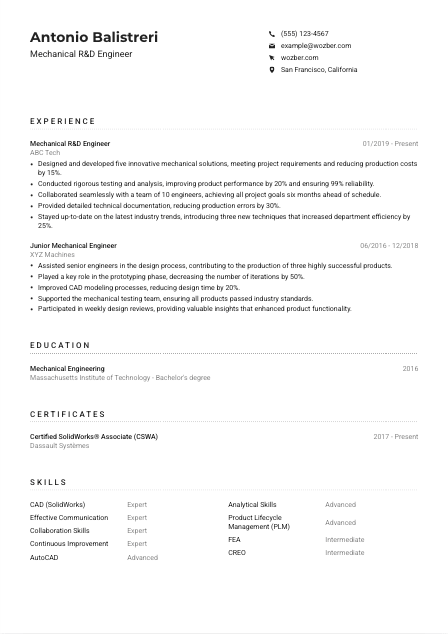
Describe what you designed, tested, improved, or supported, then add the result. Good Mechanical R&D bullets often mention prototypes, analysis methods, validation, production support, or design changes that improved performance. The example does this well by connecting design work to a 15% production cost reduction and testing work to a 20% performance gain.
Quantify impact with measures that fit the work: cost reduction, reliability, iteration count, design cycle time, schedule acceleration, defect reduction, or compliance with standards. Numbers give technical work business meaning. A line like "ensuring 99% reliability" or "reducing production errors by 30%" says far more than "improved product quality."
If you have broad mechanical experience, lead with content tied to design development, simulation, testing, optimisation, and cross-functional execution. General maintenance, routine operations, or unrelated plant support should stay brief unless they directly shaped product design or manufacturability.
A useful experience section lets a reviewer follow your work from design decision to tested outcome. When each role shows technical scope, collaboration points, and measurable results, your CV reads like someone who can contribute across the product development lifecycle.
For Mechanical R&D roles, education is usually straightforward but still important. The degree confirms your grounding in mechanics, materials, design, and analysis, and it often acts as an early qualification filter before a manager gets to your project experience.
If the job asks for a bachelor's degree in Mechanical Engineering or a related field, make that easy to find. Do not bury it under extra academic detail. In this case, a Bachelor's degree in Mechanical Engineering matches the requirement directly.
Present the core information in a clean, consistent order so it is easy to scan in a few seconds.
If your degree title aligns directly with the employer's language, use that wording. That helps both ATS parsing and human review, especially when the posting is filtering for Mechanical Engineering rather than a broader engineering background.
Recent graduates or early-career engineers can include capstone projects, lab work, design competitions, or coursework tied to CAD, FEA, thermodynamics, materials, or machine design. For experienced candidates, this detail is usually optional unless it is unusually relevant to the target product area.
Research work, honors, or technical publications can support an R&D profile when they show analytical depth or product development interest. Keep them if they reinforce the kind of mechanical design and problem-solving the role requires.
This section should confirm the formal engineering background the employer asked for and, when relevant, add a small amount of technical context. Once that is established, your experience and skills should carry the heavier proof of design capability.
Certifications are not mandatory for every Mechanical R&D Engineer role, but they can strengthen your profile when they confirm relevant tools or professional standards. The best ones reinforce design software fluency, engineering practice, or deeper specialization connected to the work.
Start with credentials that relate to the actual work, especially CAD platforms, engineering licensure, or specialised analysis areas. This posting does not require certifications, but a SolidWorks credential or PE license can still add weight because the role includes design development and technical judgment.
Do not overload this section with every course completion. Lead with the credentials that help a reviewer understand your technical profile faster. In the example, CSWA supports CAD proficiency and the PE license adds professional credibility.
If a certification is active, recently earned, or requires renewal, include the timeframe. That is especially useful for software-specific credentials and licenses that indicate current standing.
Mechanical R&D work changes with new design software, simulation workflows, materials, and manufacturing methods. Updated certifications can show that you stay current with the tools and practices shaping product development, especially if your recent experience does not fully show that on its own.
A certification section works best when it reinforces the same story your experience already tells. Choose credentials that back up your design software, engineering rigor, or product development range, and keep the list relevant.
The skills section should read like a practical engineering toolkit, not a catch-all list. For Mechanical R&D roles, that usually means showing the design tools, analysis methods, collaboration strengths, and development knowledge you actually use in bringing products from concept through validation.
Start with the language used in the job description. Here, the priority skills include CAD software such as SolidWorks or AutoCAD, analytical work involving FEA and simulation, and effective collaboration across functions. Mirror those terms where they match your real background.
Mechanical R&D hiring usually looks for both hard and soft skills because design work rarely happens in isolation. Alongside CAD, FEA, or PLM, include communication and collaboration if you can support them through design reviews, documentation, and teamwork with electrical, software, or manufacturing groups. The example balances these well instead of listing software alone.
Prioritise the skills that directly support design, testing, optimisation, and product development. A shorter list of targeted items such as SolidWorks, AutoCAD, FEA, PLM, analytical skills, and cross-functional communication is more useful than a long list of loosely related abilities.
A hiring manager should be able to glance at this section and understand the engineering environment you can step into. Keep it anchored in design software, analysis, development workflow, and collaboration that matches the role.
Language skills matter in engineering when they affect documentation, standards review, cross-team communication, or work with international stakeholders. For this kind of role, the most important point is usually whether you can read and work with technical material in English accurately.
If the employer mentions language ability, reflect that directly. In this case, the role requires the ability to read complex texts in English, which is relevant for technical documentation, specifications, test reports, and engineering standards.
Put English first if it is essential to the role, and state your level clearly. This makes it easy for the reviewer to confirm that you can handle documentation and cross-functional communication without hesitation.
Additional languages can be useful in global engineering teams, supplier communication, or multinational product environments. They are a plus, but they should stay secondary to the core technical fit for the role.
Choose simple labels that match your actual ability so there is no confusion about what you can do in a technical setting.
If the position involves global suppliers, distributed engineering teams, or technical documentation across regions, additional language ability can add value. If not, keep this section brief and let your design and development credentials stay in the foreground.
For a Mechanical R&D Engineer, this section should mainly confirm that you can work with technical English and communicate clearly where needed. Anything beyond that is useful only if it supports the actual working environment.
Your summary should give a quick, accurate read on the kind of Mechanical R&D Engineer you are. In a few lines, it should connect your experience level with the design, testing, analysis, and collaboration strengths that matter most for the target role.
Before writing, identify the few requirements that matter most in the posting. For this one, those include mechanical design, R&D experience, CAD proficiency, analytical testing, and cross-functional collaboration. Your summary should echo that mix rather than trying to cover everything you have ever done.
Lead with your current professional identity and tenure, such as "Mechanical R&D Engineer with 5+ years of experience." That immediately sets your level and helps frame the rest of the CV.
Mention capabilities that align with the role and that your CV can support, such as developing mechanical solutions, improving product performance, reducing production cost, or working effectively across engineering disciplines. The example summary works because it connects experience with design, collaboration, reliability, and optimisation rather than using vague claims.
Aim for 3 to 5 sentences. Use the space to surface your most relevant engineering value quickly, with concrete language around design, testing, simulation, documentation, or lifecycle support. Avoid generic personality traits unless they are tied to how you work in development teams.
When this section is done well, a reviewer can immediately place you in the right kind of engineering conversation. Keep it specific enough to signal your product development strengths and concise enough that the rest of the CV can expand on them.
A strong Mechanical R&D Engineer CV makes your design process, testing discipline, and product impact easy to follow. Use these sections to show how you handle concept development, analysis, validation, documentation, and cross-functional execution, with results that matter in production and product performance.
Wozber's free CV builder helps you organise that experience into an ATS-friendly CV format, and an ATS CV scanner can help you tighten alignment with the target posting. Once your wording, structure, and technical details reflect the role accurately, your CV will make it much easier for a hiring team to see your readiness for real R&D work.




