



Use Wozber and land your dream job
Create CV
No registration required
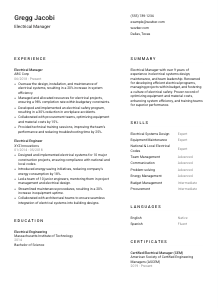
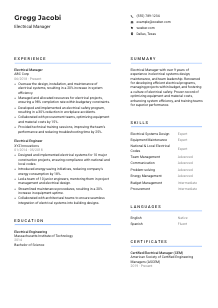
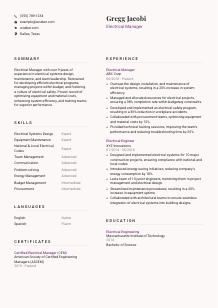
Leading circuits, but your CV seems short-circuited? Conduct this Electrical Manager CV example, created with Wozber free CV builder. Learn how to fuse your managerial prowess with job specifications, illuminating your energy-infused career path for the brightest prospects!
Electrical Managers are trusted with work that affects uptime, safety, compliance, and project delivery all at once. Hiring teams look past broad management claims and look for proof that you can direct electrical design and maintenance work, keep crews aligned with code, and make sound decisions when budgets, schedules, and system performance are under pressure.
A tailored CV changes how quickly those priorities come into focus, especially when an ATS screens for terms tied to electrical systems, code compliance, team leadership, and project oversight. Wozber's free CV builder helps you align your experience with the job description in an ATS-friendly CV format, so the hiring team can quickly see whether you have the technical depth and leadership range the role demands.
For an Electrical Manager, the contact section does more than identify you. It sets the tone for a role that depends on accountability, clear communication, and practical availability for site, plant, or project oversight.
Lead with your full name, then use the exact or closely matched title you are pursuing, such as "Electrical Manager." That immediately places you in the right hiring lane and helps frame the rest of the CV around management of electrical systems, teams, and project execution.
List a phone number you answer and a professional email address that is simple and current. This role often involves coordination with operations leaders, engineers, vendors, and maintenance teams, so your contact details should look as dependable as the communication style expected on the job.
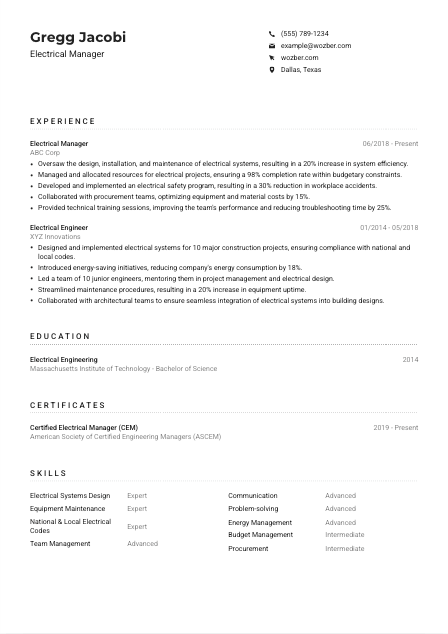
If the posting specifies a location, address it clearly in your personal details. In the example, listing Dallas, Texas supports the employer's requirement for a local candidate or someone ready to relocate. When location is part of the screening process, making it visible prevents unnecessary doubt early on.
Include LinkedIn or a professional website only if it strengthens your application. For Electrical Managers, that might mean a profile showing project scope, leadership progression, certifications, or cross-functional work with construction, facilities, or manufacturing teams. Keep the information aligned with your CV dates and titles.
Skip personal information that does not help an employer understand your suitability for managing electrical operations. Extra details such as unrelated hobbies or personal identifiers add noise when the CV should stay focused on engineering background, leadership history, and readiness for the position.
This section should confirm who you are, what role you are pursuing, and whether you meet any immediate screening requirements such as location and contactability. Clean, relevant details help the employer move straight to your technical and leadership background.




Experience is where Electrical Manager CVs are won or lost. Employers want to see the scale of electrical work you have owned, how you led technicians or engineers, and what changed under your management, whether that meant better uptime, safer operations, lower costs, or smoother project delivery.
Pull the key responsibilities from the posting and reflect them in your strongest roles. For this kind of position, that usually means electrical systems design, installation oversight, maintenance planning, troubleshooting, safety compliance, resource allocation, and team leadership. In the example CV, the experience section mirrors those priorities with bullets on system efficiency, project completion within budget, and safety program results.
Use reverse-chronological order and make each entry easy to scan with title, employer, and dates. For an Electrical Manager, that progression often shows movement from hands-on engineering or maintenance roles into broader responsibility for teams, budgets, vendors, and multi-phase electrical projects. That career path tells a hiring manager you can lead from technical knowledge, not from title alone.
Each bullet should show what you were responsible for and what happened because of your work. Focus on activities that matter in electrical leadership, such as improving system reliability, coordinating installations, reducing troubleshooting time, enforcing code compliance, or mentoring technical staff. Strong verbs help, but the real value comes from linking your decisions to operational results.
Quantify impact where the numbers are meaningful. Common measures include system efficiency, uptime, incident reduction, completion rate, energy savings, maintenance response time, or budget performance. The sample does this well with a 20% increase in system efficiency, a 30% reduction in workplace accidents, and a 98% within-budget project completion rate. Metrics like these make your management impact easier to judge.
Prioritise experience that supports the role you want now. If you have a long background, give more space to work involving electrical systems, code-driven environments, team supervision, capital or maintenance projects, and cross-functional coordination. Older or less relevant duties can be shortened so the CV stays centered on your readiness to manage electrical operations.
Your experience section should leave no doubt that you can lead electrical work from planning through maintenance and problem resolution. When titles, scope, outcomes, and metrics line up, the employer can quickly picture you running the function.
Electrical Managers are often expected to lead from both technical knowledge and operating judgment. Your education section should quickly confirm the engineering background that supports decisions about design, maintenance standards, troubleshooting, and compliance.
If the posting asks for a bachelor's degree in Electrical Engineering or a related field, make that credential unmistakable. Use the full degree and field name so there is no ambiguity during screening. In the example, "Bachelor of Science in Electrical Engineering" aligns directly with the stated requirement.
Present the degree, institution, and graduation year in a simple structure. Education is usually a fast verification point for this level of role, so clarity matters more than extra detail unless a specific academic distinction strengthens your candidacy.
Include your major or concentration because it provides context for your technical base. For Electrical Managers, an engineering field tied to power systems, controls, facilities, or electrical infrastructure helps support the credibility of later claims about system design, maintenance strategy, or technical supervision.
If you are earlier in your career, relevant coursework, academic projects, or honors can strengthen the section. For more experienced candidates, these details usually matter less unless they connect directly to the employer's environment, such as power distribution, industrial systems, or building electrical design.
If you have completed later training, specialised programs, or technical development outside your degree, mention them in the most appropriate section. That ongoing learning can support a profile focused on code updates, safety standards, energy management, or leadership growth in electrical operations.
This section does not need much space, but it does need precision. Once your degree is easy to confirm, the hiring team can stay focused on the part that matters most at this level: how you have applied that foundation in real electrical environments.
Certifications can strengthen an Electrical Manager CV when they support the work you actually do. They are especially useful for showing commitment to safety, management discipline, energy performance, or current industry standards beyond your degree.
Start with the job description. Some Electrical Manager roles do not list a required certification, but that does not mean the section has no value. Relevant credentials can still support your profile, especially when they reflect supervision, safety, or recognized expertise in electrical operations. The example's Certified Electrical Manager credential is a solid illustration of this.
Feature certifications that connect to the actual work, such as electrical management, safety compliance, energy systems, maintenance reliability, or project oversight. A short, focused list is usually more persuasive than a long list of marginal credentials.
List the year earned and renewal period when the credential is current or time-sensitive. That matters in fields where standards evolve and employers want to know your knowledge has stayed current with codes, safety expectations, or operational practices.
As your responsibilities grow, pursue certifications that match the environments you want to lead. For some candidates that may mean safety or facilities-focused credentials. For others it may mean energy management, maintenance leadership, or broader engineering management recognition. The best additions are the ones that support the next level of responsibility on your CV.
Used well, certifications show that your expertise has stayed current and recognized beyond day-to-day experience. They work best when they reinforce the exact kind of electrical leadership the employer is hiring for.
The skills section should quickly tell an employer what technical and managerial ground you already cover. For Electrical Managers, that means balancing engineering capability with supervision, coordination, safety, and cost control.
Read the job description closely and extract the terms that define the work. In this case, that includes electrical systems design, maintenance, troubleshooting, leadership, communication, problem-solving, and knowledge of national and local electrical codes. Mirroring that language helps both ATS matching and human review, as long as each skill reflects real experience.
Lead with the capabilities most central to the role. Technical depth may include system design, preventive maintenance, equipment troubleshooting, code compliance, or energy management. Management skills should cover team supervision, project coordination, budgeting, training, and cross-functional communication. The example skill list is strongest where it combines both sides of the role instead of leaning on generic soft skills alone.
A shorter list of relevant skills is more credible than a long inventory. Choose terms that would naturally come up in this work and that you can support in your experience section. "National & Local Electrical Codes" says far more than broad phrases like "technical knowledge," and "Budget Management" is stronger when your experience also shows on-time, within-budget execution.
When the skills you list line up with the problems you have solved and the teams you have led, the whole CV reads as consistent and credible. That matters in roles where technical authority and management judgment have to coexist.
Language skills are usually a supporting section for an Electrical Manager, but they can still help. The role often involves writing reports, explaining technical issues, leading toolbox talks, and coordinating with mixed teams across operations, vendors, or contractors.
If the employer specifies language ability, include it clearly. Here, strong English speaking and writing are required, so English should appear with an honest proficiency level. That matters because Electrical Managers often document incidents, explain technical decisions, and communicate with both field teams and leadership.
If you speak additional languages, list them by proficiency. In some electrical environments, another language can help with contractor communication, site coordination, or training across a broader workforce. It is a useful addition when it reflects your real working ability.
Terms such as "Native," "Fluent," "Intermediate," or "Basic" are usually enough. Keep the labels straightforward so hiring teams can understand how comfortably you can communicate in meetings, written updates, or technical discussions.
Do not overstate proficiency. If you can handle casual conversation but not technical reporting or safety instruction, label the skill accordingly. In management roles, credibility matters, and language claims are easy to test during interviews or team interactions.
Additional languages are most useful when they support the environment you want to work in. They can help when leading diverse teams or working with regional contractors, but they should remain a secondary strength behind your electrical knowledge, project control, and leadership experience.
This section should support the communication side of the role without distracting from your technical profile. Clear language levels are enough to show whether you can lead, document, and coordinate effectively.
The summary sets the frame for the rest of the CV. For an Electrical Manager, it should quickly establish your years of experience, the electrical environments you have worked in, and the kind of operational or project results you have led.
Before writing, identify the few themes that matter most in the posting. Here, those include electrical systems design and maintenance, team leadership, budget-conscious project delivery, safety programs, and communication. Your summary should reflect that mix rather than trying to cover every detail of your career.
Start with a line that gives your title, years of experience, and main area of expertise. The example does this effectively with "Electrical Manager with over 9 years of experience in electrical systems design, maintenance, and team leadership." A direct opening like that helps the employer place you immediately.
Use the next lines to highlight the kind of performance you are known for. That might include improving system efficiency, reducing safety incidents, managing projects within budget, strengthening maintenance execution, or developing technical teams. Keep the claims closely tied to the operational realities of electrical management.
Aim for a short paragraph that can be read in seconds. Three to five lines is usually enough. Dense, specific language works better than broad statements about passion or dedication. The summary should make a hiring manager expect strong detail when they move into your experience section.
A well-written summary gives the employer a quick, credible picture of your technical background and management value. It should make your CV read like that of someone ready to lead electrical work safely, efficiently, and with sound operational judgment.
A competitive Electrical Manager CV shows more than years in the field. It makes your leadership of electrical systems, maintenance work, safety programs, code compliance, and project resources easy to see in a few quick scans.
Use Wozber's free CV builder to shape that information into an ATS-compliant CV, then refine it with targeted language, measurable outcomes, and clear section structure. When the final document is aligned to the posting and grounded in real operational results, hiring teams can quickly recognize your readiness to run electrical work with confidence.




